'Progressive' Move Forward Party likely to emerge as largest bloc... Single-party majority seen as unlikely
Official results to be released in early April... Realignments expected as parties maneuver to form a coalition
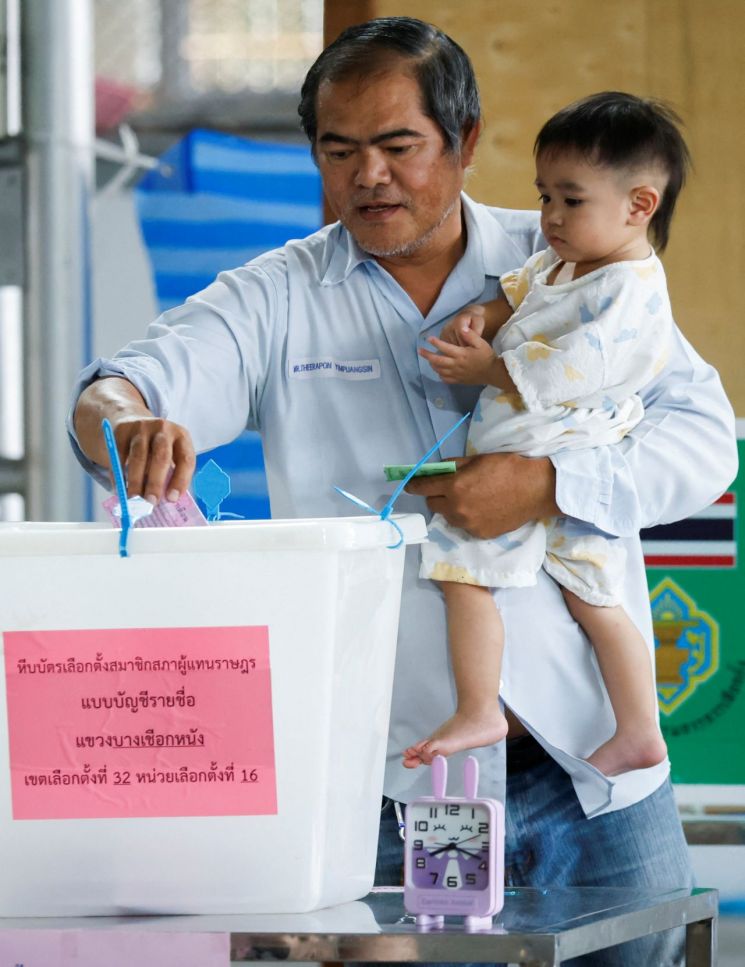
The general election to form Thailand's next government began on the 8th (local time). As the country has seen three prime ministers change over the past two years, attention is focusing on whether this election will bring an end to Thailand's political turmoil.
Move Forward Party leads in polls... If it falls short of a single-party majority, it will need to find coalition partners
According to Yonhap News, voting began at 8 a.m. at polling stations across Thailand to elect 500 members of the House of Representatives, including 400 constituency members and 100 proportional representation members. Voting will end at 5 p.m., and the official election results will be announced no later than April 9. Within about two weeks after that, the new parliament will convene and elect as prime minister the candidate who secures a majority of seats in the lower house.
A total of 5,089 candidates from 57 parties are running in this general election. Among them, a three-way race is expected among the progressive Move Forward Party, the Pheu Thai Party, a populist party aligned with former Prime Minister Thaksin Shinawatra that most recently held power, and the conservative Bhumjaithai Party, to which Prime Minister Anutin Charnvirakul belongs, which were the first, second, and third-largest parties in the 2023 general election.
In opinion polls, the Move Forward Party, led by 39-year-old leader Natthaphong Ruengpanyawut, is maintaining its lead. However, as it is unlikely to secure on its own the majority of seats needed to elect a prime minister, it will likely have to bring other parties on board as coalition partners after the general election. In the last election, Move Forward Party's predecessor, the Future Forward Party, which won by campaigning on progressive pledges such as revising the l?se-majest? law, failed to secure enough votes in the prime ministerial selection due to opposition from conservative forces and was unable to take power.
Next government faces task of overcoming economic slump and aging population
The Pheu Thai Party is considered the strongest electoral force in Thailand's modern political history. Starting with Thaksin's rise to power in 2001, it has emerged as the largest party in five of the last six general elections, excluding the 2023 election. However, many observers predict it will not be easy for Pheu Thai to reclaim the top spot, as its core support base, including rural areas in the east, has been shaken by factors such as last year's armed clashes along the Thailand-Cambodia border.
The Bhumjaithai Party, which is competing with Pheu Thai for second place in party support ratings, is pinning its hopes on solid backing from conservative forces including the monarchy and the military.
Since the 2023 general election, Thailand has experienced political instability, with two Pheu Thai prime ministers removed from office in succession by Constitutional Court rulings: Prime Minister Srettha Thavisin and Paetongtarn Shinawatra, daughter of former Prime Minister Thaksin. As in the last election, there is a strong possibility this time as well that the three major parties and several other parties will repeatedly form and break alliances in complex maneuvers to build a coalition government.
The next ruling party will have to overcome structural challenges such as economic stagnation and rapid population aging. According to Thailand's Ministry of Finance, the country's gross domestic product (GDP) growth rate last year is estimated to have been only 2.2%, and this year's growth rate is expected to decline further to 2%. This stands in stark contrast to Vietnam's economy, which grew 8.02% last year.
© The Asia Business Daily(www.asiae.co.kr). All rights reserved.

















