Busan Launches "Detailed Air-Quality Forecast Map" Service
Neighborhood- and Hourly-Specific Air Quality at a Glance for Three Days
Color-Coded 1 km by 1 km Grid Coverage Across All of Busan
Is our neighborhood red? I don't want to go for a walk today.
An air-quality forecasting service that allows residents to check the air conditions in their neighborhood by looking at the colors of square grids displayed on a map is being operated in Busan.
The Busan Metropolitan City Institute of Health and Environment announced on the 8th that it is operating a "Detailed Regional Air-Quality Forecast Map Service" to help citizens grasp the air quality in their living areas more intuitively.
Until now, air-environment information for Busan has been provided mainly based on observation data from 32 monitoring stations across the city. Because of this, residents in areas far from these stations have continued to point out that it is difficult to accurately understand the air quality near their homes.
To compensate for this limitation, the institute adopted a forecasting method that analyzes air quality by subdividing the entire Busan area into 1 km by 1 km grids. This makes it possible to check air conditions in map form for any neighborhood, including areas without monitoring stations.
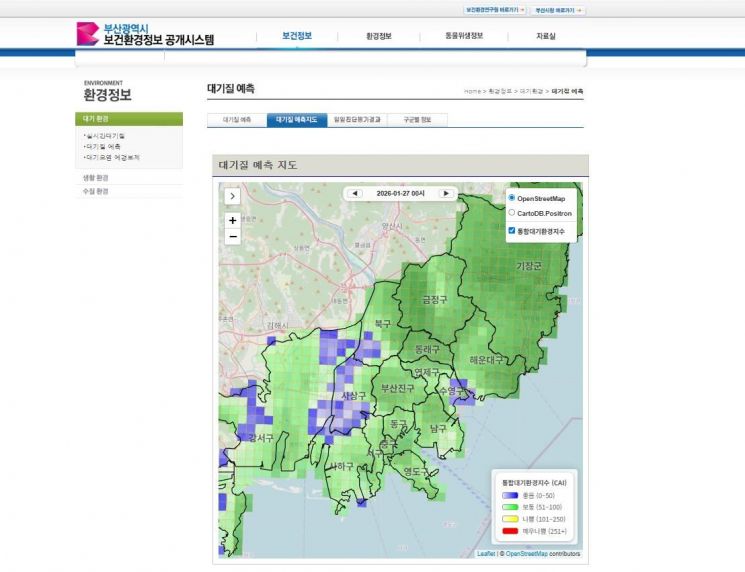
Instead of complex concentration figures, air-quality information is presented in four levels using the Comprehensive Air-quality Index (CAI): "Good," "Moderate," "Bad," and "Very Bad." A color scheme is also applied so that the air conditions can be identified at a glance.
This service focuses on providing customized information for each neighborhood. It allows users to check the air quality around their living spaces, such as apartment complexes and schools, in 1 km² grid units, and it also provides hourly air-quality forecasts for three days, from the same day through the day after tomorrow. Citizens can use this information to plan outdoor activities and their daily routines.
The detailed regional air-quality forecast map can be accessed through the Institute of Health and Environment's information disclosure system. The institute plans to continue improving the service's functions in the future.
Lee Yongju, Director of the Institute of Health and Environment, said, "This is a service we independently developed by utilizing existing observation data and forecasting technology," adding, "We hope it will help citizens manage their health and plan their daily lives by providing air-quality information they can actually feel in their everyday routines."
© The Asia Business Daily(www.asiae.co.kr). All rights reserved.
![Clutching a Stolen Dior Bag, Saying "I Hate Being Poor but Real"... The Grotesque Con of a "Human Knockoff" [Slate]](https://cwcontent.asiae.co.kr/asiaresize/183/2026021902243444107_1771435474.jpg)
















