Notice of restoring reciprocal tariffs to 25% on grounds of "legislative delay"... President Lee's dilemma deepens
Some see entry into a new phase... Shaking trade to build pressure on security as well
"Defending on trade vs. making progress on secu
After U.S. President Donald Trump unilaterally notified South Korea of a "re-increase of reciprocal tariffs from 15% back to 25%," subtle differences in tone over how to respond going forward are emerging even within the Blue House. Since the United States has cited the unexpected reason of a "delay in passing the Special Act on Investment in the United States" to justify the tariff re-hike, contrary to what was stipulated in the Korea-U.S. Joint Fact Sheet announced last November, one camp argues that South Korea should respond firmly. Another camp contends that, in the trade arena, Seoul should listen more actively to U.S. demands and, at the same time, push ahead with follow-up security negotiations on issues such as nuclear-powered submarines and uranium enrichment and reprocessing. These two currents are now colliding.
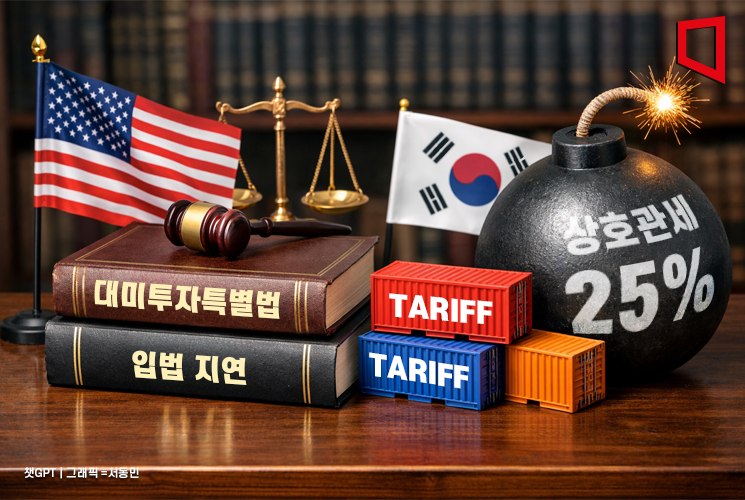
According to the Blue House on the 8th, President Lee Jaemyung has been convening meetings frequently to manage the situation amid these hawkish and dovish currents, but his agonizing as the final decision-maker appears to be deepening. Inside and outside the Blue House, some assess that it will be difficult to block publication in the Federal Register and that Korea-U.S. consultations on trade and security have entered a new phase. The view is that, although the allies had already codified their agreement as "bill introduction equals tariff reduction," the United States has begun pressuring South Korea based on its own unilateral interpretation because it wants visible investment outcomes for the midterm election campaign this November. From this perspective, the Trump administration has little choice but to keep demanding outcomes that are favorable to it, regardless of how Korea's legislative and administrative procedures work.
In fact, recent U.S. messaging has been focused on the "speed of implementation." After publicly announcing his plan to restore tariffs, Trump said, "We'll work something out with South Korea," signaling a new framework for negotiations. U.S. Secretary of State Marco Rubio, whom Foreign Minister Cho Hyun met, is also said to have hinted that the atmosphere is not good regarding the implementation of the Korea-U.S. trade agreement.
At the same time, the U.S. government continues to raise issues suggesting that Korea has not sufficiently fulfilled its non-tariff commitments, including passage of the Special Act on Investment in the United States that would underpin implementation of Korean investments, as well as promises in the agricultural and digital sectors. Washington is effectively taking up again the arguments it made during last year's reciprocal tariff negotiations. Minister Cho said that, on the sidelines of a critical minerals meeting, he met with U.S. Trade Representative Jamison Greer, and added, "Representative Greer understands the repercussions that a tariff re-hike could cause, but he emphasized that it is important for Korea to promptly present a more advanced position on issues related to non-tariff barriers as well."
Diverging views inside the Blue House over solutions... Gap between 'defending the trade front' and 'making progress in security'
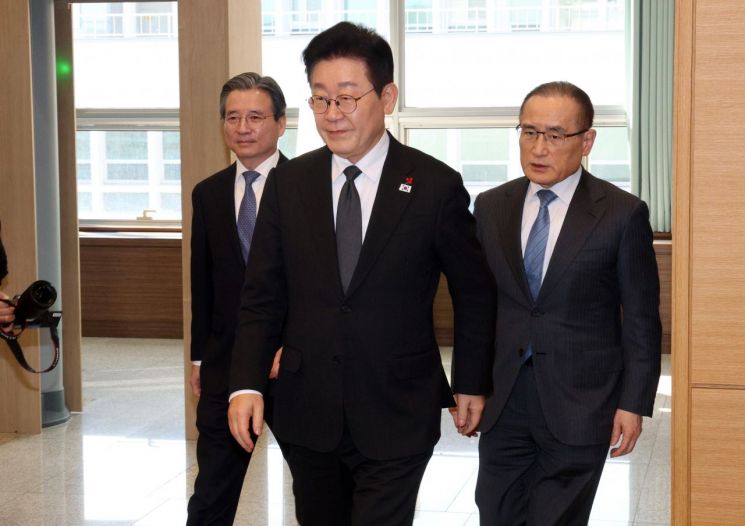 President Lee Jaemyung is entering a senior secretaries' meeting at the Blue House with Kim Yongbeom, policy chief, and Wi Seongrak, director of the National Security Office. Photo by Yonhap News
Within the Blue House, opinions are divided over how to navigate this state of negotiations between Korea and the United States. In the case of trade talks, which are heavily defensive in nature, once figures are finalized, they are difficult to reverse, and there is strong wariness that repeated additional concessions could solidify a structure in which "once you give, you keep giving." Since there is a perception that this notification runs counter to the intent of the Joint Fact Sheet, some argue that if Korea grants legitimacy to an unreasonable demand, it will open the door to further pressure. In particular, there is concern that the principles could be shaken, given that conditions such as an annual cap of 20 billion dollars were attached in light of the potential impact of the total 350 billion dollar investment package in the United States on the Korean economy and foreign exchange market.
By contrast, the prevailing mood regarding security is that this is an area where "Korea must secure gains through negotiation," and that the current phase should be navigated with a conciliatory approach. The position is that Korea should absorb and manage U.S. sources of dissatisfaction in the trade sphere as much as possible, so as not to provoke the Trump administration, and within that framework advance a security package that includes nuclear-powered submarines and uranium enrichment and reprocessing. They note that sparks from the trade issue have already begun to spread to the security realm, pointing out as a prime example that the U.S. security negotiating team has been postponing its trip to Korea.
For now, attention has shifted to the National Assembly. On the 9th, the Assembly plans to form a special committee to refine the bill and has agreed on a timetable to finalize legislation supporting implementation of the investment by March 9. Since President Trump has cited "legislative delay" as his justification, the calculation is that Korea should first remove that justification and thereby eliminate the pretext for Washington to force through its "restoration to 25%" card. Until now, the People Power Party has opposed passage of the Special Act on Investment in the United States, arguing that investments in the United States require ratification by the National Assembly.
The Blue House views the coming weeks as the most critical juncture of the current phase. If the National Assembly’s schedule picks up speed, there is a greater chance that the U.S. re-hike card will remain merely a tool of negotiating pressure. However, if, regardless of the bill’s passage, the United States proceeds with formal steps such as publication in the Federal Register and locks in the restoration to 25%, trade uncertainty could immediately turn into a tangible burden. A Blue House official said, "President Lee is being fully briefed by his aides on the state of the negotiations," and added, "We are doing our utmost to maximize the national interest by putting pragmatism first."
© The Asia Business Daily(www.asiae.co.kr). All rights reserved.


















