Possible with an initial force of 15,000 troops
U.S. leadership absent... Germany hesitates to respond to attack
WSJ: "Exposed Europe's vulnerabilities"
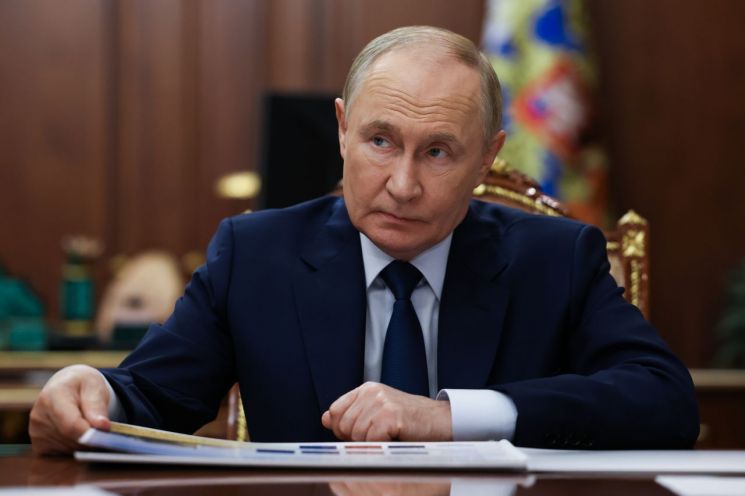
#. Tuesday, October 27, 2026, 6:47 a.m. The lights are blazing in the German Chancellery in Berlin, Germany. Russian troops have massed on the Lithuanian border. They are believed to have completed preparations to invade Lithuania. The chancellor has called an emergency meeting with key ministers and advisers. Once everyone is seated, the chancellor opens the meeting.
In a war game (simulated war) built around a scenario in which Russia invades Lithuania, a member state of the North Atlantic Treaty Organization (NATO), projections showed that Russia could seize control of the Baltic Sea within a matter of days by deploying only 15,000 initial troops.
The German daily Die Welt reported on the 5th (local time) that this outcome emerged from a war game conducted last December in cooperation with the War Game Center under the Helmut Schmidt University of the German Armed Forces, based on a hypothetical Russian invasion of Lithuania.
This war game was set in October 2026 and assumed a scenario in which Russia captures the southwestern Lithuanian city of Marijampole, through which a road runs linking Russia’s exclave of Kaliningrad with Belarus, a pro-Russian state. The Kremlin’s false claim that a humanitarian crisis was escalating in Kaliningrad was used as the pretext for the invasion.
According to the simulation, Russia achieved most of its objectives without moving large numbers of its own troops. When the absence of U.S. leadership was combined with a passive response from NATO member states, Russia secured dominance across the entire Baltic Sea region within a few days with an initial force of just 15,000 troops.
The United States refused to invoke Article 5 of the NATO treaty, which stipulates that an attack on one NATO member must be defended jointly by all allies. Germany hesitated to respond to the attack, and the German brigade already deployed in Lithuania was unable to intervene after Russia laid mines using drones near the military base. Poland tried to mobilize its forces but, in order to defend its own territory, was unable to send troops into Lithuania.
The war game brought together 16 participants, including former German officials and NATO officials, members of parliament, and security experts, who role-played the fictional invasion scenario. Franz-Stefan Gady, an Austrian military expert who played the role of Russia’s chief of the general staff, told The Wall Street Journal (WSJ), "In the war game, my 'Russian colleagues' and I knew that Germany would hesitate, and that alone was enough for us to win."
Ruben Brekelmans, the Dutch defense minister, told the WSJ, "It was assessed that Russia could move a large-scale force within a year," adding, "They are already increasing their strategic stockpiles and expanding their presence and assets along NATO’s borders." The WSJ also noted, "The results of this war game suggest that while European governments are preparing for the possibility of war with Russia, they are still not ready."
© The Asia Business Daily(www.asiae.co.kr). All rights reserved.