Rise in "A Few Large Deals" at Home and Abroad
Fewer Transactions, But Valuations Climb Again
Although capital is flowing back into the domestic venture investment market, it is being concentrated on "proven late-stage" companies, inflating the valuations of unicorns (unlisted startups with a corporate value of at least 1 trillion won). Some companies are being valued in the multi-trillion-won range, boosting expectations for initial public offerings (IPOs), but there is criticism that the number of deals is actually declining, meaning the overall base of the market is not expanding.
Toss at 20.5 trillion won, Upstage at 2 trillion won... "Money is flocking to proven late-stage companies"
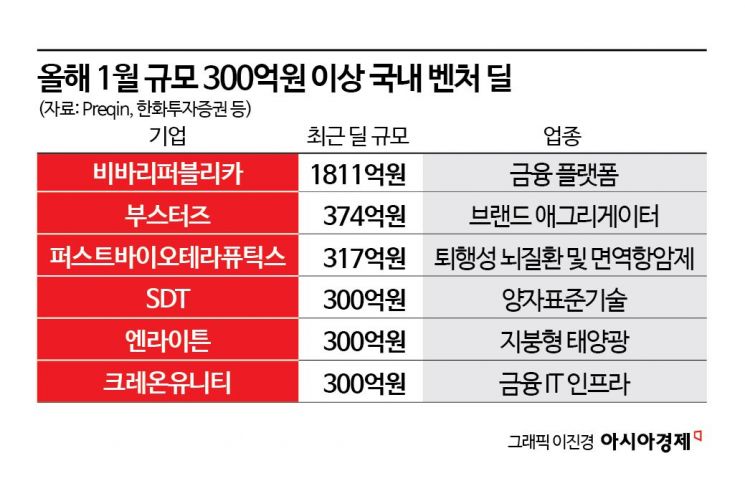
According to the venture capital (VC) industry on the 9th, Viva Republica, which operates the mobile financial service "Toss," recently completed a share swap with China's Ant Group and was recognized with a corporate value of 20.5 trillion won. In this deal, where Toss issued new shares in exchange for acquiring all of Ant Group's stake in Toss Payments, Toss recorded its highest-ever valuation. Toss plans to submit a confidential securities registration statement to the U.S. Securities and Exchange Commission (SEC) within the first quarter of this year to kick off its U.S. listing in earnest.
As the artificial intelligence (AI) boom spreads, the corporate values of related startups are also surging. The generative AI company Upstage is seeking to raise 300 billion won in a pre-IPO (pre-listing equity investment) round, with its final valuation being discussed at around 2 trillion won. Alongside this fundraising, Upstage has decided to acquire Kakao subsidiary AXZ (Daum) through a share swap. AI semiconductor design company FuriosaAI is also conducting a Series D round, with a valuation in the 2 trillion won range being mentioned.
The rise in valuations of late-stage startups is a trend seen globally as well. According to Samjong KPMG, the median pre-money valuation for rounds at Series D and beyond last year has recovered to the peak levels seen in 2021. It also analyzed that valuations for Series B and Series C rounds began to rise again from 2024, showing signs of recovery. Last year, OpenAI (operator of ChatGPT) and Anthropic (operator of Claude) each raised tens of billions of dollars, and these "mega rounds" by AI companies drove this trend.
Venture funds are also "scaling up"... Betting on scaling up rather than early-stage
The domestic fund market is also continuing to shift toward larger fund sizes. According to Hanwha Investment & Securities, among 26 funds that were formed or are in the process of being formed since the fourth quarter of last year, 30% are targeting a size of at least 100 billion won.
Kim Suyeon, analyst at Hanwha Investment & Securities, pointed out, "The reason venture funds are getting larger is that unlisted investment strategies are shifting toward scaling up." Kim added, "In December last year, there were 91 domestic venture deals totaling 370 billion won. Among them, 13 startups received investments of at least 10 billion won, and 5 startups received investments of at least 30 billion won," explaining, "Amid this trend, the valuations of startups currently preparing for IPOs have also increased."

However, there are concerns that, because capital is being concentrated in specific sectors and late-stage rounds rather than being evenly spread across all stages, a structure may solidify in which the number of transactions shrinks while only valuations grow. As venture funds become larger, asset managers naturally end up allocating capital to "a small number of large deals," making it easier for a structure to form in which valuations of late-stage companies such as unicorns rise first. If the investment gap in early- and mid-stage companies is prolonged, the foundation for nurturing early-stage startups may also be undermined.
"IPO expectations are rising... but valuations may still be adjusted"
In particular, as the stock market enters a rebound phase, expectations for exits through IPOs are growing, but if actual public offering demand fails to keep up, pre-IPO valuations may inevitably need to be adjusted during the IPO pricing process. Conversely, if exit channels such as public offerings and mergers and acquisitions (M&A) become more active, it could lend greater credibility to the multi-trillion-won valuations of some unicorns.
Jung Doyoung, Executive Director of the Startup Support Center at Samjong KPMG, said, "In the first quarter of this year as well, AI will remain the top priority sector for global venture investment, as it is a key tool for driving operational innovation and productivity improvement across companies and industries," adding, "Investment capital is gradually concentrating on proven companies, the share of small-sized funds and newly created venture funds is decreasing, and the market is being reshaped at an accelerating pace around experienced large asset managers."
Jung continued, "In Korea, the venture investment market will grow with AI at its core, as regulatory improvements and tax incentives related to venture investment are being pursued, such as extending the life of the Korea Fund of Funds," and predicted, "Based on the rise in the stock market, IPO activity is also highly likely to pick up."
© The Asia Business Daily(www.asiae.co.kr). All rights reserved.
!["The Woman Who Threw Herself into the Water Clutching a Stolen Dior Bag"...A Grotesque Success Story That Shakes the Korean Psyche [Slate]](https://cwcontent.asiae.co.kr/asiaresize/183/2026021902243444107_1771435474.jpg)

















