President Lee Attends Groundbreaking Ceremony in Geoje, Gyeongnam...Also Signs Railroad Sleeper
Includes Tongyeong?Geoje "First Undersea Tunnel": "Starting Point for Balanced National Development"
"Soaring Seoul Housing Prices and Regional Extinctio
On February 6, President Lee Jaemyung attended the groundbreaking ceremony for the Southern Inland Railway in Geoje, South Gyeongsang Province, and said, "The Southern Inland Railway will become a solid rail line that geographically connects and psychologically links the economic zones of Daegu and North Gyeongsang with those of Busan, Ulsan, and South Gyeongsang," adding, "By connecting the Seoul metropolitan area to Geoje in around two hours, it will turn various parts of the country into areas that can be reached within half a day."

In his commemorative address at the groundbreaking ceremony held at Geoje Agnes Park, President Lee described the Southern Inland Railway as "the beginning of a grand national land transformation that will overcome the limits of growth centered on the Seoul metropolitan area and create new growth engines for the regions. Today is a historic day when we break away from growth centered on the metropolitan area, which has reached its limits, and throw open the door to a new era of region-led growth."
President Lee noted that the Southern Inland Railway held a groundbreaking ceremony in 1966 under the name "Gimsamseon," but had been halted for nearly 60 years due to a lack of economic feasibility, and said, "Because the project was suspended on the grounds that it was not profitable, this region had to endure enormous damage." He went on, "Residents had to spend long hours in cars whenever they traveled to other areas, and young people had no choice but to leave for distant cities in search of jobs," adding, "The sorrow of not having even a single train station in the neighborhood undermined the region's competitiveness and ultimately led to a crisis of regional extinction."
President Lee in particular diagnosed the concentration in the Seoul metropolitan area as "a structure that has reached its limit" and once again emphasized the need for balanced development. He said, "In past years, because the Republic of Korea lacked resources and opportunities, it pursued a strategy of concentrating everything in one place, of 'putting all the eggs in one basket' and 'going all in,' and it is true that this produced considerable results through the trickle-down effect," but added, "Now this unipolar system and unbalanced growth strategy have reached their limits."
He continued, "If, as now, everything continues to be concentrated in Seoul so that housing prices in Seoul skyrocket and the city becomes unlivable, while the provinces lose people and face the risk of extinction, then sustained growth and development for this country will be impossible," and added, "We must now adopt balanced growth and balanced development as the survival strategy of the Republic of Korea."
President Lee also set out in concrete terms how the region will change as a result of the railway construction. He said, "As the beautiful archipelago of the southern coast and the magnificent inland mountains are connected as one, tourism along the southern coast will leap to a world-class level, and this will in turn lead to the revival of local commercial districts and the creation of countless jobs." He added, "The aerospace industry in Jinju and Sacheon and the shipbuilding and marine industry in Geoje will meet inland logistics hubs and further strengthen their competitiveness, and the industrial complexes that will be built along the railway line will create vibrant cities to which young people will return."
He also reaffirmed the government's commitment to support balanced development. President Lee said, "We will provide thicker and bolder support the farther a region is from the Seoul metropolitan area, and by doing so we will surely achieve a grand transformation into a 'five hubs and three special zones system' under which the southern region rises as a maritime capital." Referring to Gyeonnaeryang, where the groundbreaking ceremony was held, he said, "This is where Admiral Yi Sunshin achieved victory in the Battle of Hansan Island," and added, "If Gyeonnaeryang in the past was the front line in defending the nation, then today's Gyeonnaeryang will become the starting point from which the Republic of Korea makes a fresh leap forward through balanced regional development."
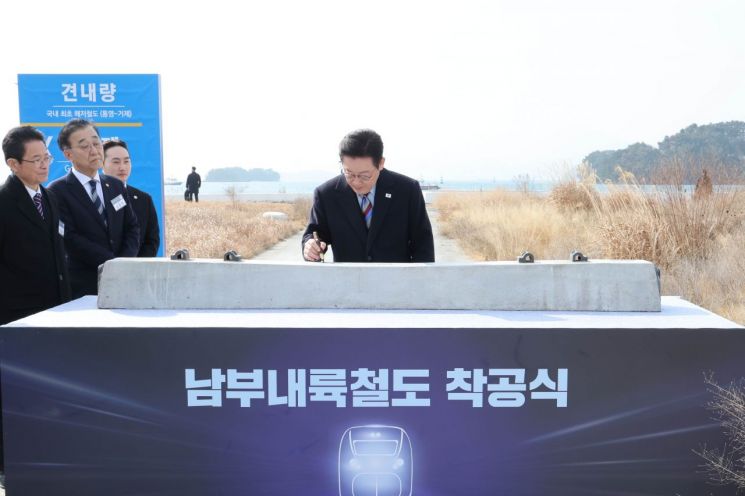
He also called for efforts to ensure that there are no industrial accidents during the construction period of the Southern Inland Railway. President Lee said, "Above all, the most important thing is your safety," and added, "Please do your utmost to ensure that not a single safety accident and not a single industrial accident victim occurs, by strictly observing safety rules during the construction process and by sparing no investment in safety."
The groundbreaking ceremony was held under the theme "Innovation that Breaks the Wall of Time: Realizing a Two-Hour Travel Time Between Seoul and Geoje," and was attended by more than 400 people, including Minister of Land, Infrastructure and Transport Kim Yundeok, Kim Kyoungsoo, Chairperson of the Presidential Committee for the Era of Local Autonomy, heads of local governments, residents, and project officials. Minister Kim also reported on the background of the promotion of the Southern Inland Railway construction project, its characteristics, and its expected effects. This was followed by a zero-accident construction pledge by the National Railroad Authority and the construction companies, and the event concluded with a groundbreaking ceremony joined by key dignitaries and local representatives. Before the ceremony, President Lee also signed a railroad sleeper. The presidential office said, "We expect this groundbreaking ceremony to serve as an opportunity to clearly reaffirm our commitment to balanced national growth."
© The Asia Business Daily(www.asiae.co.kr). All rights reserved.