Domestic Slump Makes Crisis for Small Business Owners Visible
Foot Traffic Concentrates in Seongsu-dong, Hitting Konkuk Area
"Local Governments Need to Work with Local Merchants"
"It's even harder now than it was during the COVID-19 outbreak. My sales have dropped to one-tenth."
Merchant A, whom we met in the commercial district near Konkuk University Station in Gwangjin District, Seoul, let out a deep sigh. A said, "As Seongsu-dong has become a hot place, people have all moved over there, so there are many stores whose business is not as good as it used to be," adding, "There are also many shops around here that are a full year behind on their rent."
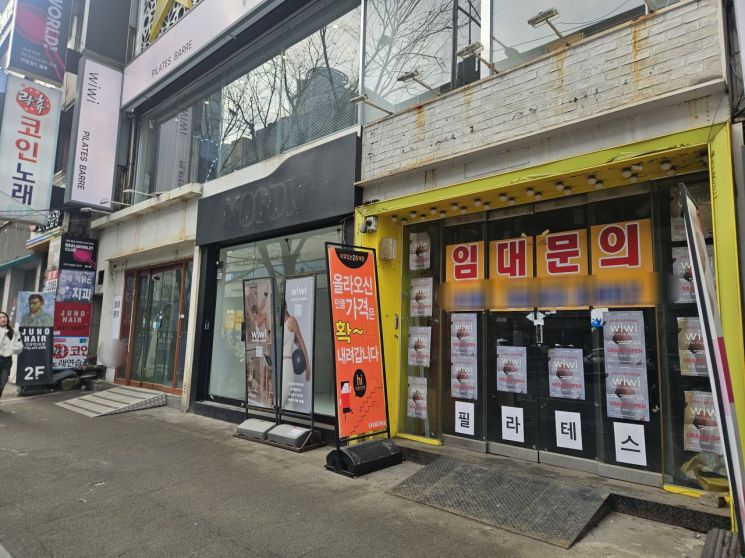 Vacant units marked 'For Lease' line the roadside near Geondaeipgu Station in Gwangjin-gu, Seoul. Reporter Park Jaehyun
A room bar that had been operating for nearly 20 years on the "Food Street" near Konkuk University Station also closed its doors three months ago. The owner had tried to hold on by even changing the business type to an izakaya (Japanese-style pub) when business slowed, but it became difficult to just sit and wait for the dwindling customers. B, who runs a real estate brokerage business in the Konkuk University Station area, said, "As the culture of company dinners followed by second and third rounds at karaoke bars or beer halls has disappeared, the commercial district has declined along with it," adding, "In the places vacated by these stores, unmanned shops with lower labor costs are mainly moving in."
As "Seongsu-dong" has emerged as a mecca of trends, the Konkuk University commercial district, long regarded as a key area among university neighborhoods in Seoul, is on the decline. Analysts say this is a "straw effect," in which the floating population of an existing commercial district is sucked into a new hot place. With consumer sentiment frozen by record-weak domestic demand, voices are calling for co-prosperity measures to support merchants suffering from rapidly rising labor costs and rent burdens.
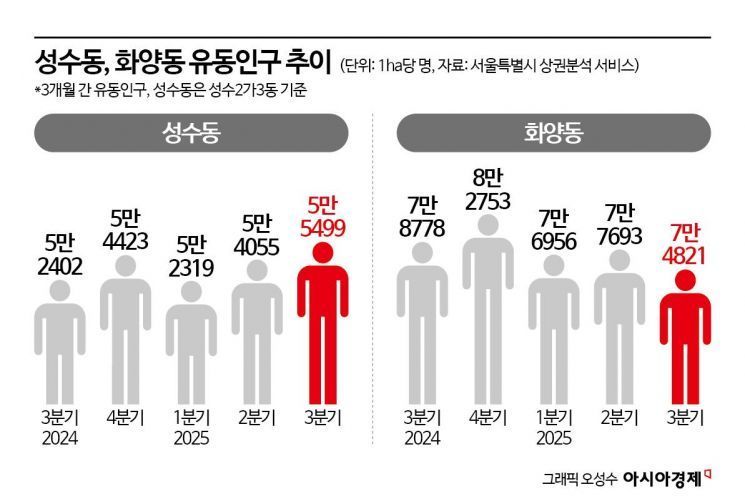
According to the Seoul Commercial District Analysis Service on the 19th, the floating population per hectare in Seongsu 2(i)-ga 3-dong in Seongdong District increased from 52,402 in the third quarter of 2024 to 55,499 in the third quarter of last year. In contrast, the floating population in Hwayang-dong, Gwangjin District, decreased from 78,778 to 74,821 over the same period.
In the Konkuk University Station area we visited in person, it was easy to spot stores with signs reading "For lease inquiries" posted on them. On a street dense with bars, closed shops stood out at 3-meter intervals, and "For lease inquiries" signs had also been hung on the upper floors of commercial buildings. Only in unmanned stores such as gacha shops (capsule toy vending shops) and arcades was lively music playing.
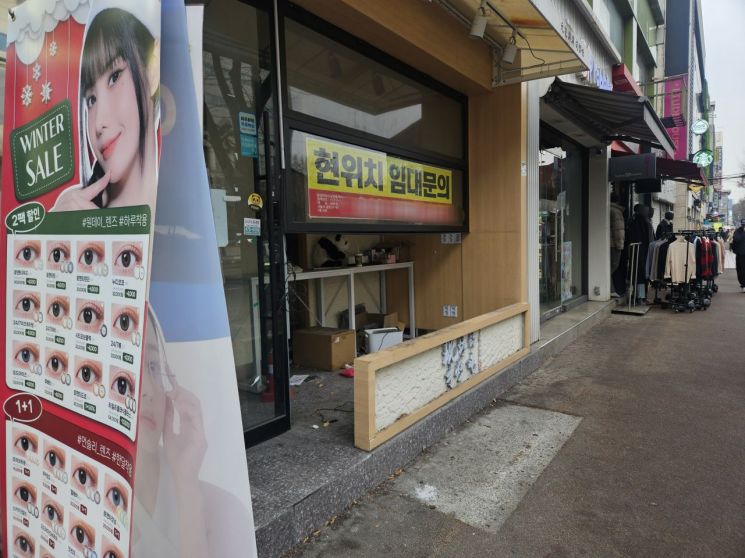 Closed stores with 'For lease inquiries' signs are lined up on the street near Konkuk University Station in Gwangjin District, Seoul, where restaurants are concentrated. 'For lease inquiries' signs have also been posted on the upper floors of the commercial building. Park Jaehyun, Reporter
Some point out that, to prevent the decline of commercial districts, local governments need to work with local merchants to find co-prosperity measures. The "Shinheung Market" near Haebangchon in Yongsan District is cited as a representative success story of reviving a blighted commercial area. Selected in 2015 as a pilot site for Seoul's urban regeneration project, Shinheung Market underwent extensive environmental improvements and has now been reborn as a hot place attracting people in their 20s and 30s. As of the third quarter of last year, the average monthly sales per store in Yongsan 2(i)-dong were 7.42 million won, up 2.49% from the same period a year earlier.
Lee Heejung, a professor in the Department of Urban Planning and Engineering at the University of Seoul, said, "When a new commercial district emerges, the old one is often hit hard, but in such cases, it is desirable to move toward a co-prosperity model through sweeping innovation," adding, "Local governments should create forums for deliberation by working with merchants to support the recovery of commercial districts."
© The Asia Business Daily(www.asiae.co.kr). All rights reserved.



















