Headquarters: "We Will Pay 500,000 Won"... Informant: "Treatment Alone Costs 1 Million Won"
Over 3,000 Franchise Violations of the Food Sanitation Act in Five Years
There has been a report that a customer bit into a metal bolt while eating a burger from a hamburger franchise and broke a tooth. When they contacted the headquarters, they were told the cause was "unknown," and it is reported that they were offered compensation in the range of 300,000 to 500,000 won.
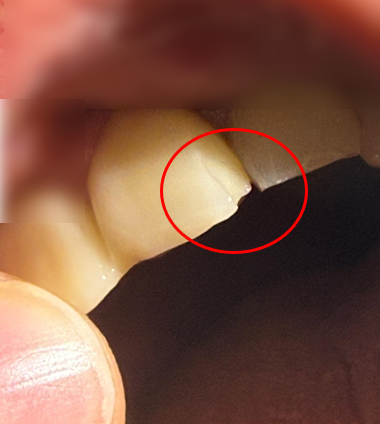 Photo of a netizen claiming that a metal bolt came out of a franchise burger while eating and broke their tooth. Screenshot from Bobaedream
On the 4th, a post titled, "My tooth was broken after a metal bolt came out while I was eating a hamburger from a hamburger franchise," was uploaded to an online community.
In the photos posted by the informant, the tip of an upper front tooth was cracked and broken, and a round bolt was shown inside the hamburger.
The informant wrote, "On January 13 at around 6 p.m., after getting off work, I ordered a hamburger for delivery from a well-known hamburger franchise, BurX King, at a branch in Yeonsu-gu, Incheon. While I was eating, I bit into a 3-5 cm metal bolt in the hamburger, and my tooth broke," adding, "When I informed the manager of the branch where I had placed the delivery order, I was told, 'If you give us the metal bolt, our headquarters will conduct a foreign-substance inspection.'"
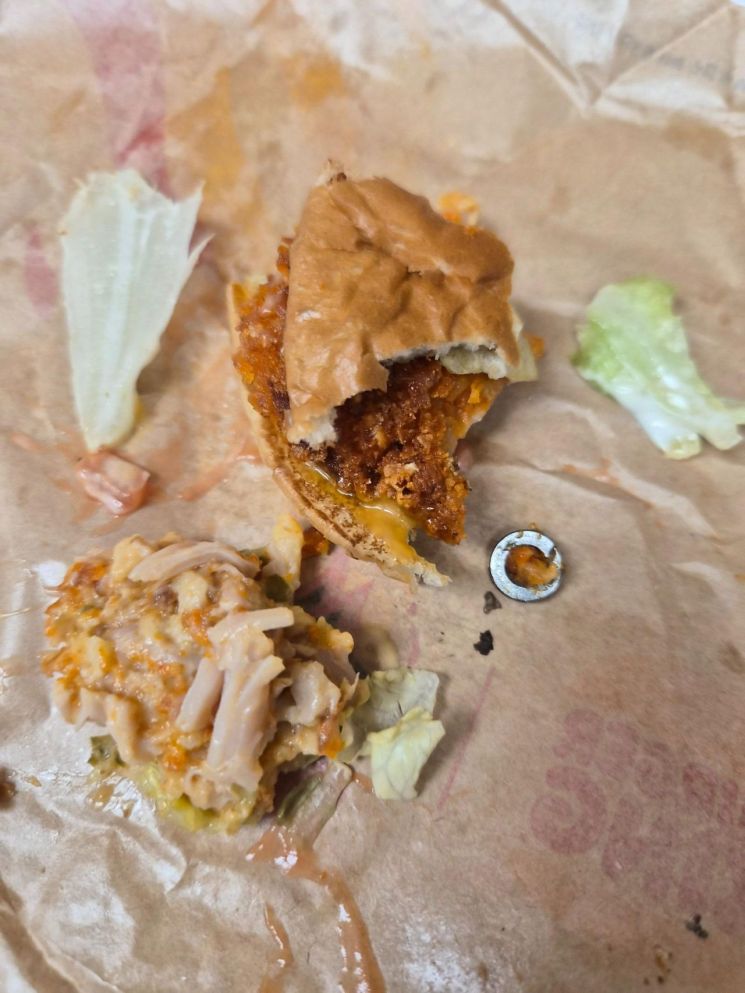 A netizen posted a photo claiming that while eating a burger from a franchise, a metal bolt came out and broke their tooth. Screenshot from Bobaedream.
The response that came back a week later was that the cause was unknown and unconfirmed. The writer continued, "I was so dumbfounded that I asked the manager how they were going to address the damage I had suffered. I was then told that they hoped to settle the matter amicably by offering compensation of 300,000 to 500,000 won," and added, "At the time, my tooth had broken, and the next day my tooth was sensitive, so I went to the dentist and received a treatment estimate of around 1 million won. After hearing that conversation, I decided without hesitation that I would continue to raise my claim for damages as it is."
In severe cases, business suspension is possible... Will this be treated as a violation of the Food Sanitation Act?
If a foreign substance is found in food, the business can face a fine, a corrective order, and, in the event of a repeat offense, even suspension of business. Such cases fall under violations of the Food Sanitation Act and are subject to fines of up to 5 million won and corrective measures. After an investigation by the Ministry of Food and Drug Safety, the relevant local government issues a corrective order, and if a repeat violation is detected within one year, the business can face an aggravated penalty, such as a "two-day suspension of business."
In fact, violations of the Food Sanitation Act by franchises continue to be uncovered. According to data from the Ministry of Food and Drug Safety released in May last year by Seo Mihwa, a proportional-representation lawmaker of the Democratic Party of Korea who serves on the National Assembly Health and Welfare Committee, there were 3,133 detected violations of the Food Sanitation Act at franchise outlets in nine restaurant sectors, including fried chicken and cafes, over the five-year period from 2020 to 2024.
By company, BBQ had the highest number with 201 cases, followed by BHC (186 cases), Mom's Touch (172 cases), Mega Coffee (158 cases), Compose Coffee (153 cases), Goobne Chicken (140 cases), Lotteria (126 cases), Kyochon Chicken (122 cases), Cheogajip Seasoned Chicken (98 cases), Nene Chicken (92 cases), Dongdaemun Yeopgi Tteokbokki (85 cases), Sinjeon Tteokbokki (83 cases), Hosigi Two Chicken (79 cases), Gcova Chicken and McDonald's (75 cases each), Mexicana and Pelicana (73 cases each), Tanghuo Kungfu Malatang (69 cases), A Twosome Place (65 cases), and The Venti (64 cases).
By type of violation, "violations of standards and specifications," including foreign substances in food, accounted for the largest share with 1,158 cases (37%), followed by failure to complete hygiene education with 968 cases (30.9%), violations of hygienic handling standards with 336 cases (10.7%), failure to conduct health examinations with 216 cases (6.9%), and violations of business operators' compliance obligations with 185 cases (5.9%).
© The Asia Business Daily(www.asiae.co.kr). All rights reserved.