Neural Chips Implanted in Pigeon Brains for Remote Control
Experts Say "Military Use Cannot Be Ruled Out"
The possibility has been raised that an era in which pigeons are controlled like drones could become a reality. Foreign media have reported that Russia is developing technology to remotely control live pigeons by implanting neural chips in their brains.
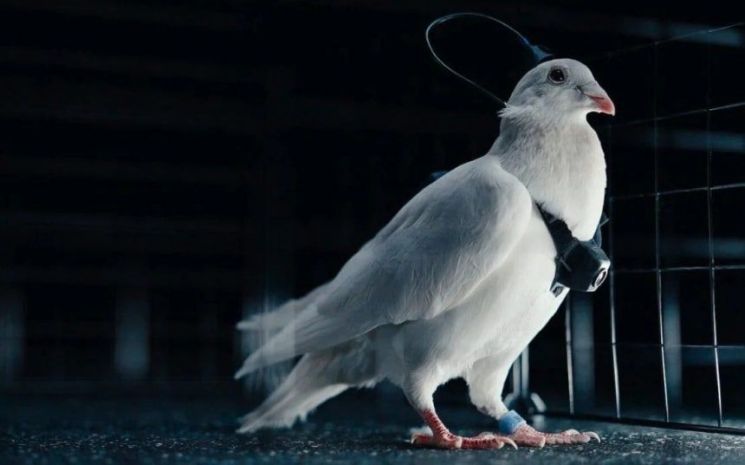
On February 4 (local time), Yonhap News, citing the British daily The Telegraph, reported that Russia is developing so-called "cyborg pigeon drone" technology.
According to the report, Neiri Group, a neurotechnology startup headquartered in Moscow, Russia, is researching bird-based drone technology through a project codenamed "PJN-1." The technology involves inserting miniature electrodes into the skulls of live pigeons and connecting them to a stimulation device attached to the head, allowing an external operator to remotely control the direction of flight.
The pigeons are fitted with backpacks equipped with solar charging, which contain flight control devices. Through this system, humans can direct the flight path in real time, and a camera for filming is attached to the pigeons' chests.
Neiri claims that these "pigeon drones" are superior to conventional mechanical drones. Pigeons can travel up to 300 miles (about 480 kilometers) a day and can enter narrow or covert spaces that are difficult for mechanical drones to access.
Alexander Panov, Neiri's Chief Executive Officer (CEO), told The Telegraph, "At the moment we are using pigeons, but any bird can be used as a carrier," adding, "We are considering crows for carrying heavier cargo, seagulls for monitoring coastal facilities, and albatrosses for wide ocean areas."
The company explained that it is developing this technology with civilian purposes in mind, such as inspecting industrial facilities or searching for missing persons. However, Western experts believe that military applications cannot be ruled out.
James Giordano, a scientific adviser to the U.S. Department of Defense, pointed out, "Such bio-drones could be misused as carriers of biochemical weapons that infiltrate deep into enemy territory and spread disease."
The Telegraph noted that Russia has already been actively using animal-based military tactics, such as deploying trained dolphins to defend naval bases in the war in Ukraine, and suggested that pigeon drones could also be an extension of these new weapons systems.
Questions have also been raised about the source of funding for the developer. According to T-Invariant, a Russian anti-war investigative outlet, Neiri is reported to have received about 1 billion rubles (about 19 billion won) in investment from Kremlin-linked figures, including those involved in the "National Technology Initiative" led by President Vladimir Putin.
It has also been reported that Neiri has established a partnership with an artificial intelligence (AI) research institute at Moscow State University run by Putin's second daughter, Katerina Tikhonova.
In response, Neiri stated, "We are not aware of any relationship between our investors and the Russian government," and added, "It is common practice around the world for states to support advanced technologies."
© The Asia Business Daily(www.asiae.co.kr). All rights reserved.