Announcement of the "2025 Survey on the Use of the Korean Language"
Usage meanings expand, such as "goguma = frustration"
The meaning of everyday words is rapidly expanding and changing, with words like "goguma" (sweet potato) used to mean "frustrating" and "michida" (to go crazy) used as high praise. This kind of semantic change is not confined to a particular generation; it is spreading across regions and age groups into everyday language as a whole.
On February 5, the National Institute of the Korean Language under the Ministry of Culture, Sports and Tourism announced the results of the "2025 Survey on the Use of the Korean Language," conducted on 3,000 men and women aged 15 to 69 nationwide.
According to the survey, 56.8% of respondents said they use "goguma" (sweet potato) with the meaning of "a frustrating situation or person," and 71.5% said they use "saida" (cider/soda) to mean "a situation that relieves frustration in a refreshing way." By generation, usage was highest among those in their 20s, but even among those in their 60s, 50.9% responded that they use "saida" in this new sense, indicating that the semantic expansion is spreading across all generations.
There is also a tendency to turn negative words into expressions with positive meanings. The word "michida," which originally meant a state of mental abnormality, is now used as a strong positive expression meaning "very great and excellent," according to 67% of respondents. Regarding this, the National Institute of the Korean Language explained that "this is an expressive strategy that paradoxically uses negative words in order to convey an individual's strong sense of satisfaction."
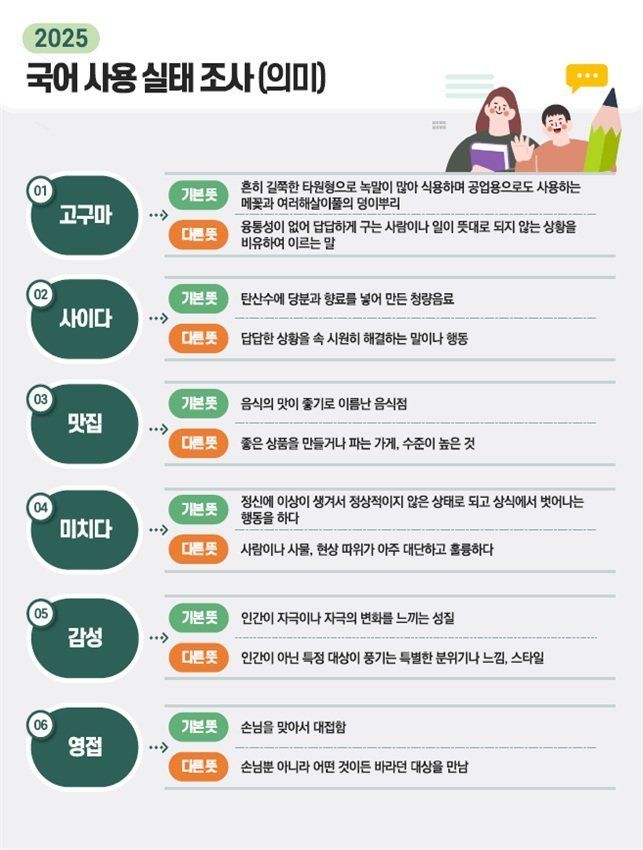
In addition, "gamseong" (sensibility) originally meant "the human capacity to feel stimuli or changes in stimuli," but the survey found that it is now used more actively as an expression for evaluating the atmosphere or image of an object. In particular, in the Jeju region and in the Gangwon and capital regions, expressions such as "gamseong cafe" (mood/sensibility-focused cafe) have become part of everyday language, and the new meaning is being naturally accepted.
A representative of the National Institute of the Korean Language said, "Through this survey, we have confirmed that the meanings of words change dynamically according to the times and social environment," adding, "We will actively reflect the results of this survey in dictionary compilation and policy-making in order to narrow the gap between actual language use and dictionaries."
© The Asia Business Daily(www.asiae.co.kr). All rights reserved.