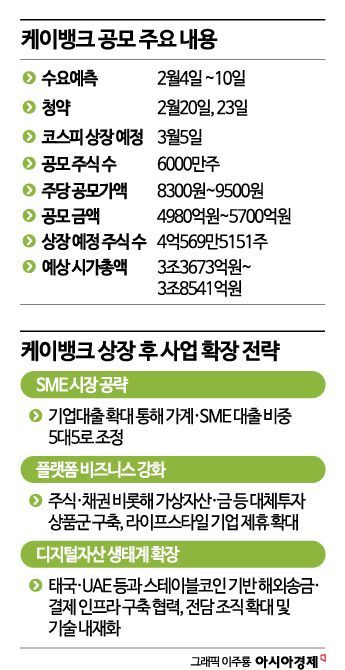
60 Million IPO Shares at 8,300-9,500 Won per Share
President Choi Woohyung: "Reflecting Market Expectations"
Expansion of Loan/Deposit Products and Alternative Investment Lineup
Stablecoin-Based Cross-Border Remittance and Payment Infrastructure<
Following its IPO attempts in 2023 and 2024, K bank, now making its third attempt this year, has made clear its intention to list on the KOSPI market in March. K bank plans to use the capital raised through this listing not only to increase earnings by expanding its portfolio of loan and deposit products, but also to secure future growth engines such as platform business and digital assets.
On February 5, at an IPO-related press conference held at the Conrad Hotel in Yeouido, Seoul, K bank President Choi Woohyung said, "Since its launch, K bank has continued to grow and innovate," adding, "Based on the capital we have secured, we will strengthen our capabilities and become an innovative financial company trusted by both customers and shareholders."
K bank will finalize its offering price on the 12th after conducting a book-building process from the 4th to the 10th of this month. Retail subscriptions will be held over two days, on the 20th and 23rd, and will be available through NH Investment & Securities, Samsung Securities, and Shinhan Investment & Securities. The listing date is March 5.
Lowering the number of IPO shares and the offering price to make a fresh start... President Choi: "We have created a shareholder-friendly IPO structure"
For this IPO, K bank has set a desired offering price range of 8,300 to 9,500 won per share. Compared with the second IPO attempt in September 2024, when the desired range was 9,500 to 12,000 won, the lower end is about 12% lower and the upper end about 20% lower. Out of the 405,695,151 shares scheduled to be listed (with an expected market capitalization of 3.3673 trillion to 3.8541 trillion won), 60 million shares have been allocated as offering shares (with an offering size of 498 billion to 570 billion won). The number of offering shares has also been reduced by 22 million shares from the previous 82 million shares.
This is interpreted as a measure to make up for the previous withdrawal of the listing due to weak demand forecasts. While the KOSPI index has risen compared to that time, the company has lowered the desired offering price in order to increase the factors attracting investors. President Choi Woohyung of K bank explained, "By reflecting the market’s expectations, we lowered the offering price compared with the previous attempt and adjusted the amount of shares available for trading on the listing date, thereby creating a shareholder-friendly IPO structure."
K bank is effectively compelled to complete the listing this time because, during its paid-in capital increase in 2021, it agreed with financial investors (FIs) to a drag-along clause that conditions a joint sale right on completing an IPO by July this year. If the listing is not completed within the deadline, the FIs can force the sale of the major shareholder’s stake together when they sell their own stake. In addition, K bank sees a KOSPI listing as essential for business expansion. President Choi explained that once the listing is completed, 725 billion won of past paid-in capital increase funds will be additionally recognized as capital when calculating the Bank for International Settlements (BIS) capital adequacy ratio, leading to an expected capital inflow effect of about 1 trillion won.
When asked by a reporter whether there is an alternative if the market sets a lower price than the desired offering range, as happened during the second listing attempt in 2024 when the final offering price was set below the desired range, Chief Strategy Officer and Chief Financial Officer Lee Junho answered, "This time, the desired offering price has been set conservatively, with a 20% discount compared with the previous attempt. As you know, Kakao Bank’s share price has risen more than 30%, and as of now, the IPO price band in the market has also moved up," expressing optimism by adding that they believe the desired offering range has been set at a level the market will consider appropriate.
President Choi: "Growth potential and profitability are our greatest strengths"... Breaking the image of being just an Upbit-linked account
President Choi plans to accelerate the expansion of new growth businesses after the listing, based on the bank’s growth potential and profitability. As of the end of last year, K bank had secured 15.53 million customers, with loan balances of 18.4 trillion won and deposit balances of 28.4 trillion won. By offering some of the lowest lending rates and some of the highest deposit and savings rates in the industry, it recorded the highest loan and deposit growth rates in the banking sector from 2020 to 2025 (deposit growth of 49.9% and loan growth of 42.8%). In particular, after successfully turning profitable in 2021, it achieved a record-high net income of 128.1 billion won in 2024, and last year as well it posted net income of 103.4 billion won through the third quarter, demonstrating solid profitability.
When reporters asked, from the perspective of financial consumers, how the bank plans to enhance its scalability given the strong perception that it is mainly an "Upbit account bank," President Choi responded, "Over the past two years, 6 million new customers have come to us. Among these 6 million customers, only 10% intended to use virtual assets. The remaining 90% were mostly customers who wanted to use our signature products and fun services," adding, "Even without massive advertising and promotion, more and more customers are gradually becoming loyal users of K bank’s products."
After listing, household and SME loans to be balanced at 5:5... Securing future growth engines by leading the digital asset market
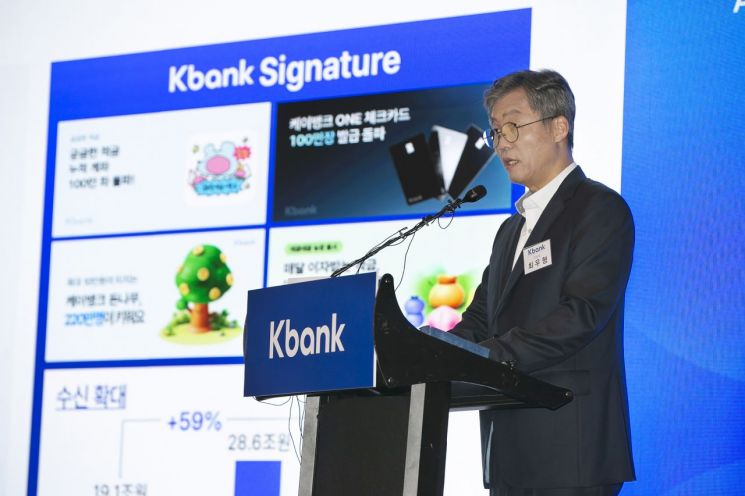
President Choi also outlined a plan to use the capital raised through this listing to expand the lineup of loan and deposit products. The bank intends to focus its investments on future growth by entering the small and medium-sized enterprise (SME) market, strengthening its technology leadership, expanding its platform business, and investing in new businesses including digital assets.
More specifically, to target the SME market, the bank plans to increase corporate lending and adjust the ratio of household to SME loans to 5 to 5 in order to enhance profitability. Addressing concerns about a possible rise in delinquency rates, President Choi said, "Even for corporate loans, we are implementing risk management policies from various angles, including credit policy, evaluation models, and the use of alternative data," and predicted a stable situation by adding, "Corporate loans will consist of three types: unsecured, guaranteed, and collateralized. We will complete a long-term portfolio structure based on these three categories."
In addition, the bank plans to build an alternative investment product lineup that includes virtual assets and gold, as well as stocks and bonds, and to increase partnerships with lifestyle companies to enhance customer appeal. To expand the digital asset ecosystem, it will strengthen cooperation with countries such as Thailand and the United Arab Emirates (UAE) to build stablecoin-based overseas remittance and payment infrastructure. On this day, President Choi showed a video demonstrating a remittance process in which a won-based stablecoin is converted into Thai baht and sent, and explained that this method can drastically reduce both remittance time and fees (which are zero) compared with existing methods. Regarding this, he emphasized, "After the listing, based on the capital we secure, we will focus on expanding dedicated organizations and internalizing technology, and we plan to lead the next-generation digital finance standards that comply with domestic and international regulations."
He also explained that once the Digital Assets Act is enacted, the bank plans to participate in consortia and other structures as a stablecoin issuer along with other banks. In response to a reporter’s question about how K bank plans to respond as banks are forming a stablecoin consortium, President Choi stressed, "It is difficult to go into detail, but we are also in discussions with several commercial banks."
Regarding K bank’s strategy to differentiate its stablecoin services, the bank pointed to leading technology trends and strengthening information security. Chief Technology Officer (CTO) Kim Jaesung said, "We are actively adopting systems such as cloud and artificial intelligence (AI). We believe there must not be even the slightest gap when it comes to information protection and security," and expressed confidence by adding, "We have invested more in information security than other financial institutions in the market, and the fact that there has not been even a trace of a single related incident over the past 10 years is, in our view, proof of our operational performance."
© The Asia Business Daily(www.asiae.co.kr). All rights reserved.