Representative Choi Kisang and Korea Customs Service Hold Policy Seminar
Need to Make Stablecoin Monitoring More Effective
Mandatory Reporting of Large Transactions, Following Japan
As financial crimes using virtual assets become more sophisticated, there is a growing call to bring stablecoins into the Foreign Exchange Transactions Act framework and to make monitoring more effective in practice.
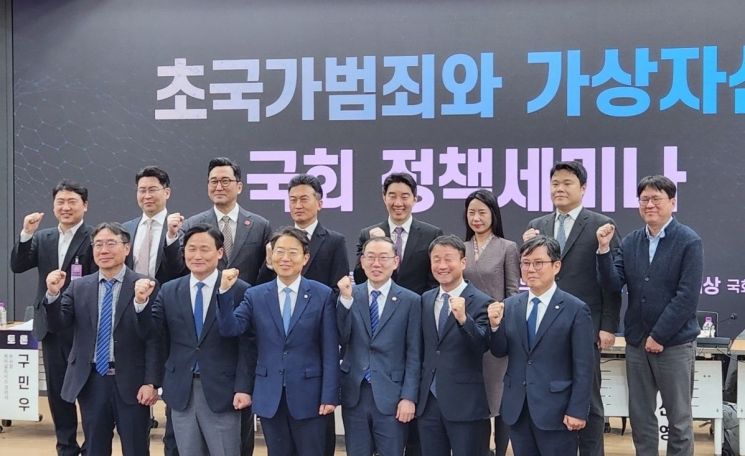 Participants are shouting slogans at the "Transnational Crime and Virtual Assets National Assembly Policy Seminar," held on the 5th in Meeting Room 1 of the National Assembly Members' Office Building. Photo by Im Chunhan
On the 5th, lawyer Jung Youngki of Kim & Chang stated at the "Transnational Crime and Virtual Assets National Assembly Policy Seminar," "The courts are responding by actively interpreting existing legal principles based on 'substance,' but they have reached the limits posed by the absence of clear provisions," adding, "It is urgent to establish an institutional foundation to prevent illegal foreign exchange transactions in advance, rather than relying solely on ex post responses."
Looking at Japan's foreign exchange transaction legal system related to virtual assets, crypto-assets are defined under the Foreign Exchange and Foreign Trade Act but are not included in the concept of means of payment. Crypto-asset exchange providers must verify whether their customers' payments and receipts are subject to licensing or reporting, and the parties to a transaction are required to report transaction details when the amount exceeds a certain threshold (30 million yen). In effect, the regulatory system is operated not through a registration obligation for virtual asset service providers, but through individual reporting obligations for large or abnormal transactions.
Jung said, "Given the inherently transnational nature of virtual assets and their relationship with the Act on Reporting and Using Specified Financial Transaction Information, which monitors virtual asset transfers, the key task is to amend the relevant provisions in the most efficient way while ensuring they do not become unnecessary regulations on the industry."
Hwang Seun, research fellow at the Korea Capital Market Institute, said, "In the course of the transition to a digital economy, there is a possibility that stablecoins will emerge as an important means of payment and settlement. Stable value maintenance and transparent disclosure of information are essential," adding, "It is necessary to impose customer due diligence obligations on issuers, to impose customer due diligence obligations on virtual asset service providers, and to impose reporting obligations for certain transactions."
The need to further advance the travel rule was also emphasized. Hwang said, "Because stablecoins are widely used as a conduit for cross-border transfers and the use of overseas exchanges, the travel rule, which requires the collection and transmission of sender and recipient information in virtual asset transfers, is particularly important for stablecoins," adding, "We can consider making it mandatory to strictly comply with the travel rule so that information on the sender and recipient is transmitted when remitting stablecoins, and strictly prohibiting transactions with anonymous wallets."
Hwang also noted, "At present, virtual assets are not explicitly specified as foreign exchange or as a means of payment under the Foreign Exchange Transactions Act, so cross-border transactions using them remain outside the legal framework," adding, "We need to establish a legal basis that allows monitoring within the existing foreign exchange control network by defining stablecoins as external means of payment or as a separate category of virtual asset means of payment."
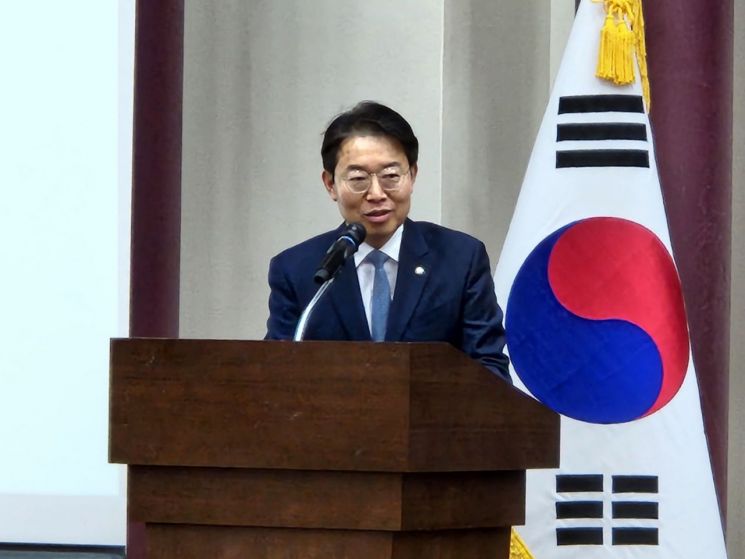 Choi Kisang, a lawmaker of the Democratic Party of Korea, is speaking at the 'National Assembly Policy Seminar on Transnational Crime and Virtual Assets' held on the 5th in Meeting Room 1 of the National Assembly Members' Office Building. Photo by Im Chunhan
Han Byungdo, floor leader of the Democratic Party of Korea, said, "Crimes involving virtual assets are on the rise with each passing year," adding, "They not only undermine market order but also lead to losses of citizens' assets, and there is a significant risk that they will erode the nation's tax base and financial credibility. We will spare no effort in our interest and support for institutional improvements and policy responses."
Democratic Party lawmaker Choi Kisang said, "Under the current legal system, there are no provisions related to virtual assets, so there is no framework for verifying the purpose of transactions or for reporting individual transaction information," adding, "This discussion, joined by academia, the legal profession, government officials, and the virtual asset industry, will serve as a meaningful forum where voices from the field and institutional considerations can come together."
Korea Customs Service Commissioner Lee Myeonggu said, "Virtual assets carry the potential for innovation and growth, but they also entail risks," adding, "The Korea Customs Service will establish a cooperative system with relevant agencies to eradicate transnational crimes using virtual assets and firmly safeguard the pillars of the economy."
© The Asia Business Daily(www.asiae.co.kr). All rights reserved.