Poor harvest and shipment delays drive prices sharply higher
Strawberry retail prices up 13% from a year earlier
Prices of strawberries and tangerines, the representative seasonal fruits of winter, are showing little sign of coming down. As the impact of last year's record-breaking heat waves and torrential rains is now being fully reflected in the market by delaying shipments and reducing production volumes, fruit prices have entered an emergency phase. At some supermarkets, a single pack is priced at around 20,000 won, rapidly increasing the burden of perceived prices for consumers.
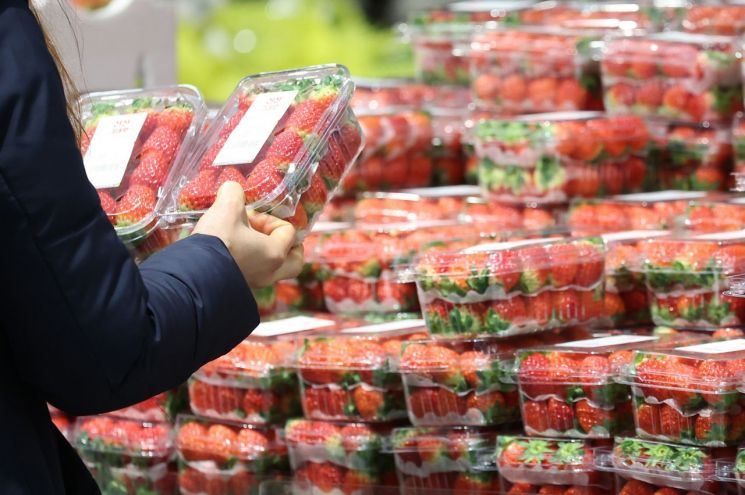
Strawberry prices remain sky-high... Expensive from the start of the season
According to the Seoul Agro-Fisheries & Food Corporation on the 4th, the average price of Seolhyang strawberries (extra grade, 2 kg) traded at Garak Market the previous day was 37,063 won, up 10.1% from the same period a year earlier. Kingsberry, a premium variety with large fruit (extra grade), recorded 50,000 won, surging 31.6% from a year earlier.
Retail prices are also on the rise. According to the Korea Agro-Fisheries & Food Trade Corporation (aT), as of the 2nd, the retail price of grade strawberries was 22,736 won per kg, 13.6% higher than a year ago. Last month's average price also remained 4% above the level of a year earlier.
Normally, strawberry prices tend to stabilize as shipments increase after November, but this year high prices have been maintained from the early part of the season. This is interpreted as being due to delayed shipments, which prevented initial supply from increasing sufficiently.
Impact of record heat waves... Shipment delays dealt the decisive blow
The main factor behind the price increase is cited as the record heat waves that continued through last summer. As the planting period for strawberry seedlings was pushed back due to the extreme heat, initial production volumes decreased, and this impact has carried over into the winter shipping season.
With shipments delayed and winter demand concentrated, prices appear to have come under natural upward pressure. Industry insiders believe that supply-demand imbalances are likely to continue and keep prices strong at least until February, when full-scale consumption peaks.
Tangerines also on the rise... Even prices of blemished fruit are climbing
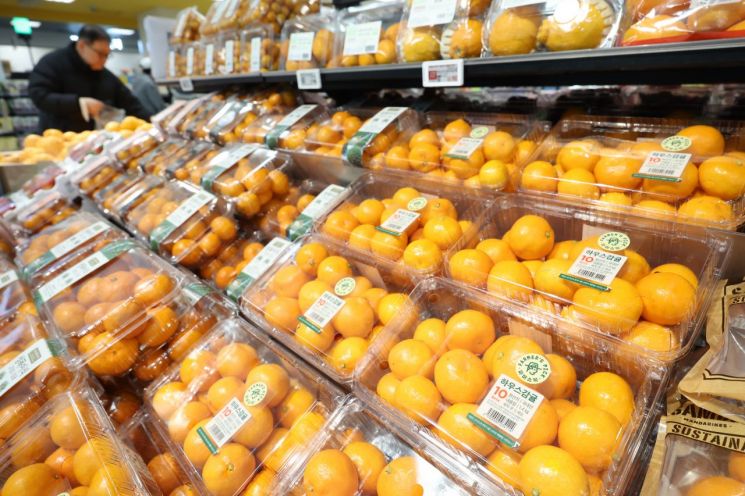
Tangerines are in a similar situation. On the 3rd at Garak Market, the price of greenhouse tangerines (extra grade, 3 kg) was 38,324 won, up 12.7% from the same period a year earlier. Overall production volume declined due to torrential rains and abnormal high temperatures in the fall, and the proportion of lower-grade fruit with reduced marketability increased, which also had an impact. As the supply of higher-grade tangerines with relatively better quality has become insufficient, a structure has formed in which the average price is pushed up.
In fact, lower-grade tangerines (3 kg) were traded at 15,912 won, jumping more than 50% compared with the recent seven-day average. As prices have risen even for low-quality tangerines classified as so-called "paji" (blemished or off-grade fruit), overall tangerine prices are being driven upward.
"Not a temporary phenomenon"... Climate risk becoming a constant
Experts point out that it is difficult to view this surge in fruit prices as merely a temporary phenomenon. As climate risks such as heat waves and torrential rains become a structural factor in agricultural production, there is a high possibility that sharp price spikes will recur.
There is also an assessment that, given the vulnerability of the domestic fruit production base to climate change, it will be difficult to resolve price instability solely through short-term increases in imports. Within the distribution industry, voices are growing that volatility in winter fruit prices is likely to remain high going forward, and that response strategies are needed across the entire production and distribution chain.
© The Asia Business Daily(www.asiae.co.kr). All rights reserved.