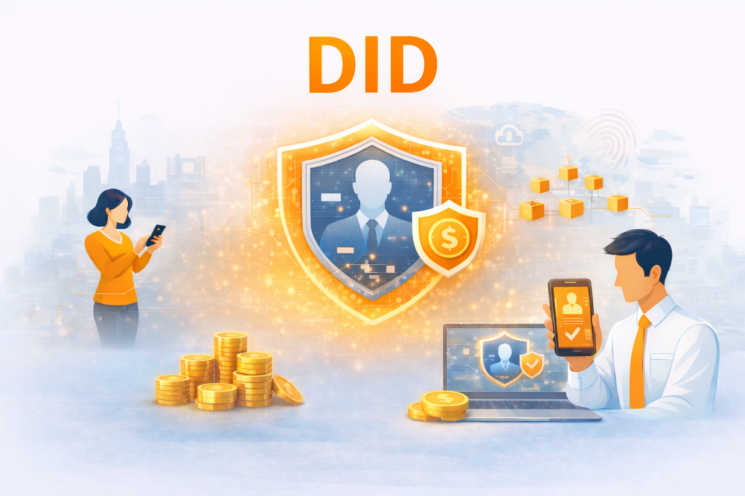
"Without digital identity verification, there can be no virtual asset trading."
The core of the "GENIUS Act," passed by the U.S. Congress last year, can be summarized this way. It aims to prevent market disruption and consumer damage by imposing stricter identity verification obligations on stablecoin issuers than before. The law is expected to take effect as early as the second half of this year.
Since the bill passed, global payment networks such as Visa and Mastercard have begun building related systems, and technologies for verifying identity are rapidly emerging as essential infrastructure in the IT and financial markets. The principle that "every transaction begins with digital identity verification" is solidifying as a global standard.
According to Citigroup, the global stablecoin market is projected to grow from 282 billion dollars (about 409 trillion won) last year to as much as 4 trillion dollars (about 5,810 trillion won) by 2030. As the market expands, competition over the accuracy and reliability of identity verification will inevitably intensify.
In Korea as well, as stablecoins move visibly into real-world payment and settlement, digital identity verification is being viewed not as an option but as a prerequisite for transactions. While the presidential office is reviewing measures to achieve KOSDAQ 3,000 by revitalizing the digital asset market, including stablecoins, the ruling party is also accelerating institutionalization by discussing a Basic Act on Digital Assets that covers stablecoins.
The spread of stablecoin-based everyday payments will popularize "digital wallets," and the number of wallet addresses is likely to surge accordingly. The problem is that as these addresses increase, so do the operational burdens of identity and ownership verification, transaction tracking, and responding to regulations in each country. Ultimately, the obligation of digital identity verification to confirm "who is transacting" is emerging as the starting point of stablecoin regulation.
The key is "proving who you are while disclosing only the minimum necessary personal information." Instead of submitting a full copy of an ID card to a bank, a structure is needed in which only the required credentials are selectively proven. The technology that meets this need is "Decentralized Identity (DID)."
The essence of DID is "decentralization." Rather than storing identity information on a central server, it is designed so that multiple parties can verify identity in a distributed manner. This avoids a structure where a single breach shakes the entire system, and reduces the risk of incidents and misuse by dispersing identity information.
An official at a commercial bank said, "The moment stablecoins start being used in earnest for payments, the biggest concern will be digital identity verification," adding, "If the number of wallets explodes without proper identity verification, it may become difficult not only to verify and track who is who but also to determine who is responsible."
In the United States, DID has already begun to be incorporated into the design of stablecoin services. As transactions increase and digital identity verification of traders becomes more important, the traditional model of aggregating and storing all personal information in one place is becoming riskier in terms of data breaches and operational burden.
For example, Verite, a joint project between U.S. fintech firm Circle and virtual asset exchange Coinbase, is cited as a case of proactively preparing for regulatory compliance. Based on DID, Verite satisfies identity verification requirements while leaving control over personal data with the user.
The structure is clear. Instead of submitting a full copy of an ID card every time, users present the credentials they possess only when necessary. Service providers do not need to store excessive amounts of users' personal data, and users can provide information only within the required scope.
In addition, U.S. blockchain company Blueprint last year conducted a pilot operation of the "Know Your Issuer (KYI)" project with its partners, a system that cryptographically verifies the identity of token issuers at the issuance stage and blocks fake stablecoins.
Global market research firm Mordor Intelligence forecasts that the DID market will grow from 7.4 billion dollars (about 11 trillion won) this year to 58.74 billion dollars (about 85 trillion won) by 2031. It also added that the acceleration of DID adoption in the financial sector will serve as a catalyst for market growth.
Korea is ahead in digital identity verification, to the point of actually operating mobile resident registration cards and mobile driver's licenses. As blockchain-based DID is applied to digital IDs issued by the government to citizens, the reliability of the technology is being verified through "nationwide real-world use."
From the perspective of monetary sovereignty as well, in a phase of stablecoin proliferation, a DID-based identity verification system that confirms "who is transacting" could become increasingly important. Mobile IDs, as identity verification tools validated within the institutional system, are seen as contributing to the spread of related infrastructure.
The company that provided the core technology for these mobile IDs is Raonsecure. Specifically, its DID platform "OmniOne Enterprise" and its mobile security solutions have been applied to the issuance systems for mobile resident registration cards and mobile driver's licenses. More than 6 million people have received mobile IDs built with Raonsecure's DID technology.
The key strength of Raonsecure is that it does not stop at DID as a standalone technology. By integrating DID with its FIDO-based multi-factor authentication (MFA) platform "OnePass" and its integrated account and access management platform "TouchEn WiseAccess," the company has designed "identity verification plus transaction security" as a single, continuous flow.
Globally, Raonsecure has been building its presence by serving on the board of the FIDO Alliance, which leads passkey and biometric authentication standards, alongside Google, Microsoft, Samsung Electronics, Amazon, Apple, and others. In Japan, the number of monthly active users (MAU) of OnePass is on the verge of surpassing 10 million.
Industry observers expect Raonsecure to play a key role in the domestic stablecoin market as well. This is because it can provide a one-stop solution from identity verification to transaction security by combining its DID technology, proven in the construction of mobile resident registration cards, with biometric authentication and security solutions.
The academic community has also made meaningful progress in this field. In December last year, a research team led by Yeom Heung-Yeol, an emeritus professor at Soonchunhyang University, worked with the U.S. Federal Bureau of Investigation (FBI) to establish an international standard for a Decentralized Identity Verification System (DIVS). This expansion of decentralized identity verification capabilities into international standards is expected to bolster monetary sovereignty amid the spread of stablecoins.
A security industry official said, "As the stablecoin market grows, providers that combine 'digital identity verification' with 'transaction security' will gain an advantage," adding, "Operational experience accumulated through the national mobile ID system and ongoing technological research will contribute as stablecoins expand into private-sector payment and settlement."
© The Asia Business Daily(www.asiae.co.kr). All rights reserved.