Spread of gift-giving culture ahead of Valentine's Day
Central Bank of Kenya: "Currency mutilation punishable by up to seven years in prison"
Nigeria and Ghana also strengthen "respect for currency"
As Valentine's Day approaches, the Central Bank of Kenya (CBK) has issued a stern warning over the practice of making so-called "money bouquets." It stated that acts that cause physical damage to banknotes constitute currency mutilation, which is considered a crime punishable by up to seven years in prison.
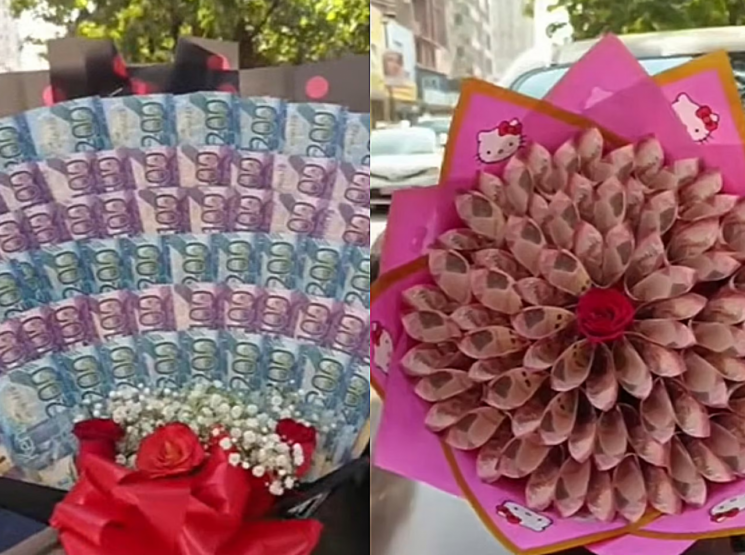 For special occasions like Valentine's Day, a practice has spread in Kenya of decorating cash into flower shapes and giving it as gifts. Kenya Television Network YouTube
On February 4, Yonhap News, citing BBC News and other outlets, reported that the Central Bank of Kenya warned in an official statement that "using glue on banknotes or fastening them with staplers or pins to make bouquets is an illegal act that damages the value of the banknotes." Although in Kenya it has become common to arrange cash into flower shapes and give it as gifts for special occasions such as Valentine's Day, this practice has now been put on hold. The bank stressed that "banknotes are the country's legal tender, and there is responsibility attached to how they are used." It particularly emphasized the need for strict management, noting that damaged banknotes can have a negative impact on public systems by causing recognition errors in ATMs and banknote counting machines.
However, the Central Bank of Kenya clarified that it is not banning the act of giving banknotes as gifts itself, and that it is acceptable to wrap or present banknotes in ways that do not damage them. This is seen as an attempt to recognize creative gifting practices as long as they do not undermine the original function of money. Following this measure, demand for fresh flower bouquets as an alternative to "money bouquets" has surged in Kenya. As Kenya is a leading global producer and exporter of cut flowers, there is growing sentiment among the government and citizens that "this measure will have a positive impact on the country's floriculture industry."
The crackdown on currency mutilation is not limited to Kenya. Recently, several African countries have been strengthening efforts to promote respect for their currencies. In Nigeria, for example, it is common practice to spray money into the air at weddings and celebratory events. However, after videos of such scenes spread on social media, the authorities labeled it "an act that fails to respect legal tender" and went so far as to arrest the individuals appearing in the footage. Ghana has taken similar steps. Ghanaian authorities recently issued a warning that "money cakes" - gifts made by folding multiple layers of banknotes into the shape of a cake, which have gained popularity on social media in recent years - can be regarded as currency mutilation.
In this way, many African countries increasingly regard money not as a mere object but as a symbol of national trust, and a clear trend is emerging toward applying strict standards to physical damage or artistic alteration of currency.
Unlike in Africa, South Korea strictly punishes only the mutilation of coins. Article 53 of the Bank of Korea Act stipulates that "no person shall, without the permission of the Bank of Korea, melt, pulverize, compress, or otherwise mutilate coins." Violations are punishable by imprisonment for up to one year or a fine of up to 10 million won. However, this provision applies only to coins, and there is no separate criminal penalty clause for the mutilation of banknotes.
The Bank of Korea and the Ministry of Justice do not have clear punitive provisions specifically targeting the mutilation of banknotes, but they do impose severe penalties for counterfeiting, altering, or obstructing the circulation of banknotes. Even so, as various gift items using banknotes (such as money bouquets and money cakes) continue to trend on social media, some argue that if cases of causing physical damage to banknotes increase, it will be necessary to establish legal standards in the future.
© The Asia Business Daily(www.asiae.co.kr). All rights reserved.