1.2207 Trillion Won Economic Impact from a Single Concert
Inbound Searches for Trips to Seoul Soar 155%
Gwanghwamun Accommodation Prices Jump 353% in One Month
"Bangtanomics" Surpassing Taylor Swift
"These days, a 'real' fan is someone who dresses like them, enjoys the same jjimjilbang scrubs they do, and tries the same makeup."
Sofia (30), who came from Mexico, finalized her trip to Seoul early in order to see BTS's comeback concert, which will be held on March 21 at Gwanghwamun Square in Seoul. For this trip, the thing she devoted the most effort to after securing a ticket was booking "K-experiences." Sofia said, "I spent 100 dollars (about 140,000 won) on a one-hour sesin scrub and 200 dollars (about 300,000 won) on idol makeup," adding, "I wanted to experience firsthand the culture of the city where BTS lives and breathes."
1.2 Trillion Won Economic Impact from a Single Concert... Spreading Across Downtown Commercial Districts
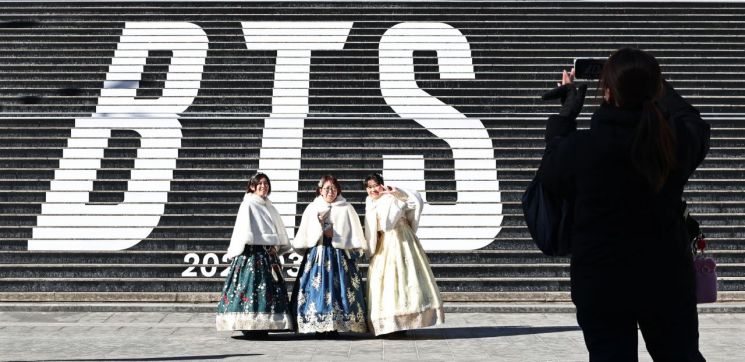 On the 22nd, Japanese tourists are taking commemorative photos on the steps of the Sejong Center for the Performing Arts in Jongno-gu, Seoul, with a promotional poster in the background announcing the comeback of the group BTS, returning as a full lineup this coming March after 3 years and 9 months. Yonhap News
With the comeback of BTS, who are leading the Korean Wave, Seoul’s downtown is transforming into a massive stage for "experiential consumption." Whereas large-scale concerts in the past mostly drove "viewing"-centered spending, the so-called "Bangtanomics (BTS + Economics)" phenomenon is now emerging, in which demand is spreading across the entire experiential industry, including beauty, fashion, and spas, and driving up prices. Some point out that certain fees have jumped severalfold, which could undermine the sustainability of inbound global tourism.
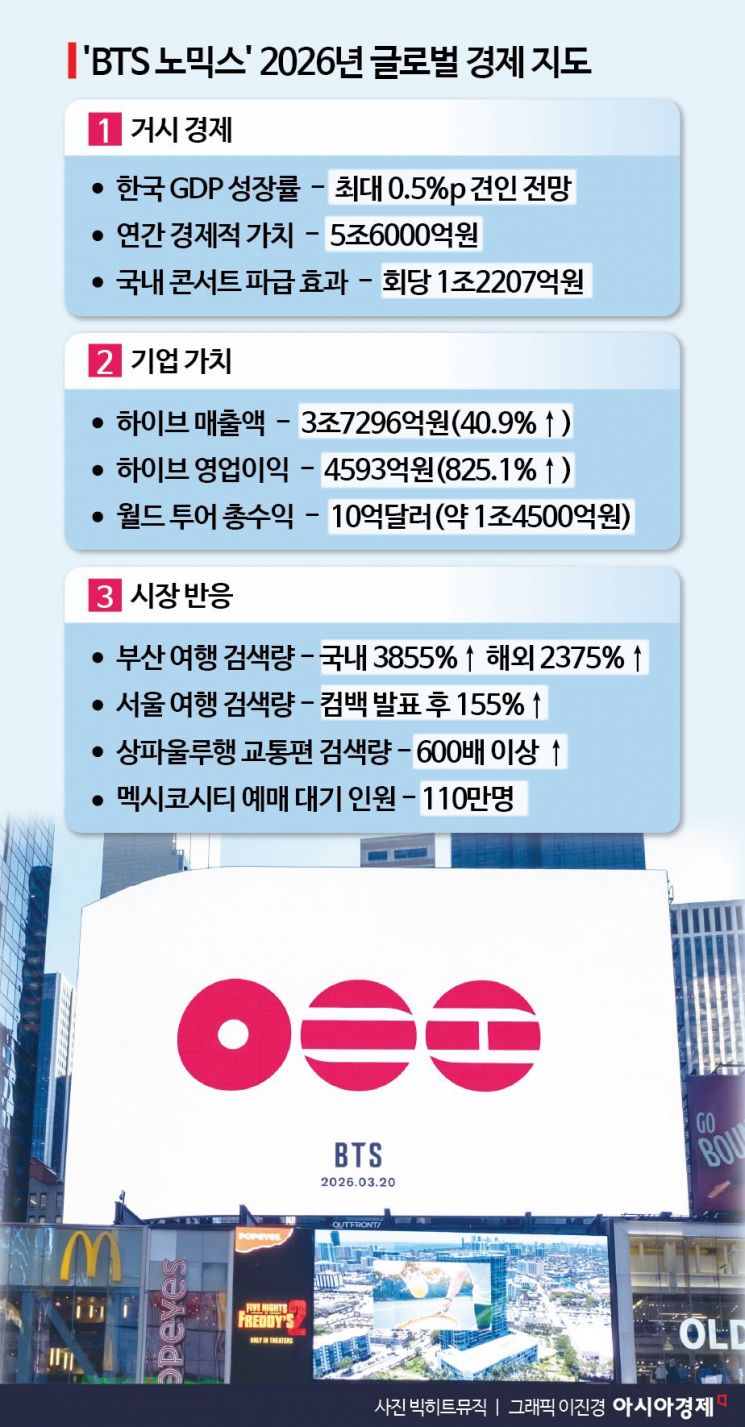
According to an analysis released on the 5th by the Korea Culture & Tourism Institute, the economic ripple effect of a single BTS concert held in Korea can reach up to 1.2207 trillion won. BTS will make a comeback next month with their fifth full-length album, "Arirang," their first in 3 years and 9 months. The Seoul Metropolitan Government expects that up to 200,000 people, including global fans, will flock to downtown Seoul on the day of the concert alone.
The commercial districts near Gwanghwamun are already entering a boom period. Restaurants in the Jongno and Gwanghwamun areas, which used to be relatively quiet on weekends, are preparing by increasing their orders for ingredients by 40-50% compared to usual and assigning additional staff. Choi (58), who runs a restaurant in the area, said, "It was unimaginable to receive advance reservations from Muslim or European tour groups on weekends," adding, "We are even preparing English ingredient labels because we are getting many requests for vegetarian menus or for excluding specific ingredients."
"150,000 won? I'm Curious About K-Temeili" Experiential Consumption Booming
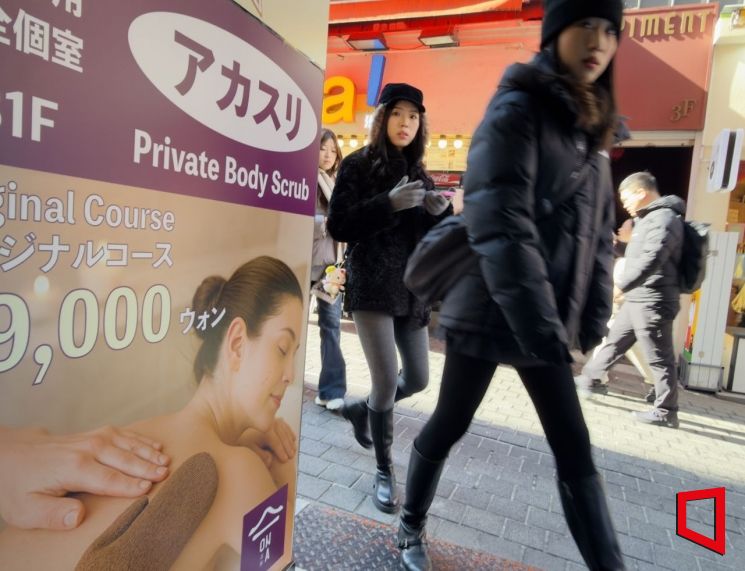 On the afternoon of the 3rd, foreign tourists were walking in front of a Sesin shop in Myeong-dong, Seoul. With BTS's comeback approaching, demand for experiential consumption such as K-Sesin has increased, enlivening the beauty and experiential businesses in the Myeong-dong area. Photo by Park Hosu
The core of this boom is analyzed as a shift in consumption toward "Korean-style experiences." A prime example is "K-sesin," which became widely known to the public after BTS member Jin showcased it on a variety show and it later appeared in the animated film "K-Pop Demon Hunters."
A visit on the 3rd to 10 sesin shops in the Myeong-dong, Hongdae, and Yongsan areas found that "80-90% of single-person sesin shop customers are foreigners." Some places have even begun charging foreigner-only rates. For foreigners, the fee for a sesin scrub is around 100 dollars (about 130,000-150,000 won) per hour, roughly 4-5 times the average "temeili" scrub price for Korean customers. Nevertheless, most reservations for weekends in March are already fully booked. A representative of a tourist hotel in Myeong-dong explained, "A significant portion of customers using high-end sesin packages priced in the 200,000-300,000 won range are foreigners."
The hanbok rental market near Gyeongbokgung Palace is also thriving. The number of visitors wearing hanbok when visiting the palace rose from about 150,000 in 2020 to 2.07 million last year, more than a 13-fold increase. This is also seen as a result of the Korean Wave. According to global travel and leisure platform Klook (KLOOK), package products priced in the 300,000 won range (over 200 dollars) that combine hanbok rental, professional snapshot photography, and idol makeup have become established as a "pilgrimage course," leading to fierce competition for March reservations.
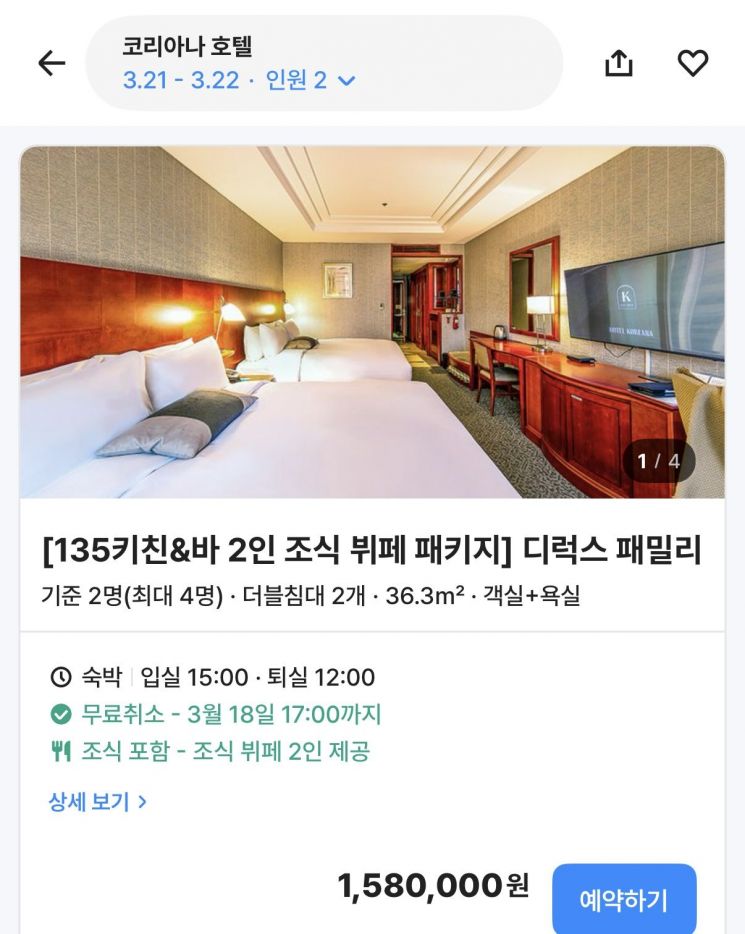 March 21 ? Room reservation screen of the Koreana Hotel near Gwanghwamun, Seoul. Ahead of BTS's comeback concert, lodging demand surged, causing the hotel's deluxe room rate to exceed 1.5 million won and city center accommodation prices to spike. Screenshot from Yeogieottae.
An overheating trend is also appearing in the accommodation market. According to global lodging platform Hotels.com, inbound searches for trips to Seoul increased by 155% in the 48 hours following the concert announcement on the 13th of last month, compared with the previous week.
Based on data compiled from major platforms such as Yeogieottae, Yanolja, and Airbnb, the room rate at Four Seasons Hotel Seoul near Gwanghwamun Square has surged to 1.75 million won for March 22, up sharply from 710,000 won at the end of this month. Nearby Koreana Hotel has also seen the price of its deluxe queen room, which is 349,000 won on the 21st of this month, soar to 1.58 million won on March 21, the day of the concert, an increase of about 353%. A representative from The Westin Josun Seoul said, "Room rates at nearby motels, which used to be in the 100,000 won range, have risen to as high as 700,000-800,000 won, creating a situation where prices are reversed with luxury hotels," adding, "At our hotel as well, the average room rate has risen by more than 20% compared with last year."
Conscious of controversy over the price surge, some accommodations have even blocked reservations altogether. On the lodging platform Yeogieottae, many tourist hotels in the Gwanghwamun area have set their prices as non-public for specific dates. A Yeogieottae representative said, "Uploading products and setting pricing policies are up to the accommodations, and the system allows them to hide prices."
Like "Swiftnomics"... Caution Against Excessive Price Surges
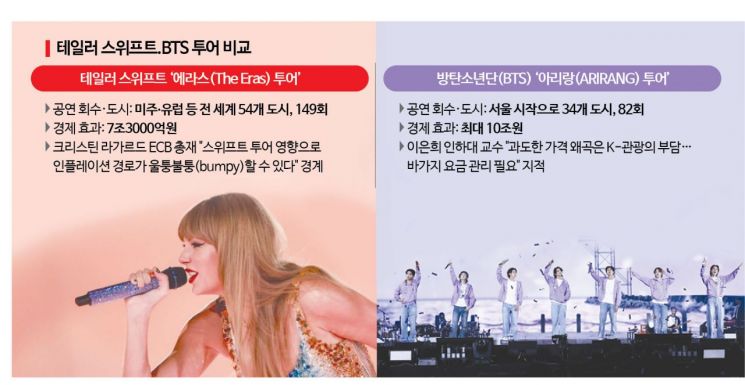
Overseas, too, observers are paying attention to the impact of BTS’s tour. On the 26th of last month, UK media outlet Clash Magazine, citing an analysis by City, University of London professor Graham Cookson, projected that the London concert in July alone would generate an economic impact of about 164 billion won. The total economic effect of this world tour is estimated to be up to 10 trillion won.
This phenomenon resembles the impact of American pop star Taylor Swift’s "Eras Tour," which injected economic vitality into every city where she performed. The "Eras Tour" triggered about 5 billion dollars (about 7.347 trillion won) in direct consumer spending across the United States, and the average revenue per available hotel room in the regions where Swift performed increased by about 7% compared with the previous year. Timothy Calkins, a professor at Northwestern University in the United States, even remarked in a recent interview with The Guardian that "the economic effect of the BTS world tour could surpass that of Taylor Swift’s tour."
However, there are also concerns that this boom could replicate the problems of "Swiftflation" (Swift + inflation), in which prices were excessively driven up. In fact, in July 2024, European Central Bank (ECB) President Christine Lagarde acknowledged the impact of Swift’s tour on the then-rising services prices in the eurozone and cautioned that "the inflation path will be bumpy."
Lee Eunhee, a professor in the Department of Consumer Science at Inha University, said, "It is positive that the powerful intellectual property (IP) of BTS is expanding beyond accommodation into experiential consumption, but excessive price distortions could become a burden on K-tourism in the long run," adding, "Along with short-term measures to curb price gouging, there needs to be serious consideration of a sustainable tourism model."
© The Asia Business Daily(www.asiae.co.kr). All rights reserved.