An artificial intelligence (AI) semiconductor technology with an inference speed 2.1 times faster than Nvidia’s has been developed in Korea. The core of this technology lies in improving inference speed by resolving bottlenecks in the graph preprocessing stage.
On February 5, KAIST announced that a research team led by Professor Jeong Myungsoo of the School of Electrical Engineering has developed an AI semiconductor technology called “AutoGNN,” which dramatically boosts the AI inference speed of graph neural network (GNN)-based models.
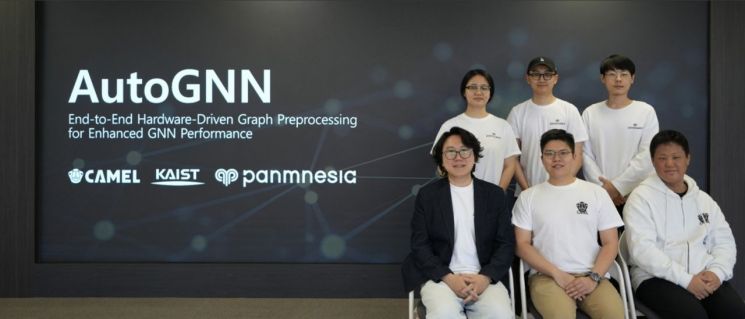 (From the bottom row, left) Professor Jeong Myungsoo, KAIST; PhD candidate Kang Seungkwan, Department of Electrical and Electronic Engineering; PhD candidate Lee Seungjun. (From the top row, left) Kwon Miryeong, Jang Junhyuk, Lee Sangwon of Panesia Co., Ltd. KAIST
Graph neural networks are a core AI technology that can rapidly analyze complex relationships between people, such as recommending YouTube videos or detecting financial fraud. Here, a graph does not mean a picture but refers to the network of connections between people. AutoGNN, developed by the research team, reduces latency compared to Nvidia, achieving a recommendation speed that is 2.1 times faster while also lowering power consumption, which is cited as a major strength.
During the development of AutoGNN, the research team discovered that graph preprocessing, which takes place before AI inference, acts as the main cause of service latency. Graph preprocessing accounts for 70% to 90% of the total computation time, but existing GPUs show limitations in operations that organize complex relational structures, resulting in bottlenecks.
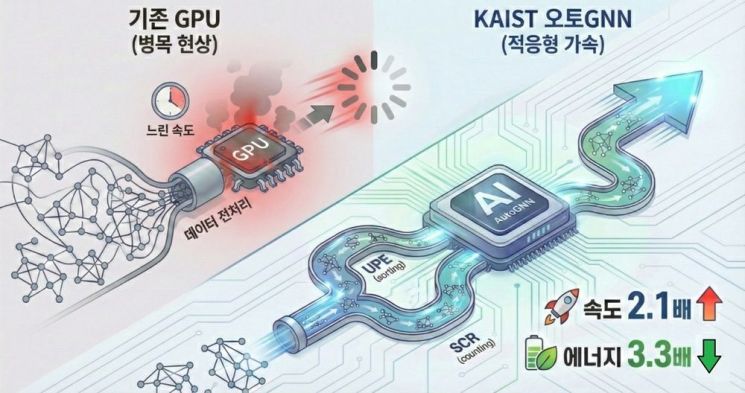
To address this, the research team designed an “adaptive AI accelerator” technology that changes the internal circuitry of the semiconductor in real time according to the structure of the input data. The semiconductor automatically finds and switches to the most efficient architecture based on how the data to be analyzed is interconnected.
The research team also implemented within the semiconductor a UPE module, which selectively extracts only the necessary data, and an SCR module, which rapidly organizes and aggregates that data. When the volume or form of the data changes, the optimal module configuration is automatically applied accordingly, enabling stable performance under any circumstances.
As a result, in performance evaluations, AutoGNN recorded a processing speed 2.1 times faster than Nvidia’s high-performance GPU (RTX 3090). It also delivered performance nine times faster than a general-purpose CPU. In addition, the research team emphasized that the technology achieves energy efficiency by reducing power consumption by a factor of 3.3.
This technology can be applied immediately to AI services that require complex relationship analysis and rapid response, such as recommendation systems and financial fraud detection.
By securing AI semiconductor technology that autonomously optimizes itself according to data structure, it is evaluated that it will be possible to simultaneously improve both the speed and energy efficiency of intelligent services that handle large-scale data in the future.
Professor Jeong said, “This study is meaningful in that it implements a flexible hardware system capable of effectively processing irregular data structures,” adding, “We expect AutoGNN to be utilized not only in recommendation systems but also in various AI fields that require real-time analysis, including finance and security.”
Meanwhile, this research was presented at the “IEEE International Symposium on High-Performance Computer Architecture (HPCA 2026),” an international conference on computer architecture recently held in Sydney, Australia.
© The Asia Business Daily(www.asiae.co.kr). All rights reserved.