Participation of Five International Organizations and Law Enforcement Agencies from 22 Countries
Making "Case-Centered" International Cooperation More Concrete and Systematic
The police are launching an operational meeting that will bring together law enforcement agencies from 22 countries around the world to jointly respond to transnational scam crimes. Following the crackdown on scam organizations in Cambodia, they plan to prepare countermeasures against the so-called "balloon effect," in which criminal organizations move their areas or countries of operation or reorganize their groups to evade investigations by the authorities.
The National Police Agency announced that it will hold the 2nd International Joint Operation Meeting for a Coordinated Response to Transnational Scam Crimes in Seoul on February 5 and 6. This is a joint operation led by the National Police Agency of the Republic of Korea to respond to transnational scams and human trafficking, and the operation has been named "Breaking Chains." The name reflects the determination to free victims from the chain of transnational crimes such as scam centers, human trafficking, and online fraud.
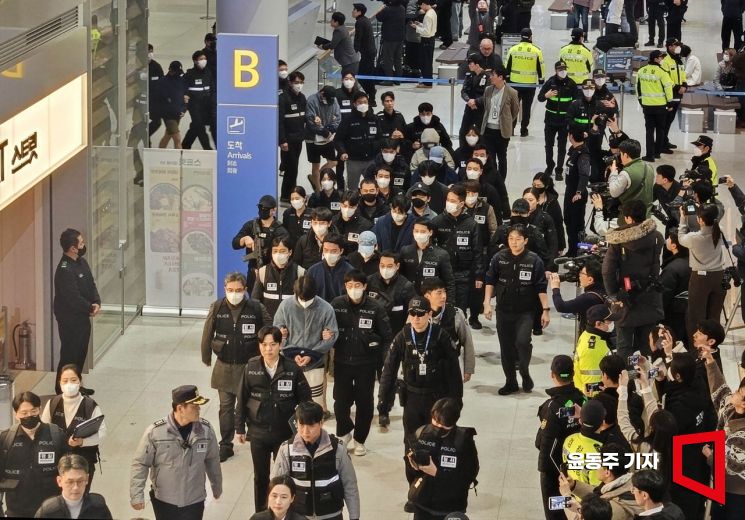 Seventy-three Korean members of a criminal organization arrested in Cambodia are being forcibly repatriated to South Korea. Yoon Dongju, reporter
Five international organizations, including Interpol, ASEANAPOL, AFRIPOL, the International Organization for Migration (IOM), and the United Nations Office on Drugs and Crime (UNODC), as well as law enforcement agencies from 22 countries including the United States, China, Japan, and Cambodia, will participate in the operational meeting. The international community will discuss practical response measures to organized crimes that cross borders.
This meeting is a follow-up to the 1st International Joint Operation Meeting held in November last year. The cases and investigative leads shared by each country at that time were combined with the whole-of-government response efforts centered on the Presidential Office's "Task Force for Special Response to Transnational Crimes," and led to actual joint crackdowns and arrests. Building on these achievements, this meeting will focus on expanding international cooperation into a more practical and sustainable framework.
At the first meeting, 75 investigative leads related to 26 scam crime cases were exchanged. As the National Police Agency and participating countries continued case-based cooperation, joint crackdowns on major scam organizations produced tangible results. Fifteen members of a Cambodia-based criminal organization that defrauded 2.5 billion won from 29 victims using a scam method that connected them with women were arrested and repatriated, and one ringleader of a Cambodia- and Thailand-based human trafficking organization, identified as the person who lured the victim of a murder case involving a South Korean national in Cambodia overseas, was arrested. In addition, joint crackdowns were carried out on five other scam crime cases based in countries such as Vietnam and China, resulting in the arrest of 31 suspects, of whom 15 were repatriated to South Korea. Through the first meeting, the effectiveness of "case-centered" international cooperation was demonstrated.
 National Police Agency, National Investigation Headquarters, Seodaemun-gu, Seoul. Reporter Kang Jinhyung
The same mode of cooperation will continue at the second meeting. Participating countries will share necessary information focusing on pre-selected cases and coordinate cooperation measures that can lead to joint crackdowns and the rescue of victims. In particular, 13 countries are scheduled to share 45 cases and 80 key leads through bilateral and multilateral coordination meetings.
One agenda item drawing particular attention is the "balloon effect," in which some criminal organizations move their areas of operation or reorganize their groups to evade crackdowns after international cooperation is strengthened. The South Korean government has emphasized the need for border control measures that can block criminal organizations in the phase where they flee across borders or relocate their bases. The National Police Agency has previously carried out joint operations in major border regions of Southeast Asia in cooperation with Interpol, Vietnam, and Cambodia.
At this meeting, the National Police Agency plans to share the achievements of tracking and blocking the movement routes of criminal organizations through these operations and to broaden the consensus on border management methods that can block criminal organizations before they flee and spread further. Through this, the agency aims to develop an international cooperation model that not only prevents joint crackdowns from being one-off events, but also enables the joint management of criminal organizations from their movement to their re-expansion.
Park Sungjoo, Commissioner General of the National Investigation Headquarters of the National Police Agency, said, "Because transnational scam crimes are interconnected crimes that cross borders, our response must also be interconnected across borders," adding, "We expect this meeting to serve as a turning point for expanding the effectiveness of international cooperation and building a more systematic and sustainable response framework."
© The Asia Business Daily(www.asiae.co.kr). All rights reserved.


















