Special parliamentary committee to operate for one month
Bill expected to pass by early next month
The ruling and opposition parties have agreed to form a special committee in the National Assembly to handle the "Special Act on Managing Strategic Investment between Korea and the United States" (hereinafter the U.S. Investment Special Act).
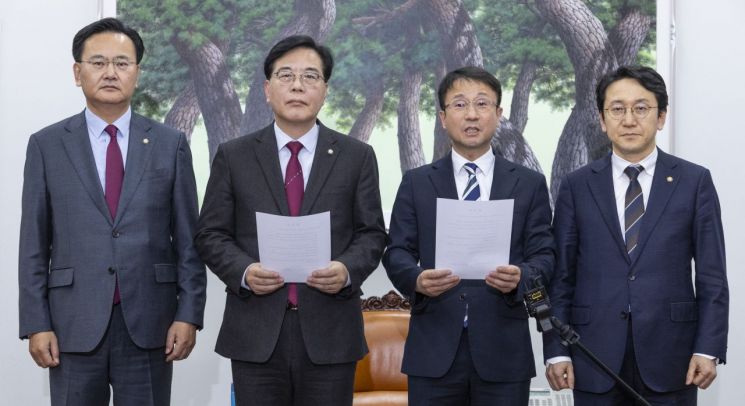 On the 4th at the National Assembly, the ruling and opposition floor leaders signed the agreement and issued a joint statement after agreeing to form a special committee on the U.S. Investment Special Act. From left in the photo: Yoo Sangbeom, Senior Deputy Floor Leader of the People Power Party; Song Eonseok, Floor Leader of the People Power Party; Han Byungdo, Floor Leader of the Democratic Party of Korea; Chun Junho, Senior Deputy Floor Leader of the Democratic Party of Korea. Provided by Yonhap News
Han Byungdo, Floor Leader of the Democratic Party, and Song Eonseok, Floor Leader of the People Power Party, told reporters that they reached this agreement during a meeting at the National Assembly on the 4th.
The U.S. Investment Special Act was proposed in November last year, following the signing of a memorandum of understanding (MOU) on tariff agreements between Korea and the United States. The bill includes provisions such as the establishment of an investment fund to expand investment in the United States. As U.S. President Donald Trump has mentioned the possibility of raising tariffs, citing the Korean National Assembly's "failure to legislate," the agreement between the ruling and opposition parties to create a special committee is seen as an effort to accelerate the review of the bill.
The special committee will operate for one month and conduct an intensive review of the bill. Accordingly, the U.S. Investment Special Act is expected to complete the committee's approval process by early next month at the latest.
The special committee will consist of 16 members in total, and the chair will be from the People Power Party. The committee will be composed of 8 members from the Democratic Party, 7 from the People Power Party, and 1 from a non-negotiating group. It was also agreed that at least one member each from the Political Affairs Committee, the Strategy and Finance Committee, and the Trade, Industry, Energy, SMEs and Startups Committee will be included.
The ruling and opposition parties plan to pass a resolution to form the special committee at the plenary session of the National Assembly on the 9th, which is scheduled in line with the government questioning session.
Until now, the People Power Party had taken a cautious stance on giving priority to the special act, arguing that the MOU on the tariff agreement required ratification and approval by the National Assembly. However, during this round of negotiations, it was decided that the ratification and approval issue would not be made a point of contention at the stage of discussions within the special committee.
Explaining the background to this change in stance, Floor Leader Song said, "Our basic position that ratification is necessary remains the same, but there are practical constraints," adding, "We have concluded that, in terms of the national interest, it is urgent to prioritize handling the bill, which is a pending issue."
Meanwhile, the ruling and opposition parties have agreed to convene a plenary session of the National Assembly on the 12th to pass non-controversial bills that have been mutually agreed upon. As a result, the so-called judicial reform bills promoted by the Democratic Party, including those related to the crime of legal distortion, are not expected to be included on the agenda of this plenary session.
Floor Leader Han said, "Our basic stance of handling reform and livelihood-related bills together during the February session of the National Assembly remains unchanged," adding, "We will continue to persuade the opposition parties on the reform bills going forward."
© The Asia Business Daily(www.asiae.co.kr). All rights reserved.