Onion wholesale prices down 27.6% year-on-year
Exports promoted as part of market isolation efforts
Up to 40% discount support to boost consumption
The government has decided to export reserved onions to Vietnam, Taiwan, and other countries to stabilize onion supply and demand. As onion prices continue to fall, the government is isolating the onions it purchased and stockpiled from the domestic market. To boost onion consumption, it will also provide discounts of up to 40%.
The Ministry of Agriculture, Food and Rural Affairs announced on the 4th that it will implement these preemptive supply and demand management measures to help onion wholesale prices recover and stabilize supply.
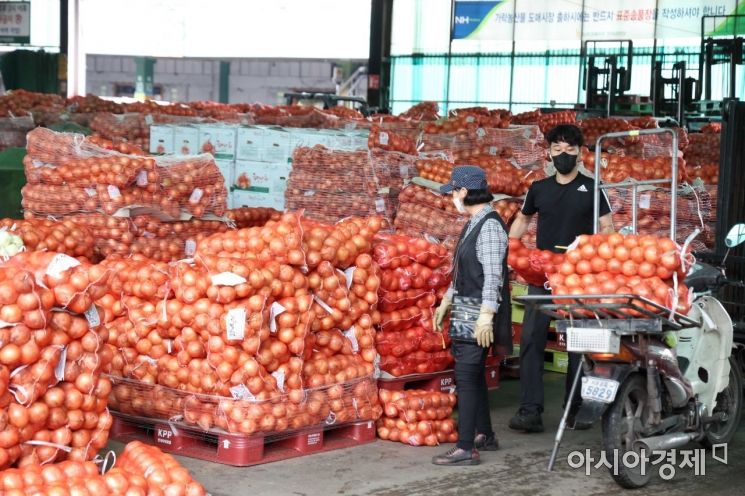
Normally, the wholesale price of stored onions tends to rise between January and March, before the harvest of new onions. However, the stock of 2025 stored onions, including government reserves, is about 8.7% higher than the previous year. Due to a combination of factors, including declining demand and the shipment of onions with poor quality, the late-January wholesale price (for standard products) stood at 1,022 won, which is 27.6% lower than a year earlier and 23.3% lower than the average of previous years.
The ministry judged that if the current wholesale price level is maintained through February and March, it could affect field transactions at production sites (bulk field purchases) and the supply and demand of new onions, making short-term supply and demand management measures necessary. As an initial step, the government plans to export 15,000 tons out of the 25,000 tons of onions it purchased and stockpiled, to Vietnam, Taiwan, Japan, Malaysia, and other destinations as part of its market isolation efforts. The remaining 9,600 tons will be used only in a limited way, and only if there is a sudden supply and demand disruption, such as a sharp price surge after new onions begin shipping in late March.
In addition, to promote onion consumption, the ministry will provide discount support of up to 40% at large and small supermarkets and traditional markets through the 16th of this month. Next month, it plans to carry out additional promotions and discount programs for domestically produced onions in cooperation with NongHyup Agribusiness Group and the onion checkoff fund.
The ministry also plans to strengthen quality sorting for onions listed on wholesale markets. To minimize indiscriminate shipments of onions that are poorly stored or have low marketability, it will reduce factors that drive down prices in wholesale markets through distribution agreements among NongHyup and producer organizations. Furthermore, until early-harvest onions start shipping in March, it will reinforce cooperation with relevant ministries, including the Korea Customs Service and the Ministry of Food and Drug Safety, to strictly control illegal customs clearance and residual pesticide inspections of imported onions.
Hong Inki, Director General for Distribution and Consumer Policy at the Ministry of Agriculture, Food and Rural Affairs, said, "This onion supply and demand management measure goes beyond a short-term response to prices and has been implemented as a preemptive step to ensure overall supply and demand stability for onions this year," adding, "Going forward, the government will closely monitor conditions in production areas and markets not only when wholesale prices rise but also when they fall, and will take necessary actions in a timely manner so that producers do not face difficulties."
© The Asia Business Daily(www.asiae.co.kr). All rights reserved.