Malaysia to Toughen Punishment for Borrowed-Name Accounts and Enable Immediate Freezing
Two Countries to Build a Cooperation System by Combining Their Crime Response Models
The Korean police are joining hands with the Government of Malaysia to strengthen cooperation in responding to transnational crime.
On the 4th, at the National Police Agency headquarters in Seodaemun-gu, Seoul, Acting Commissioner General of the National Police Agency Yu Jaesung held a chiefs-of-police meeting with Mohd Khalid bin Ismail, Inspector-General of Police of Malaysia, and signed the "Memorandum of Understanding on Police Cooperation for Combating Transnational Crime between the National Police Agency and the Government of Malaysia." The police emphasized that this cooperation is highly significant in that it explicitly defines the specific scope of joint efforts against transnational crimes such as scam (fraud) compounds based in Southeast Asia, including: rapid information sharing, the conduct of joint operations, and the arrest and repatriation of fugitives.
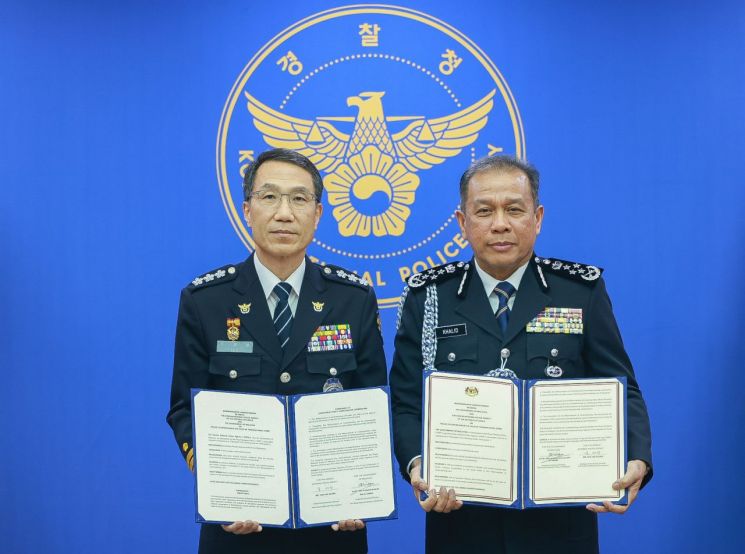 Yoo Jaesung, Acting Commissioner General of the National Police Agency, and Mohd Khalid bin Ismail, Inspector?General of Police of Malaysia, pose for a commemorative photo after signing the Memorandum of Understanding (MOU) on security cooperation to counter transnational crime between the National Police Agency and the Government of Malaysia at the agency’s headquarters in Seodaemun?gu, Seoul, on the 4th. Photo by National Police Agency
In particular, the heads of the two national police agencies shared the view that online fraud damage has recently hit an all-time high and is emerging as a national threat, and that it is inevitable to establish a cross-border cooperation framework among police agencies in order to eradicate fraud crimes. Last year, losses from voice phishing in Korea amounted to about 1 trillion won, while losses from online and financial fraud in Malaysia totaled 277 million ringgit (about 830 billion won).
On this day, Acting Commissioner General Yu introduced Korea's pan-government response measures, including the establishment of the "Special Task Force for Transnational Crime Response," as well as the activities of the "Integrated Response Unit for Telecommunication and Financial Fraud." The Malaysian side shared the activities of the "National Scam Response Center (NSRC)," launched in 2022, and examples of legal revisions that strengthened penalties for members of scam organizations.
Malaysia has revised its Penal Code and Criminal Procedure Code in 2024 to strengthen criminal penalties for those who lend bank accounts for use as so-called "borrowed-name accounts," and to enable immediate freezing of accounts even without a warrant.
The two countries agreed to combine Malaysia's response model with Korea's operational methods for the Integrated Response Unit for Telecommunication and Financial Fraud in order to eradicate transnational online fraud crimes. In particular, they agreed to share regulatory cases on borrowed-name accounts, which are a key tool of fraud crimes, and to actively cooperate in information sharing, joint operations, and the freezing and recovery of criminal proceeds, in order to block the "balloon effect" in which crime bases shift to neighboring countries.
Meanwhile, Acting Commissioner General Yu formally requested that the Malaysian side participate in the "International Cooperation Council," which was launched under the leadership of the National Police Agency. Taking the International Chiefs of Police Conference hosted in October last year as a starting point, the National Police Agency launched the "International Cooperation Council" together with participating countries and is expanding a multilateral cooperation network for joint responses to scam crimes.
© The Asia Business Daily(www.asiae.co.kr). All rights reserved.

















