Rising sea temperatures shrink fish size as exports grow
Perceived supply falls despite higher production
Mackerel gets pricier while salmon gains popularity
The price of mackerel, often called the "national fish," has been posting double-digit growth for nearly a year.
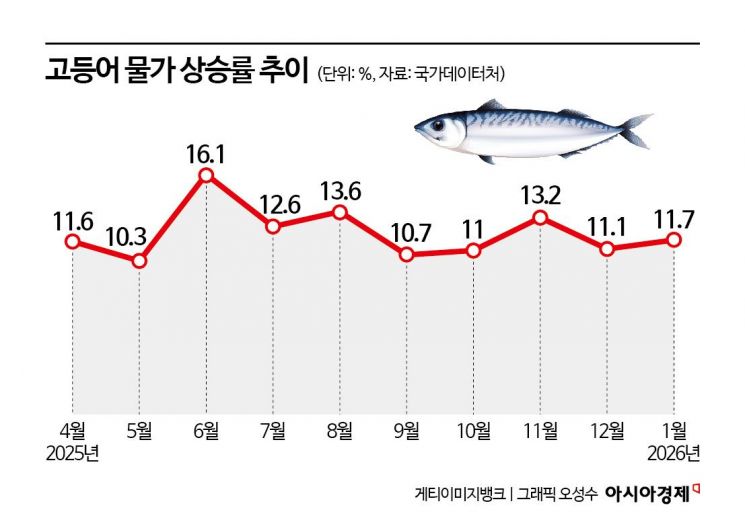
According to the National Statistics Portal on the 7th, the price of mackerel last month rose 11.7% year-on-year. Mackerel prices jumped 11.6% in April last year and then continued to show double-digit growth every month through the end of the year. On an annual basis last year, the price of mackerel rose 10.3% compared to the previous year.
Statistics released by the Korea Agro-Fisheries & Food Trade Corporation show that the annual average price of mackerel (one fish, domestically produced and salted) has been steadily rising in recent years. The price of mackerel increased from 3,625 won in 2022 to 4,299 won in 2023, 5,369 won in 2024, and then jumped to 7,030 won last year. This means the price has nearly doubled in three years. The average price for January to February this year also remained high at 7,158 won.
In contrast, domestic mackerel production has increased. According to the Ministry of Oceans and Fisheries, mackerel production rose from 125,135 tons in 2024 to 208,259 tons last year.
Industry insiders cite changes in mackerel "size" as one of the causes of price instability. They explain that, due to factors such as rising sea temperatures, the supply of medium-to-large mackerel weighing 300 grams or more, which consumers prefer, has been shrinking and becoming increasingly scarce in fishing grounds. In addition, rising exports are also analyzed to have pushed up mackerel prices. Mackerel export volume surged from 111,117 tons in 2023 to 143,920 tons last year. This is seen as the result of a sharp decline in mackerel catches in Europe due to catch quota restrictions.
European countries, including the International Council for the Exploration of the Sea, have moved to reduce catch volumes in order to protect mackerel stocks. As a result, the import unit price of frozen Norwegian mackerel, which accounts for most of the imported mackerel coming into Korea, rose to 3.3 dollars per kilogram as of November last year, up 27% from a year earlier. On top of this, the rise in the won-dollar exchange rate further pushed up import costs. These pressures are being reflected in consumer prices. As of the 3rd, the price of imported (salted) mackerel stood at 10,575 won, up 12.2% from 9,426 won a month earlier.
The strong mackerel price trend shows signs of becoming prolonged. Norway plans to cut its mackerel catch quota this year by about 52%, from 165,000 tons last year to 79,000 tons. A distribution industry official said, "Mackerel is an item whose price is difficult to judge based solely on production volume," adding, "There is a high possibility that price instability will recur as climate change, supply-and-demand conditions, and shifts in consumption patterns all intersect."
© The Asia Business Daily(www.asiae.co.kr). All rights reserved.


















