Every material possesses a unique "light fingerprint," much like how each person has a distinct fingerprint. Spectroscopy, which interprets these fingerprints, is referred to as the "eyes of science" for its ability to identify substances without direct contact. However, until now, the process has heavily relied on the expertise of specialists, which has also limited its range of applications. With the development of artificial intelligence (AI) technology that enables real-time, automated spectral analysis, the scope of potential uses is expected to expand significantly.
On February 3, KAIST announced that Professor Park Sanghoo’s research team from the Department of Nuclear and Quantum Engineering has developed an "AI-based deep spectral analysis technology." This technology allows for the real-time and automatic interpretation of various spectral data using AI.
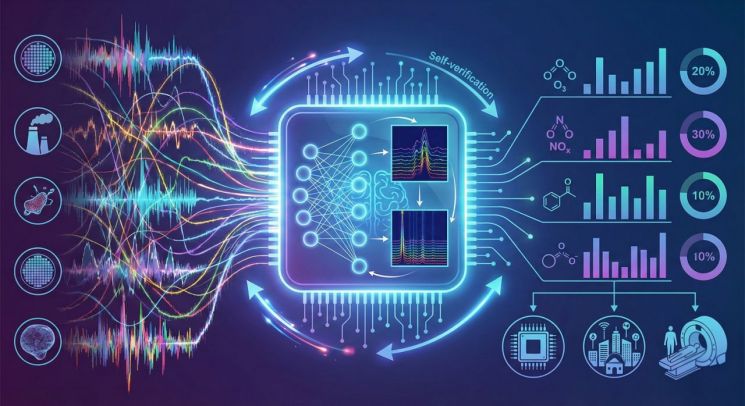
A spectrum is a graph that displays the light emitted or absorbed by a material, spread out like a rainbow. Conventional spectral analysis required manually interpreting signals identified as numbers within the spectrum by comparing them one by one with known reference data.
In contrast, the research team enabled AI to recognize the entire spectrum as a single "image" and learn its patterns. As a result, even when the data contained noise or some parts were missing, the AI accurately identified material information, much like recognizing objects in a photograph. Furthermore, the AI independently verified whether its predictions were scientifically valid, thereby increasing the reliability of the analysis.
The technology was also validated using "absorption spectroscopy data," a method widely used in atmospheric and plasma chemistry. During validation, the technology accurately predicted the concentrations of eight different chemical substances, including ozone and nitrogen oxides, even amidst complex, overlapping signals. Not only was its accuracy higher than that of traditional manual analysis, but it also maintained stable performance in environments with lower data quality.
This level of performance is expected to mark a turning point, transforming the vast amounts of spectral data-previously discarded due to analysis difficulties-into "immediately usable information."
The research team believes the technology has high potential for diverse applications in advanced industries, such as improving semiconductor plasma process yields, stable control of fusion plasma, smart city environmental monitoring, and non-contact disease diagnosis.
Professor Park stated, "This technology is significant because it dramatically lowers the entry barrier for spectral data analysis, which until now depended solely on expert experience. The technology developed by our team can be immediately applied across industries that require spectrum analysis, including environmental monitoring, healthcare, and plasma diagnostics."
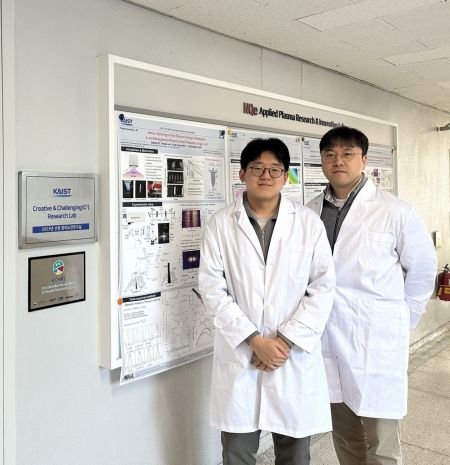
Meanwhile, doctoral candidates Kim Jongchan and Heo Sungchul from the Department of Nuclear and Quantum Engineering participated as co-first authors in this research. The results of the study (paper) were published online on January 12 in the international journal Sensors and Actuators B: Chemical, which specializes in measurement and analytical chemistry.
© The Asia Business Daily(www.asiae.co.kr). All rights reserved.


















