LIG Nex1 and Korean Air to Meet Minister Fuhr on February 4
Highlighting the Use of Canadian Jets as Electronic Warfare Aircraft Platforms
South Korean defense companies are presenting a surprise proposal in their bid for Canada’s submarine project (CPSP). Representatives from HD Hyundai Heavy Industries, LIG Nex1, and the defense division of Korean Air are scheduled to meet with Stephen Fuhr, Canada’s Minister of State, who is currently visiting South Korea. During this meeting, they plan to propose the establishment of a local torpedo factory if Canada decides to adopt Korean submarines.
According to government officials on February 2, Minister Fuhr will meet with HD Hyundai Heavy Industries, LIG Nex1, and Korean Air on February 4, before visiting the Korea Institute for Defense Analyses. At this meeting, LIG Nex1 will propose the establishment of a local production facility for submarine-launched torpedoes. LIG Nex1 manufactures the domestically produced heavyweight torpedo “Baeksangeo,” lightweight torpedo “Cheongsangeo,” and long-range anti-submarine torpedo “Hong Sangeo.” These torpedoes are installed on Jangbogo-II class (1,800-ton) and Jangbogo-III class (3,000-ton) submarines and are considered key weapons for attacking enemy ships and submarines.
If awarded the CPSP contract, LIG Nex1 plans to supply core naval weapon systems, including the conformal array sonar, which determines a submarine’s underwater surveillance capability, and domestically produced heavyweight torpedoes. Last year, LIG Nex1 partnered with Canadian underwater acoustic detection company GeoSpectrum Technologies to jointly develop sonar systems.
The companies will also highlight their existing cooperative relationships. LIG Nex1 is expected to emphasize that it uses the Canadian business jet Bombardier G6500 as the airframe for its electronic warfare aircraft. Electronic warfare aircraft are strategic weapons that neutralize enemy anti-aircraft radar using electronic equipment and jamming devices. LIG Nex1, in consortium with Korean Air, successfully secured an electronic warfare aircraft contract last year. They plan to acquire and modify four G6500 aircraft. Korea Aerospace Industries (KAI) is also participating, emphasizing that it uses Canadian jets in the development of the “Korean Maritime Patrol Aircraft.”
Earlier on the morning of February 2, Minister Fuhr and his delegation visited Hanwha Ocean’s Geoje Shipyard, Hanwha Aerospace, and Hyundai Rotem, as well as other defense companies located in Changwon, Gyeongsangnam-do. Since taking office, U.S. President Donald Trump has provoked Canada by suggesting it be incorporated as the 51st state of the United States. Prime Minister Carney, who campaigned on an anti-Trump platform, overturned a substantial deficit against the Conservative Party to win the general election at the end of April last year. Since then, the Canadian Army has shown interest in the K239 Chunmoo multiple rocket launcher, which is similar to the U.S. HIMARS (High Mobility Artillery Rocket System), and the K9 self-propelled howitzer.
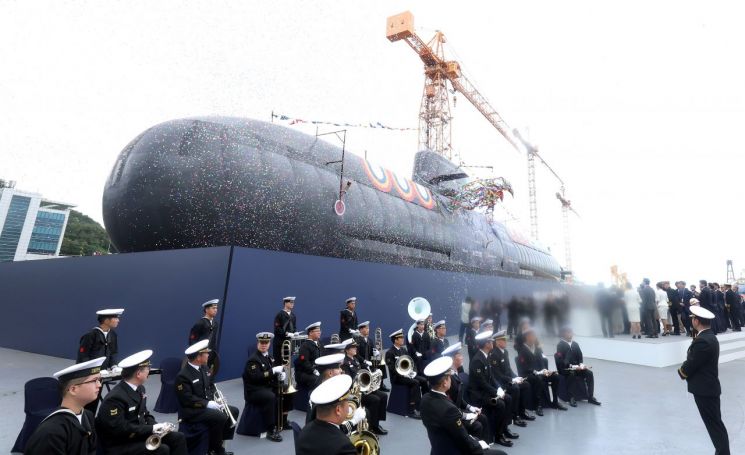
In the afternoon, the delegation is scheduled to visit the Jinhae Naval Base Command in Jinhae, Gyeongsangnam-do, to see the Dosan Ahn Changho-class (KSS-III) submarine, which was designed and built using Korean technology. They will also tour related facilities, including the submarine integrated tactical center and control simulator. On February 5, after meeting with government officials such as Minister Ahn Kyubaek, Defense Acquisition Program Administration Commissioner Lee Yongcheol, Public Procurement Service Commissioner Baek Seungbo, and Chief of Naval Operations Kang Donggil, the delegation is scheduled to depart on February 6.
Some voices have expressed caution regarding Canada’s excessive demands. The Canadian side is reportedly requesting “reciprocal benefits,” such as the establishment of a Hyundai Motor factory or military aircraft cooperation with Korean Air, in exchange for the submarine procurement project.
Choi Kiil, professor of military studies at Sangji University, commented, “Last year’s defense exports (15.2 billion dollars) accounted for only 0.02% of Korea’s total exports (700 billion dollars). Although the Canadian submarine project is large in scale (60 trillion won), we need to carefully consider whether giving up core national industries such as automobile or aviation factories is truly in the national interest.”
© The Asia Business Daily(www.asiae.co.kr). All rights reserved.
![Clutching a Stolen Dior Bag, Saying "I Hate Being Poor but Real"... The Grotesque Con of a "Human Knockoff" [Slate]](https://cwcontent.asiae.co.kr/asiaresize/183/2026021902243444107_1771435474.jpg)
















