Minister Kim Meets Lutnick for Over an Hour
"Wide-Ranging Discussions" Held
Emphasizes Steadfast Commitment to U.S. Investment
Talks Could Shift to Negotiations If Additional Measures Are Demanded Tomorrow
Kim Jeong-Kwan, Minister of Trade, Industry and Energy, who was urgently dispatched to prevent the reimposition of US tariffs, held a meeting with Howard Lutnick, US Secretary of Commerce, but was unable to reach an immediate agreement. The next day's meeting is expected to focus on resolving the tariff dispute. However, there are observations that if the United States demands a specific implementation timeline or additional measures, the explanatory talks could quickly shift into de facto negotiations.
On the afternoon of the 29th (local time), Minister Kim visited the Department of Commerce building in Washington, D.C., and met with Secretary Lutnick. He left the building after about an hour and 20 minutes. Speaking to the press, he said, "We had a broad discussion," and added, "We agreed to meet again tomorrow morning for further talks." When asked about the possibility of blocking the tariff increase, he stated, "At this stage, it is not a situation where I can say it has been blocked or not." Regarding whether the publication schedule in the official gazette was discussed, he replied, "That level of discussion did not take place."
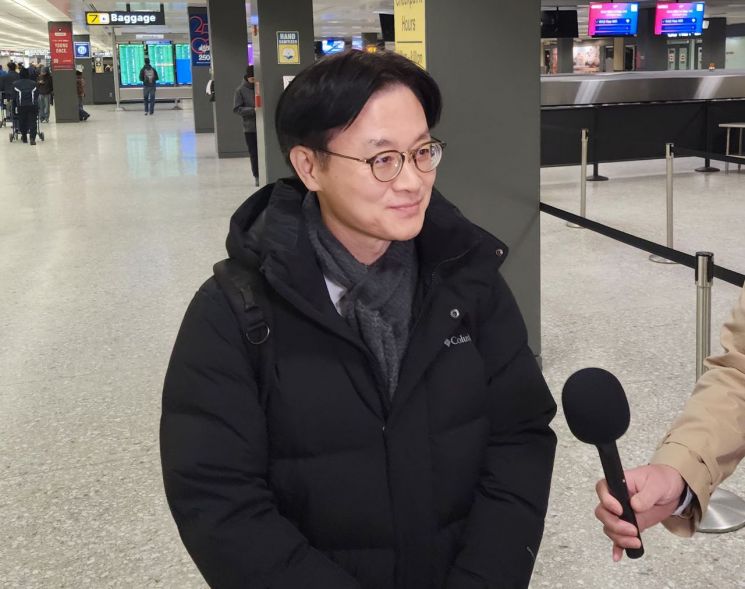 Kim Jeong-Kwan, Minister of Trade, Industry and Energy, visited the United States through Dallas International Airport near Washington DC on the night of the 28th (local time) to respond to the 'Trump tariffs' and is being interviewed by the Korean press. Photo by Yonhap News.
During this meeting, Minister Kim explained that the Korean government is firmly committed to implementing US investment agreements, including the Special Act on US Investment, and sought to persuade the US side not to reimpose tariffs. Upon his arrival in Washington, D.C., Minister Kim had previously stated, "I will make sure to clarify to the US side that there is no misunderstanding regarding the progress of domestic legislation, and clearly convey that our policy of cooperation and investment in the US remains unchanged."
The US pressure to reimpose tariffs is seen as an attempt to confirm how Korea intends to manage its US investment commitments. Although the lack of a Special Act on US Investment is the official issue, many believe that the real US concern lies more with the speed and reliability of implementation than with the legal provisions themselves. The fact that the US raised the possibility of tariff increases, even though the original agreement did not specify a deadline for enacting the special law, is interpreted as an effort to increase pressure and prompt Korea to act more quickly, rather than to break the agreement.
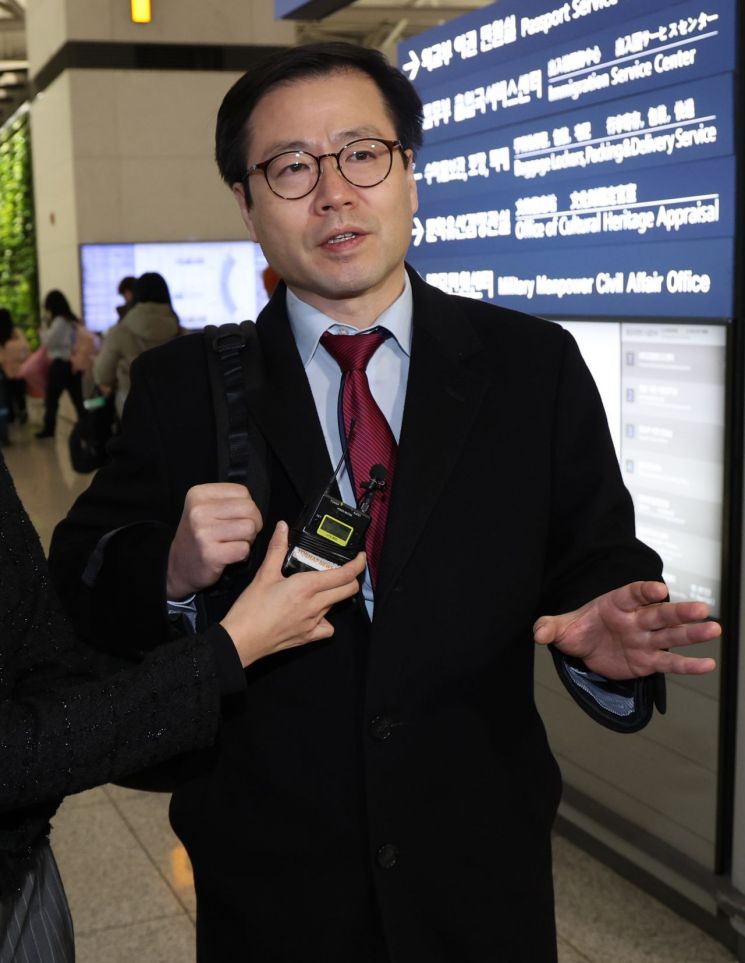 Yeo Hangoo, Director-General for Trade Negotiations, who is visiting the United States to discuss trade issues, is answering questions from reporters as he departs through Terminal 1 of Incheon International Airport on the 29th. Photo by Yonhap News.
However, there are discussions within and outside the government that the scope of negotiations may not be limited to tariffs alone. If the US uses tariffs as leverage to address not only the timeline for implementing US investment, but also digital regulations, platform policies, and the domestic regulatory environment for US companies, the talks could escalate beyond a simple explanation of tariffs.
In fact, the US has long approached Korea's data regulations, platform policies, and issues related to global big tech companies as trade issues, and it is known that recently, the US has also been closely monitoring the domestic regulatory environment for American investors, including the Coupang case. If these issues are all brought to the table during the process of blocking tariffs, there are concerns that Korea may have to consider broad concessions in exchange for tariff defense.
Minister Kim's remarks drawing a line on whether the official gazette publication schedule was discussed are seen as an attempt to manage the message that the negotiations have not yet entered the stage of exchanging conditions. However, if the US demands a specific implementation timeline or additional measures at the next meeting, the explanatory talks could immediately shift into de facto negotiations.
Meanwhile, Yeo Hangoo, Director-General for Trade Negotiations at the Ministry of Trade, Industry and Energy, is also scheduled to arrive in Washington, D.C. soon to continue discussions on overall trade issues with the US Trade Representative and others. As high-level talks are proceeding on two parallel tracks, it is highly likely that the direction of the tariff issue will be determined through a series of negotiations over several days, rather than a single meeting.
Foreign media are also paying close attention to the outcome of these talks. According to the US Department of Commerce, Korea exported goods worth 132 billion dollars to the United States in 2024. CNN reported, "In particular, Korea's main export items are automobiles, auto parts, semiconductors, and electronic products," adding, "These goods are likely to become more expensive due to high tariffs."
However, investors remain skeptical about whether the tariff increases will actually be implemented. The BBC noted, "President Trump once announced plans to impose additional tariffs on eight European countries that opposed his plan to annex Greenland, but later withdrew them," adding, "The market is viewing this latest development more as a carrot than a stick."
© The Asia Business Daily(www.asiae.co.kr). All rights reserved.


















