Demonstration Held at Gwacheon Apartment Construction Site
"Eliminating Fall Risks and Blind Spots to Enhance Worker Safety"
Hyundai Engineering & Construction announced on January 30 that it held a demonstration event for its remote-controlled tower crane technology at the DH Adelstar construction site in Gwacheon, Gyeonggi Province.
This marks the first time that a system allowing operators to control a tower crane-a task considered high-risk-remotely from the ground, without entering the crane itself, has been applied at an actual site. Hyundai Engineering & Construction introduced this equipment after receiving special approval for construction machinery safety standards from the Ministry of Land, Infrastructure and Transport. The system combines omnidirectional monitoring cameras with low-latency remote control technology.
The tower crane is equipped with nine cameras, enabling real-time, multi-angle monitoring of the entire work radius. This setup allows operators to see blind spots that were previously difficult to check from the traditional overhead cockpit. Key information-including live video of operations, wind speed data, and the collision avoidance system-is integrated and relayed to the control room. Thanks to low-latency communication technology, control response is possible within 0.01 seconds.
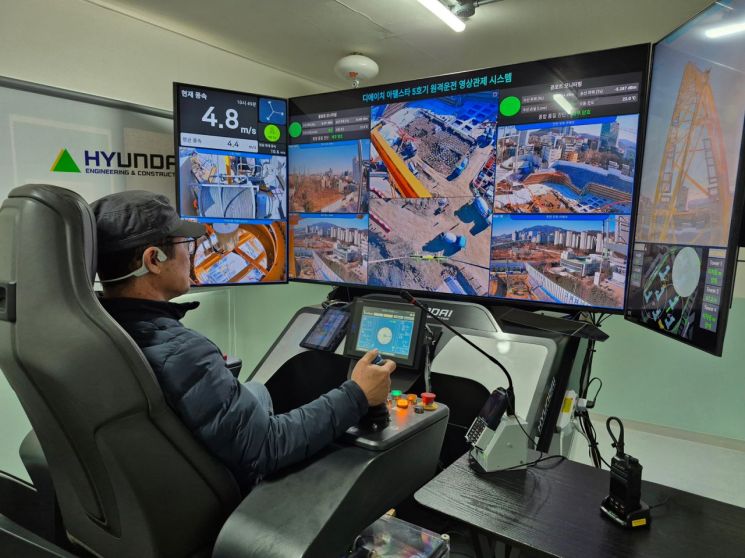 A tower crane operator is controlling a tower crane from the "remote control room" developed by Hyundai Engineering & Construction. Provided by Hyundai Engineering & Construction
The demonstration was attended by officials from related public institutions, including the Ministry of Land, Infrastructure and Transport, the Korea Commission for Corporate Partnership, Gyeonggi Provincial Government, Korea Agency for Infrastructure Technology Advancement, Korea Institute of Civil Engineering and Building Technology, Korean Society of Civil Engineers, and the Korean Society of Construction Automation and Robotics. Previously, the company showcased a remote demonstration at its Yongin research center in 2024. Building on those research results, it became the first domestic construction company to apply the technology at an actual site. Unlike small equipment used for maintenance or auxiliary work, this is a large-scale device, 50 meters in height, commonly used at multi-family residential construction sites.
The company expects that introducing this equipment will reduce the risk of falls and the burden associated with working at heights. It also offers the advantage of minimizing the impact of weather changes and extreme environments, while digitalizing equipment operation processes for systematic management of work routes. A company representative stated, "We plan to expand digital-based operation methods to key work areas, thereby enhancing the safety and efficiency of site operations."
© The Asia Business Daily(www.asiae.co.kr). All rights reserved.