"Unusual Statement: 'Korean Won's Depreciation Does Not Align With South Korea's Fundamentals'"
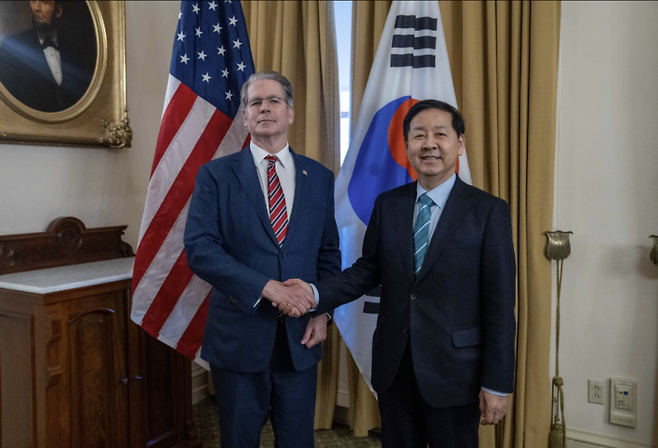
South Korea has been listed for the third consecutive time as a currency monitoring country by the US Department of the Treasury. The US authorities determined that South Korea's trade surplus with the United States and its current account surplus exceeded the established criteria.
On January 30, the Ministry of Economy and Finance announced that the US Department of the Treasury had classified and published a monitoring list that includes 10 countries, such as South Korea, Japan, China, Germany, and Singapore.
The US Department of the Treasury evaluates the top 20 countries by trade volume every year, in both the first and second halves, and designates a country as a currency manipulator if it meets all three criteria: trade surplus with the United States, current account surplus, and foreign exchange market intervention. If a country meets two of these criteria, it is designated as a monitoring country.
Among these, South Korea maintained its status as a monitoring country by meeting the criteria for a trade surplus with the United States (52 billion dollars) and a current account surplus (5.9% of GDP).
However, South Korea did not meet the foreign exchange market intervention criterion (net dollar purchases for more than eight months and at least 2% of GDP). Large-scale net dollar purchases in the foreign exchange market can raise suspicions of currency manipulation, as buying dollars increases the value of the dollar while decreasing the value of the local currency, thereby enhancing export price competitiveness.
South Korea was removed from the currency monitoring list in November 2023 for the first time in over seven years since April 2016, but was re-included in November 2024, prior to the inauguration of the Trump administration. The most recent report, following the one released in June last year, also maintained South Korea's status on the list.
In an unusual move, the US Department of the Treasury included an assessment in this report stating, "The additional depreciation of the Korean won in the second half of last year does not align with South Korea's strong economic fundamentals."
Regarding this, the Ministry of Economy and Finance explained, "The US Department of the Treasury's assessment suggests that the excessive one-sided weakening of the Korean won since the second half of last year is inappropriate."
On the US Treasury's evaluation that efforts to improve the foreign exchange market system will strengthen the resilience and efficiency of the market, the ministry commented, "This is in line with the policy announced in last year's first-half currency report that, starting with this report, the US Treasury will evaluate not only market intervention but also capital flows, macroprudential measures, and the use of government investment institutions for competitive devaluation."
In its assessment of government investment institutions, the US Department of the Treasury noted that the National Pension Service's foreign currency purchases are being made for the purpose of diversifying overseas investments. In particular, it stated that the foreign exchange swap between the National Pension Service and the Bank of Korea helped alleviate downward pressure on the Korean won during a period of increased volatility in the fourth quarter of 2024.
The government stated, "We will continue to closely communicate with the US Department of the Treasury and maintain cooperation to ensure the stability of the foreign exchange market going forward."
© The Asia Business Daily(www.asiae.co.kr). All rights reserved.

















