Production Up 0.5%, Consumption Up 0.5% in 2025
Record Decline in Construction Performance Due to Industry Downturn
December Production Up 1.5%, Investment Down 3.6%
The lingering effects of the martial law declared two years ago have significantly dampened the growth in production. However, after three consecutive years of decline, retail sales managed to rebound slightly last year. Facility investment continued to increase for the second consecutive year, but completed construction volume sharply decreased due to the worsening construction sector.
According to the "Industrial Activity Trends for December 2025 and the Year" released by the National Data Agency on January 30, total industrial production rose by 0.5% compared to the previous year. This growth rate is 1.0 percentage point lower than the 1.5% recorded in 2024. The decline is attributed to the continued disruption through the first quarter of last year following the 12·3 Martial Law. In the mining and manufacturing sector, production decreased in non-metallic minerals and primary metals, but increased in semiconductors and other transportation equipment, resulting in a 1.6% year-on-year increase. Production in the service sector rose by 1.9%. While there was a decrease in education, there were increases in health and social welfare, as well as wholesale and retail trade.
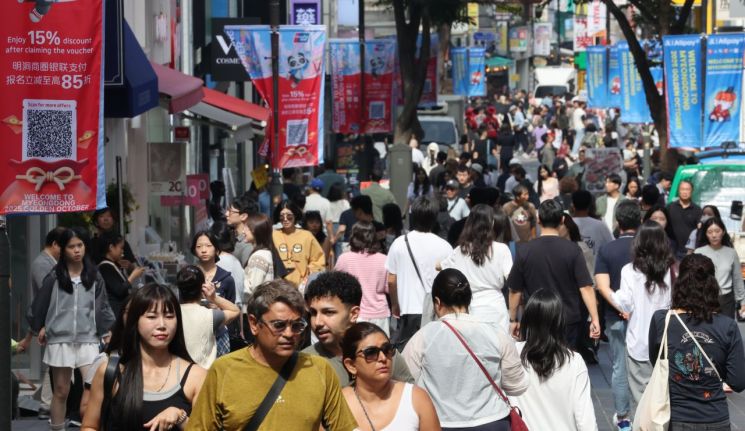
In contrast, retail sales rose by 0.5%, successfully reversing a three-year downward trend. Sales of durable goods such as telecommunications equipment and computers fell by 0.7%, but sales of semi-durable goods such as clothing increased by 3.1%, and sales of non-durable goods such as food and beverages rose by 0.9%.
Facility investment, which reflects the amount invested in equipment supplied domestically, increased by 1.7%. However, completed construction volume (in constant prices), which measures the value of domestic construction work performed by construction companies, fell by 16.2%. This is the largest drop since statistics began in 1998. Due to the deterioration in the construction sector, the volume of new housing supply declined, resulting in reduced construction performance in both building construction (-17.3%) and civil engineering (-13.0%).
Looking at the data for December last year alone, total industrial production grew by 1.5% compared to the previous month. Retail sales also increased by 0.9%. Increased sales of clothing and food and beverages drove the growth in consumption. The government's livelihood recovery support payments also appear to have had some impact.
On the other hand, facility investment fell by 3.6%. Investment in machinery, including precision instruments, increased by 1.3%, but investment in transportation equipment, including ships and aircraft, decreased by 16.1%. Completed construction volume increased by 12.1%, with both building construction (up 13.7%) and civil engineering (up 7.4%) showing gains.
The coincident composite index of cyclical variation, an indicator of the current economic situation, stood at 98.5, down 0.2 points from the previous month. This index has recorded negative growth for three consecutive months since it turned downward by 0.4 points in October last year. The leading composite index of cyclical variation, which forecasts future economic conditions, rose by 0.6 points from the previous month to 103.1.
© The Asia Business Daily(www.asiae.co.kr). All rights reserved.
![Clutching a Stolen Dior Bag, Saying "I Hate Being Poor but Real"... The Grotesque Con of a "Human Knockoff" [Slate]](https://cwcontent.asiae.co.kr/asiaresize/183/2026021902243444107_1771435474.jpg)
















