Additional Housing Supply Measures by the Lee Administration
New City-Scale Area Equivalent to 1.7 Times Yeouido
On January 29, the government unveiled its “Measures to Expand and Accelerate Urban Housing Supply,” confirming specific sites and construction timelines. Recognizing the high demand for housing in central city areas due to factors such as proximity to workplaces, the government has decided to expand the scale of previously planned projects in areas like Yongsan, Seoul. Additionally, it has included a large number of areas where previous development efforts were halted due to resident opposition. The government stated that the total area involved is equivalent to 1.7 times the size of Yeouido, amounting to 4.87 million square meters, comparable to a new city. The Ministry of Land, Infrastructure and Transport, along with other relevant ministries, has coordinated these plans, with future execution expected to be a key challenge.
Noteworthy among the sites are Gwacheon Racecourse and the Defense Security Command site. The Ministry of Land, Infrastructure and Transport plans to relocate both the Gwacheon Racecourse and the Defense Security Command, integrating the sites for a unified development that will provide 9,800 housing units in the Gwacheon area. By connecting this to the recently popular Gwacheon and Juaam residential districts, the government aims to create a live-work environment that allows for commutes to high-tech business districts. To this end, it also plans to secure land exceeding the scale of the Gwacheon Knowledge Information Town nearby, establish the Gwacheon AI Techno Valley, and attract advanced companies from Yangjae.
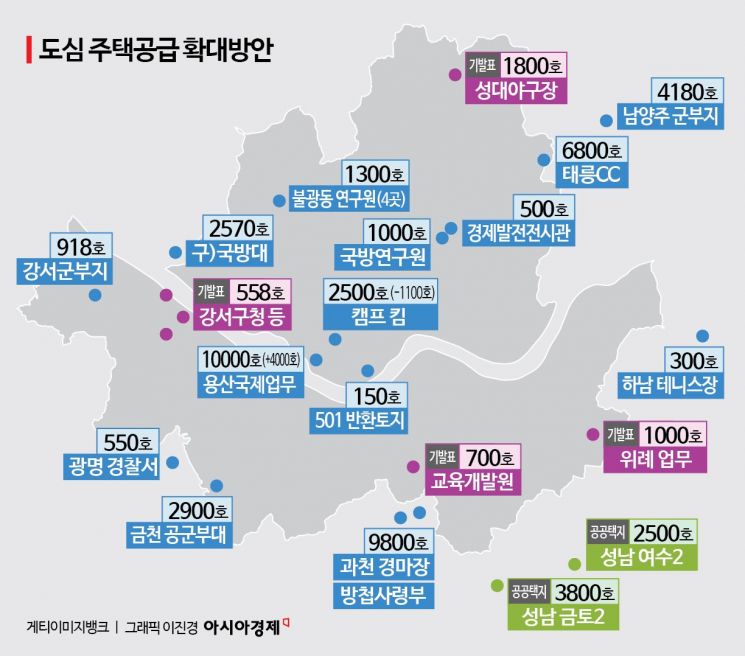
In Gwacheon, large-scale additional housing supply has been planned through public housing district designations, leading to significant resistance from both local governments and residents. The main concern is that simply adding housing due to Gwacheon's proximity to Seoul is inappropriate given the lack of supporting infrastructure. In response, a Ministry of Land, Infrastructure and Transport official stated, “We will integrate the racecourse and nearby military land to keep the number of units under 10,000, ensure sufficient self-sustaining facilities, and minimize inconvenience to residents.” The official added, “Since there will be coordination with local governments during the planning or district designation stages, we believe these issues can be resolved.”
The plan for the Yongsan International Business District and the adjacent Camp Kim site has been expanded by about 5,100 units compared to the original proposal. The Yongsan International Business District will supply 10,000 units, while the Camp Kim site will provide 2,500 units. To achieve this, the government plans to relax the green space requirements within the Yongsan Park development district, as stipulated by the Yongsan Park Act, aligning them with standards from the Housing Act and other relevant laws to secure additional supply.
Reaching consensus with the Seoul Metropolitan Government is expected to be a key issue. The city has previously indicated that supplying more than 8,000 units (including officetels) in the International Business District would be difficult. Additionally, the Seoul Metropolitan Office of Education has expressed concerns about school capacity due to an increase in the school-age population, leaving variables to be addressed in further discussions.
A Ministry of Land, Infrastructure and Transport official stated, “To address the increase in school-age population resulting from the higher number of housing units, we are discussing options such as assigning additional students to the existing Namjeong Elementary School or allocating them to other nearby schools. We will continue to work with the Seoul Metropolitan Government and the Office of Education to minimize these issues.”
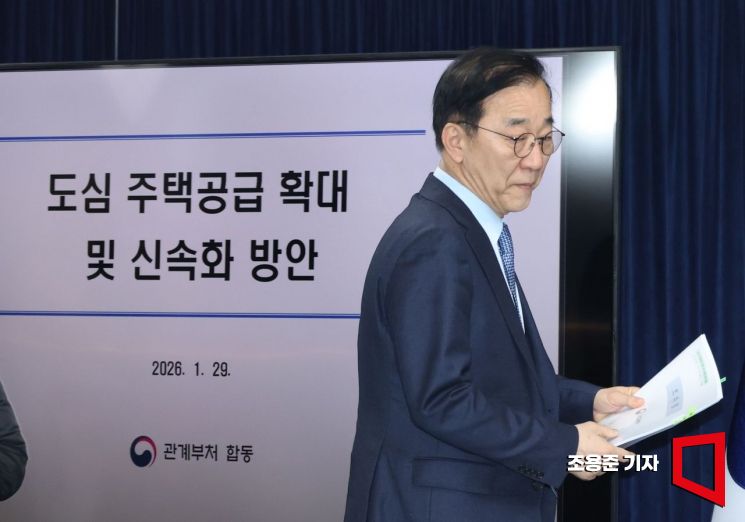 Kim Yoonduk, Minister of Land, Infrastructure and Transport, is attending a joint briefing on housing supply promotion at the Government Seoul Office in Jongno-gu, Seoul on January 29, 2026. Photo by Jo Yongjun
The development of Taereung Country Club, a military golf course in Gongneung-dong, Nowon-gu, Seoul, will also be resumed. The Ministry of Land, Infrastructure and Transport has designated the Korea Land and Housing Corporation (LH) as the project operator for the 875,000-square-meter site, where 6,800 housing units will be built. This is a reduction from the 10,000 units planned during the previous Moon administration. The ministry plans to coordinate with the Cultural Heritage Administration to expedite the Cultural Heritage Committee review and the World Heritage Impact Assessment and, when establishing the project plan, will incorporate sufficient resident feedback to develop transportation and green space plans.
The government has also finalized plans to relocate the Korea Economic Development Exhibition Hall, located near the Korea Institute for Defense Analyses in Dongdaemun-gu, Seoul, and construct 1,500 housing units. This site is near a transit station and several universities, and will be redeveloped as a residential area supporting business startups and talent development, in connection with the Hongneung Small-Scale R&D Special Zone. The plan is to relocate the facility by the first half of 2028, in coordination with the Ministry of National Defense and the Ministry of Economy and Finance, and to begin construction the following year.
Four research institutes, including the Korea Institute of Public Administration in Bulgwang-dong, Eunpyeong-gu, Seoul, will also be relocated. The government expects to complete the relocations by the first half of 2027 and to begin construction in 2029. The Gwangmyeong Police Station site will be relocated by next year, with construction targeted to begin in 2029, and a mixed-use residential complex will be built on the Hanam Sinjang Tennis Court site, with capacities of 550 and 300 units, respectively. The military site in Gangseo, Seoul, will be developed through a trust-based method rather than a land sale, making it possible to start construction of 918 units as early as next year. Additionally, plans have been finalized to supply 2,900 units at the Doksan Air Force Base, 4,180 units at the Namyangju military base, and 2,570 units at the former Korea National Defense University site in Goyang.
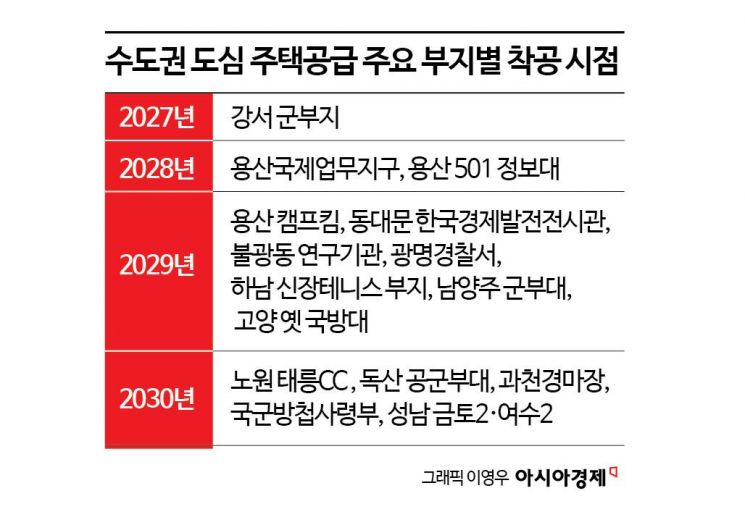
The Ministry of Land, Infrastructure and Transport stated, “For sites requiring relocation of existing facilities, the entire government has pooled its resources to ensure relocation decisions and commencement by 2027.” The ministry added, “We will pursue measures to exempt public enterprises from preliminary feasibility studies within this year and will expedite pre-approval processes such as the State Property Review Committee and the World Heritage Impact Assessment.” The ministry also noted, “For public housing district development projects aimed at supplying affordable housing, we plan to seek Cabinet approval for exceptions to the total lifting of development restriction zones (GB).”
© The Asia Business Daily(www.asiae.co.kr). All rights reserved.
![Clutching a Stolen Dior Bag, Saying "I Hate Being Poor but Real"... The Grotesque Con of a "Human Knockoff" [Slate]](https://cwcontent.asiae.co.kr/asiaresize/183/2026021902243444107_1771435474.jpg)


















