Conflict Between Canada and the United States
Chinese Media: "Strategic Autonomy"
Canada-China Partnership on the Rise
Chinese state-run media have praised Canada's efforts to reduce its political and economic dependence on the United States, describing them as "strategic autonomy that has cracked U.S. hegemony." As Prime Minister Mark Carney of Canada actively seeks cooperation with Asian countries such as China and South Korea in response to unstable relations with the United States, including tariff pressure, there is growing interest in Canada's diplomatic direction within China.
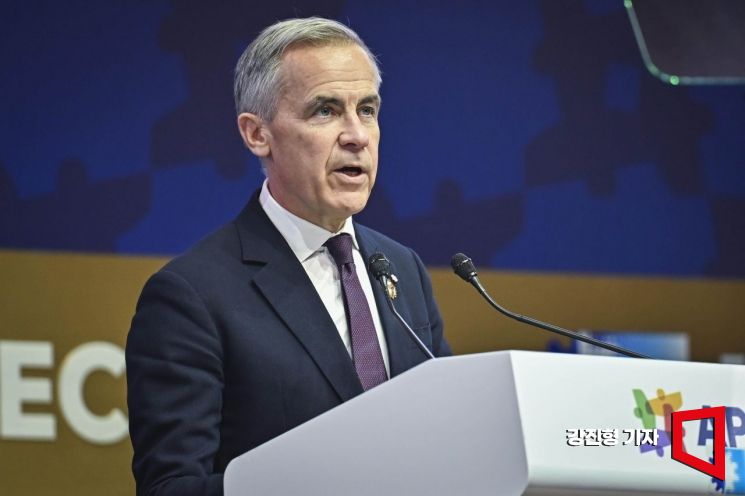 Mark Carney, Prime Minister of Canada, is delivering a special keynote speech at the Asia-Pacific Economic Cooperation (APEC) CEO Summit held at the Gyeongju Arts Center in Gyeongbuk on October 31 last year. Photo is unrelated to the article content. Photo by Kang Jinhyung
On January 29, the Chinese state-run English-language newspaper Global Times quoted Chinese experts, calling Prime Minister Carney's actions "a remarkable event symbolizing a visible rift within the Western alliance." Liu Dan, a researcher at the Regional and Country Studies Center at Guangdong University of Foreign Studies, stated, "The United States' closest ally is now seeking practical transformation instead of pledging unconditional loyalty. Leaders of Western countries will make their own choices based on a sober assessment that prioritizes national interests, sovereignty, and dignity. Over time, we will see what the best outcome is."
Song Guoyou, Deputy Director of the Center for American Studies at Fudan University, said, "Canada's relationship with China is likely to become a key variable in its pursuit of diversified diplomacy and economic policies. In the past, ideology and other factors prevented choices that aligned with national interests. Now, the pragmatic shift among Western countries will contribute to building a multipolar world with a fair international order."
Conflict with President Trump... Prime Minister Carney's Gamble
Recently, Prime Minister Carney has shifted to a more hardline stance in relations with the United States, standing up to the pressure from U.S. President Donald Trump. On January 27, at the Canadian Parliament in Ottawa, Carney commented on the outlook for trade negotiations with the United States, saying, "The world has changed. Washington has changed. There is almost nothing normal in the United States right now."
Furthermore, in a speech at the World Economic Forum (WEF) in Davos, Switzerland, on January 20, shortly after his visit to China, Carney stated that a new reality has taken root in international relations, saying, "In a system where great power rivalry is intensifying, major powers use economic integration as a means of coercion for their own interests." He added that countries like Canada can no longer be safe by simply "adapting to reality," emphasizing, "Middle powers must act together."
After Carney's speech in Davos, President Trump expressed his displeasure, saying, "Canada exists because of the United States." On January 24, he warned that if Canada signs a free trade agreement with China, the United States would impose a 100% tariff on Canadian goods, even referring to Carney as "Governor Carney," a term suggesting he had not abandoned the idea of merging Canada with the United States.
Canadian Oil Heads to Asia Instead of the United States
The political conflict between the two countries has led to diversification in Canada's oil exports and strengthened economic cooperation with Asian countries such as China. Canada is actively targeting the Asian market to reduce its dependence on the U.S. market for oil sales. Prime Minister Carney visited Beijing, China, this month, promoting a "new strategic partnership" with China. At the Davos Forum, he also warned of cracks in transatlantic relations and promoted Canada as an "energy superpower."
According to the Baltic and International Maritime Council (BIMCO), the world's largest shipping association, Canada's oil exports to China last year reached 88.7 million barrels, more than quadrupling from the previous year. In contrast, U.S. oil exports to China during the same period fell by 61% to 39 million barrels.
According to the Financial Times, experts say that geopolitical turmoil has highlighted Canada as a stable energy supplier. Heather Exner-Pirot, Director at the Macdonald-Laurier Institute in Ottawa, said, "In a world of growing uncertainty, Canada is a low-risk option." David Chelick, Head of the Energy Sector at the Toronto Stock Exchange, commented, "This is a very good time for the Canadian oil sands industry. Now our oil is going to China, South Korea, and India."
© The Asia Business Daily(www.asiae.co.kr). All rights reserved.
![Clutching a Stolen Dior Bag, Saying "I Hate Being Poor but Real"... The Grotesque Con of a "Human Knockoff" [Slate]](https://cwcontent.asiae.co.kr/asiaresize/183/2026021902243444107_1771435474.jpg)
















