Official Supply to Nvidia, AMD and Others
Recognized by Clients for Enhanced Speed and Power Efficiency
Cutting-Edge 1c Nano DRAM Technology Applied
Ongoing HBM Supply Shortage, Shipments Expected to Increase
Samsung Electronics is making a counteroffensive in the AI memory market by introducing its sixth-generation high bandwidth memory (HBM4). According to industry sources, Samsung Electronics will officially supply HBM4 to major global clients such as Nvidia and AMD in the United States next month. The company plans to begin mass production as early as next month, having passed the final quality tests of both companies. Attention is focused on whether Samsung Electronics, which previously lost leadership to competitors in the HBM3E (fifth-generation) market, can regain its technological leadership with the launch of HBM4.
According to industry sources on the 29th, Samsung Electronics recently passed the final quality tests for HBM4 conducted by Nvidia, AMD, and others, and has begun full-scale preparations for shipment next month. The company is reportedly receiving positive feedback from global clients after successfully implementing HBM4 technology.
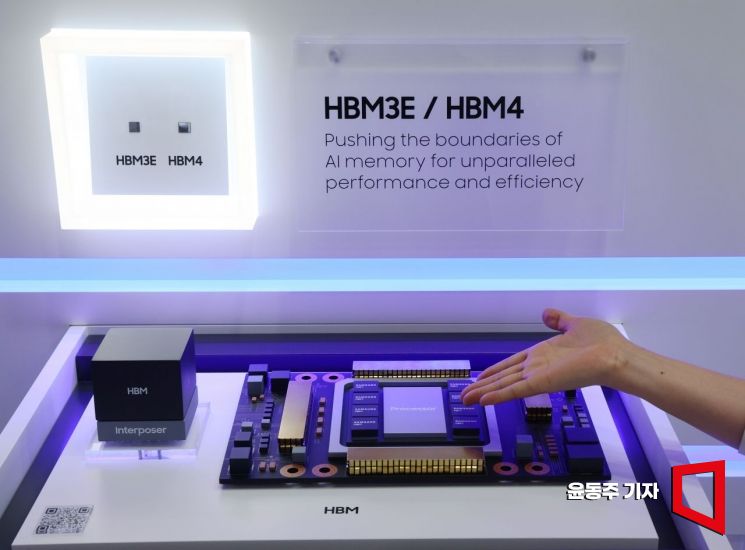 Visitors attending the "2025 Semiconductor Expo" held at COEX in Gangnam-gu, Seoul on October 22 last year are viewing Samsung Electronics' products related to HBM4 on display. Photo by Dongju Yoon
Samsung Electronics, which had fallen behind SK hynix and US-based Micron in the supply competition for its flagship HBM3E products, has focused on "performance realization" to overturn the situation in the HBM4 market. The company utilized sixth-generation (1c) DRAM products based on a 10-nanometer (nm) process, one generation ahead of competitors, and applied a cutting-edge 4nm foundry (semiconductor contract manufacturing process) to the logic die, which acts as the brain, several generations ahead of competitors. When major clients such as Nvidia requested an increase in HBM4 operating speed to boost AI accelerator performance in the fourth quarter of last year, Samsung Electronics reportedly passed verification without the need for redesign.
Samsung's HBM4 achieved 11.7Gbps (gigabits per second), comfortably exceeding the 10Gbps specification required by AI accelerator companies. Compared to its predecessor, HBM3E, the number of input/output (I/O) pins for data transmission has been increased, raising the memory bandwidth per stack to around 3TB/s. Power efficiency has also been significantly improved. Samsung Electronics is said to have improved energy efficiency by about 40% over the previous generation through optimized base die design based on the 4nm process. It is evaluated that the product can support next-generation AI accelerators by minimizing heat generation even in high-speed operating environments.
The structural advantage of being an integrated device manufacturer (IDM) is cited as the background for Samsung Electronics' ability to secure technological competitiveness with HBM4. As a company with capabilities in memory, foundry, and packaging, Samsung Electronics organically optimized design and mass production by applying its own 4nm foundry process to the HBM4 base die. In addition, the application of cutting-edge 1c nano DRAM has reportedly enabled the company to secure both performance and yield simultaneously.
The market outlook is also positive. JP Morgan expects Samsung Electronics to deliver results exceeding market expectations in the HBM4 quality certification process, forecasting that HBM bit shipments in 2026 will increase by more than 128% compared to the previous year. Morgan Stanley also analyzed that, due to expanding AI demand, the HBM market has entered a phase of structural supply shortage.
© The Asia Business Daily(www.asiae.co.kr). All rights reserved.
![Clutching a Stolen Dior Bag, Saying "I Hate Being Poor but Real"... The Grotesque Con of a "Human Knockoff" [Slate]](https://cwcontent.asiae.co.kr/asiaresize/183/2026021902243444107_1771435474.jpg)











