KOSPI Surpasses 5,100 Points Early on the 28th
"160,000 Won Samsung Electronics" and "840,000 Won SK Hynix" Lead Index Gains
Earnings Improvement in Other Sectors and Foreign Investor Flows Also Key Factors
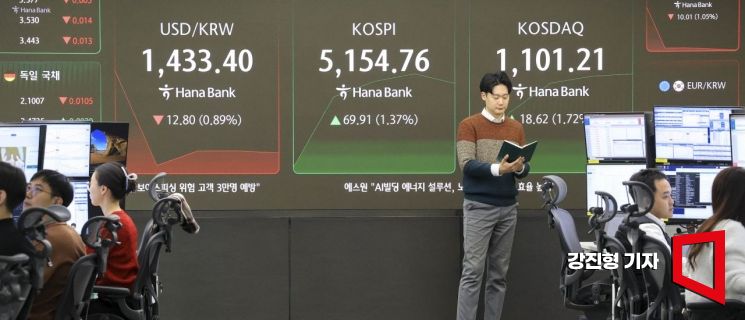 On the 28th, when the KOSPI index surpassed the 5100 mark for the first time during the session, dealers were working in the dealing room of Hana Bank in Jung-gu, Seoul. On the same day, the KOSDAQ index broke through the 1100 mark during the session, and the won-dollar exchange rate started trading at 1431 won, down 15.2 won from the previous trading day. 2026.1.28 Photo by Kang Jinhyung
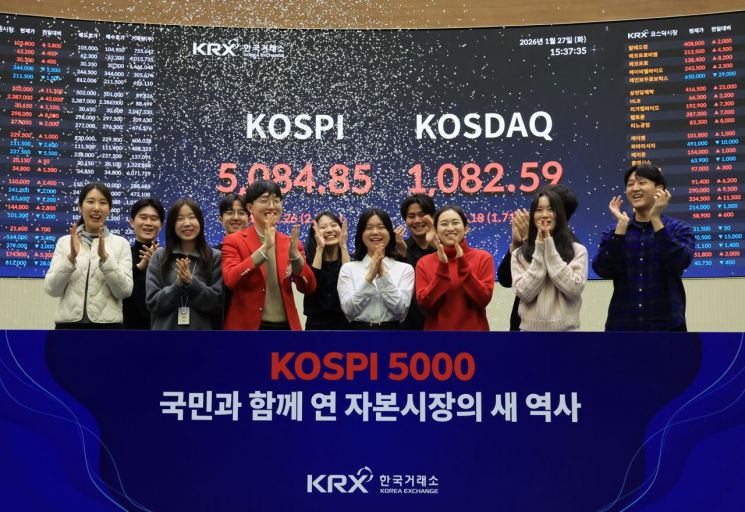
The KOSPI, which closed above 5,000 points for the first time ever, is continuing its strong upward momentum for a second consecutive day. Market analysts believe that if the earnings of key industries such as semiconductors continue to improve, and if the government maintains its capital market-friendly policies such as the third amendment to the Commercial Act, reaching 6,000 points is entirely possible.
KOSPI Closes Above 5,000 Points for the First Time
On January 28, the KOSPI opened at 5,145.39, up 60.54 points (1.19%) from the previous trading day. This is the first time in the history of the Korean stock market that the KOSPI has surpassed 5,100 points. The KOSDAQ also started the day at 1,105.60, up 23.01 points (2.13%), and continued to gain throughout the session. The Korean stock market was influenced by the record-high close of the U.S. market the previous day, driven by expectations for strong earnings from major big tech companies.
On January 27 (local time), the S&P 500 index closed at 6,978.60, up 28.37 points (0.41%) from the previous session, surpassing its previous all-time high of 6,977.27 set on January 12. The tech-heavy Nasdaq Composite Index finished at 23,817.10, up 215.74 points (0.91%). Expectations for strong earnings from major big tech companies pushed both the S&P 500 and the Nasdaq higher. Key members of the "Magnificent 7" (M7), including Tesla, Microsoft, and Meta, are scheduled to announce their quarterly earnings after the close of trading on January 28.
With the continued rise of the U.S. stock market and growing anticipation for artificial intelligence (AI), there is a prevailing outlook that the KOSPI will continue to reach new all-time highs. According to the Korea Exchange, the KOSPI first surpassed 4,000 points on October 27 last year, and in just three months, it closed above 5,000 points for the first time as of the previous day. The KOSPI's growth rate this year stands at 21%, ranking first among the G20 nations. The gap with runner-up Turkey (17%), third-place Brazil (11%), and fourth-place South Africa (8%) is significant.
The improved earnings and rising stock prices of semiconductor companies such as Samsung Electronics and SK Hynix are cited as the core drivers behind the KOSPI reaching 5,000 points. As the AI industry rapidly advances, demand for memory semiconductors has increased, and the stock prices of Samsung Electronics and SK Hynix have risen by 32.8% and 23.4%, respectively, so far this year, leading the KOSPI's gains. On this day, their share prices surpassed 160,000 won and 840,000 won, respectively, during morning trading. The optimism surrounding AI has spread beyond semiconductors to other sectors such as automobiles, robotics, and transportation equipment, resulting in a rotation market that has further boosted the index. An Ilchan, Head of the Stock Market Division at the Korea Exchange, explained, "While the strong performance of the semiconductor sector has kept the electrical and electronics industries robust, the rotation into sectors such as automobiles, robotics, shipbuilding, defense, and nuclear power has also contributed to the KOSPI's rise."
Government policies that are friendly to the capital market have also been a major factor behind the KOSPI's surge past 5,000. The Lee Jaemyung administration has implemented a variety of capital market policies-including amendments to the Commercial Act, easing of separate taxation on dividend income, and eradication of unfair trading practices-which are credited with improving the overall structure of the Korean stock market. Namwoo Lee, Professor at Yonsei University Graduate School of International Studies and Chairman of the Korea Corporate Governance Forum, analyzed, "Since the Lee Jaemyung administration took office, the KOSPI has doubled from 2,500 to 5,000. In the early stages, expectations for improved investor protection governance from two rounds of Commercial Act amendments played a major role, while in the latter stages, AI and semiconductor themes had a significant impact."
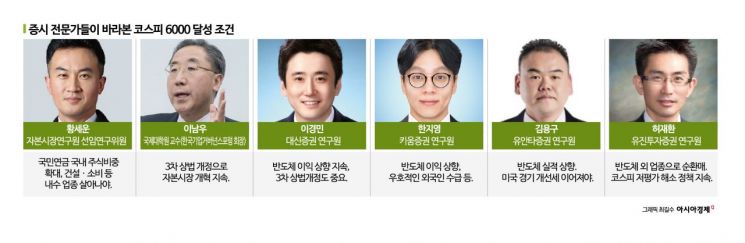
"Upgraded Semiconductor Earnings Forecasts and Third Commercial Act Amendment Will Drive KOSPI to 6,000 Points"
Experts point out that for the KOSPI to reach 6,000 points, the improving earnings trend in key industries, especially semiconductors, must continue. Kyungmin Lee, a researcher at Daishin Securities, said, "The recent rise in the KOSPI is due to the rapid upward revision of semiconductor earnings forecasts. For further gains, earnings forecasts need to be raised even more." Jiyoung Han, a researcher at Kiwoom Securities, also emphasized, "The improvement in profit momentum centered on semiconductors and favorable foreign investor inflows will drive additional index gains."
Many experts also argue that for the KOSPI to maintain a long-term upward trend, earnings improvements and rotation markets must occur in sectors beyond semiconductors. Sewoon Hwang, Senior Research Fellow at the Korea Capital Market Institute, stated, "Recently, export-driven sectors such as semiconductors, AI, robotics, automobiles, and defense have lifted the market, while domestic demand sectors have not. As the economic growth rate rises and household consumption capacity increases this year, domestic sectors such as construction and consumer-related industries may improve, leading to market rotation." Jaehwan Heo, a researcher at Eugene Investment & Securities, added, "Even with the KOSPI at 5,000, the 12-month forward price-to-earnings ratio (PER) is just 10.6 times, so the valuation burden on our stock market remains low. As rotation occurs into sectors such as shipbuilding, securities, utilities, and trading capital goods, where this year's operating profit forecasts are being revised upward, the index could rise further."
Capital market-friendly policies from the government and the National Assembly, including the third amendment to the Commercial Act that mandates treasury stock cancellation, are also key grounds for further KOSPI gains. Senior Research Fellow Hwang noted, "The National Pension Service's decision to increase its allocation to domestic stocks after years of reducing it is a major positive for the Korean stock market. The KOSPI's valuation remains low compared to advanced markets, and with the third Commercial Act amendment underway, there is ample room for further gains in terms of market liquidity." Professor Lee also stressed, "The third amendment to the Commercial Act is a crucial piece in completing capital market reform. After the law is revised, corporate valuations will rise and foreign investors' confidence in Korea's capital market reforms will increase."
© The Asia Business Daily(www.asiae.co.kr). All rights reserved.



















