Lower Court Rules 'Valid' on the 23rd
"Uniform Nullification Is Not an Appropriate Solution"
Distorted Practice Emerges of Increasing Upfront Retainers
A lower court has recognized the validity of contingency fee agreements for criminal defense attorneys.
The ruling states that not all contingency fee agreements in criminal cases should be deemed invalid; rather, their effectiveness should only be denied if there is a risk that such agreements undermine the public nature of legal work or the order of criminal justice.
It is drawing attention as to whether the Supreme Court will change its stance, as this appellate decision directly contradicts the Supreme Court en banc ruling from July 2015, which held that contingency fee agreements in criminal cases are invalid as they violate good morals and other social order, marking the first such reversal in over a decade.
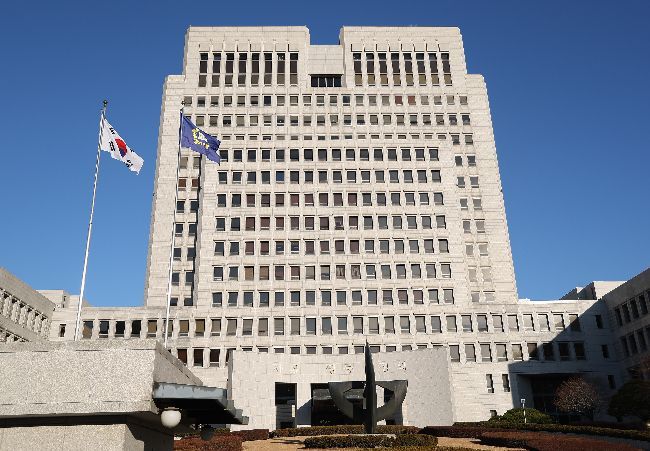
According to the legal community on January 28, the Seoul Central District Court Civil Appellate Division 1-3 (Presiding Judge Choi Seongsu) ruled on January 23 in the appeal filed by Law Firm Wi against two clients, including Mr. A, regarding a contingency fee agreement, ordering, "The defendants shall jointly pay the plaintiff 33 million won and interest," thus partially ruling in favor of the plaintiff.
The court stated, "The relationship between an attorney and a client in a criminal case is based on a freely entered mandate contract, so a contingency fee agreement ancillary to it should also be subject to the parties' autonomy under the principle of freedom of contract, unless it violates mandatory provisions, good morals, or other social order." The court further explained, "The permissibility and appropriateness of a criminal contingency fee agreement should be determined individually and specifically, considering all relevant circumstances such as the nature of the case, the method of calculating the fee, and the contents of the agreement."
The court continued, "To safeguard fairness in criminal judicial proceedings, it is appropriate to establish a judicial system that corrects misconduct by attorneys in criminal cases through punishment under the Attorney-at-Law Act or the Improper Solicitation and Graft Act and other relevant laws. It cannot be considered an appropriate solution to fundamentally ban contingency fee agreements that are not directly related to such misconduct."
The court also noted, "Since the types of 'success' in criminal contingency fee agreements can vary depending on the specifics of the case-such as dismissal of an arrest warrant, bail, revocation of detention, acquittal, suspended sentence, reduction of sentence, or non-prosecution-a contingency fee agreement should only be deemed contrary to good morals or other social order if its fee structure poses a risk of undermining the public nature of legal work or the order of criminal justice."
The court added, "Rather than uniformly assessing all criminal contingency fee agreements as contrary to good morals or other social order, only in cases where the specific agreement severely undermines the integrity and fairness of criminal justice or runs counter to judicial justice should it be considered invalid."
Meanwhile, the court referenced the abnormal practice that emerged after the Supreme Court en banc ruling, in which higher upfront retainers were set instead of contingency fees, and stated, "There are doubts as to whether banning contingency fees in all criminal cases truly promotes the public nature and ethics of legal work and achieves genuine social justice." The court also mentioned foreign legislative examples, such as Japan, which permits criminal contingency fee agreements, and Germany and France, which generally prohibit them but allow exceptions.
Mr. A was indicted for violating the Protection of Communications Secrets Act and for defamation by stating false facts. In November 2019, at the first trial, he was sentenced to four months in prison with a two-year suspended sentence. The first-instance court found Mr. A not guilty of violating the Protection of Communications Secrets Act but guilty of defamation by stating false facts.
Law Firm Wi, which handled Mr. A's appeal, entered into an additional fee agreement in February 2020. Under this agreement, if Mr. A was acquitted on all counts at the appellate level, or if the charge of defamation by stating false facts (which the first court had found guilty) was changed to defamation by stating facts and recognized as such, or if, without an amendment to the indictment, Mr. A was found guilty of defamation by stating facts and received a fine or a suspended sentence, Mr. A would pay 30 million won (excluding VAT) within seven days of the finalization of the verdict.
However, even after being acquitted on all counts at the appellate level, Mr. A failed to pay the agreed 33 million won, prompting Law Firm Wi to file a lawsuit for the agreed amount in June 2023.
In the first trial of the contingency fee lawsuit, Judge Jeong Sunhee of the Seoul Central District Court Civil Division 33 ruled against the plaintiff in May last year, following the Supreme Court en banc precedent.
At the time, Judge Jeong stated, "It is clear that this agreement ties the outcome of the investigation and trial to a monetary reward in the form of a contingency fee. Based on the circumstances and evidence presented by the plaintiff, it cannot be considered a deferred payment for litigation or advisory services provided by the plaintiff to the defendants." The judge concluded, "Therefore, the agreement included in this mandate contract is invalid as it violates good morals or other social order."
However, the appellate court held that the validity of a criminal contingency fee agreement should be determined individually in each case. In this instance, the court found that Mr. A and others were abusing existing legal principles to evade responsibility, which was contrary to the principle of good faith, and thus ruled in favor of the plaintiff.
Mr. A, who lost in the appellate court, filed an appeal on January 26.
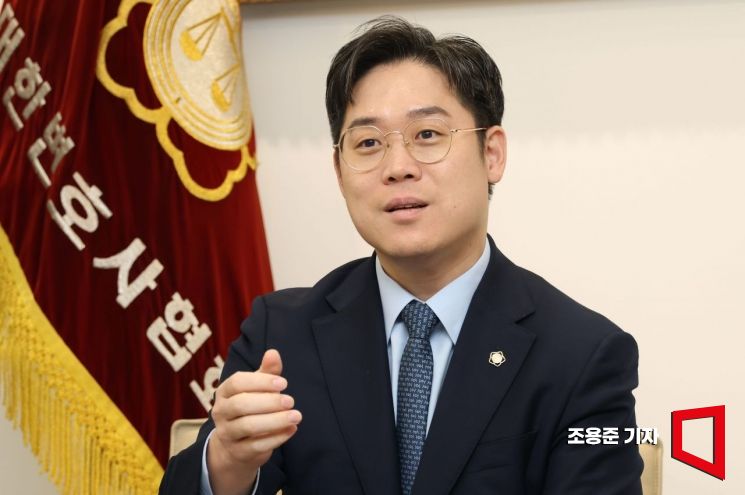 On March 6, 2025, Kim Jungwook, President of the Korean Bar Association, is being interviewed by The Asia Business Daily at the Bar Association office in Seocho-gu, Seoul. Photo by Jo Yongjun
Within the legal profession, the 2015 Supreme Court en banc ruling has been continuously criticized as being contrary to the principle of freedom of contract and disconnected from practical realities. Kim Jungwook, President of the Korean Bar Association, also pointed out the need to reinstate criminal contingency fees in an interview with The Asia Business Daily shortly after taking office last year, stating, "The ruling was logically inconsistent and contrary to the intent of existing precedents related to disposition documents, and the outcome was poor. Law firms began to include contingency fees in advance in their retainers, which became widespread and ultimately led to increased fees. This also limited the choices of legal consumers, who could previously negotiate the ratio of retainers to contingency fees."
As more than a decade has passed since the en banc ruling, with the widespread practice of charging higher retainers or substituting contingency fee agreements with separate advisory contracts, all eyes are on how the Supreme Court will rule on the validity of contingency fee agreements in criminal cases.
© The Asia Business Daily(www.asiae.co.kr). All rights reserved.
![Clutching a Stolen Dior Bag, Saying "I Hate Being Poor but Real"... The Grotesque Con of a "Human Knockoff" [Slate]](https://cwcontent.asiae.co.kr/asiaresize/183/2026021902243444107_1771435474.jpg)

















