Indicates Willingness for Tariff Negotiations
Resolution Hinges on Korea's Commitment to the Agreement
Speculation Over Coupang Data Leak Probe
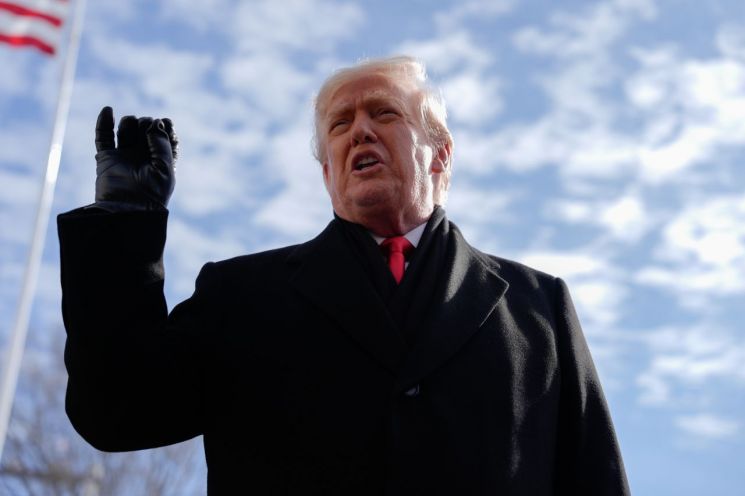 Donald Trump, President of the United States, is holding a press conference at the White House before departing for Iowa on the 27th (local time). Photo by UPI
On the 27th (local time), President Donald Trump of the United States indicated there is room for negotiation on his plan to raise tariffs on South Korean products by 25%, stating, "We will work something out with South Korea." The South Korean government's willingness to implement the Korea-U.S. trade agreement is expected to be the key to resolving the current crisis.
Some have pointed out that there may be an intention to hinder the government's and the ruling party's investigation into Coupang, which leaked personal information of South Korean citizens. However, the U.S. government denied any connection between the Korea-U.S. trade agreement and other pending issues.
"We Will Work Something Out with South Korea"
Before departing for Iowa at the White House on this day, President Trump reiterated to reporters regarding the potential tariff hike on South Korea, "We will work something out with South Korea."
This statement by President Trump is interpreted as leaving room for negotiations with the South Korean government. As of now, there has been no official proclamation or notice in the Federal Register from the White House regarding this matter. Bloomberg News pointed out, "Experts generally do not consider social media posts to be the president's final decision," adding, "They check whether related directives are published in official White House proclamations or the Federal Register."
When asked by The Asia Business Daily about the meaning, background, and outlook of President Trump's remarks, the White House responded only, "The President reduced tariffs on South Korea, but South Korea has made no progress in fulfilling their end of the bargain."
The previous day, President Trump criticized the delay in the passage of the Special Act on U.S. Investment at the South Korean National Assembly through his social media platform, Truth Social. He then abruptly announced that tariffs on South Korean products such as automobiles would be raised again from 15% to 25%. The South Korean government decided to send Minister of Trade, Industry and Energy Kim Jeonggwan to the United States as soon as possible to ascertain the Trump administration's exact intentions and devise countermeasures.
Room for Negotiation Opened, But a Solution Remains Difficult
With President Trump leaving room for negotiation, the South Korean government was able to breathe a sigh of relief. However, accelerating the pace of investment as he wishes is not easy. To implement the promised $350 billion (about 505 trillion won) investment in the United States, the "Special Act for Strategic Korea-U.S. Investment Management (Special Act on U.S. Investment)," which is pending in the National Assembly's Planning and Finance Committee, must be passed.
The ruling Democratic Party and the opposition People Power Party have not been able to narrow their differences over this bill. The Democratic Party argues that the details of the U.S. investment agreement are a memorandum of understanding (MOU), so there is no need to make it a treaty like the Korea-U.S. Free Trade Agreement (FTA). In contrast, the People Power Party insists that the agreement should be reviewed and ratified by the National Assembly.
Defending the exchange rate is also necessary. Deputy Prime Minister and Minister of Economy and Finance Koo Yooncheol stated in an interview with Reuters on the 16th that "given the current foreign exchange situation, it will be difficult to make significant investments at least this year," indicating that the execution of U.S. investments may be delayed.
Foreign Media Focus on "Korean TACO"
Foreign media are paying attention to the possibility of a "Korean TACO" (Trump Always Chickens Out). They predict that, just as President Trump recently withdrew his intention to impose tariffs on Greenland after discussions with NATO, he may take a similar approach with South Korea.
Amid such expectations, the KOSPI surged nearly 3% the previous day, closing above 5,000 for the first time ever. Despite President Trump's pressure, foreign investors did not withdraw their funds from the Korean stock market. On this day, the index opened at 5,145.39, up 1.19%.
Some analyses suggest that, contrary to the official reasons presented by the U.S. government, President Trump appears to be dissatisfied with the South Korean government's investigation into Coupang and related matters. On this day, the House Judiciary GOP of the U.S. House of Representatives shared President Trump's post on its official X account, stating, "This is what happens when American companies like Coupang are unfairly targeted."
On the same day, The Wall Street Journal reported that U.S. Vice President JD Vance recently warned Prime Minister Kim Minseok not to disadvantage U.S. tech companies such as Coupang and expressed hope for easing tensions. This statement was made before President Trump mentioned reciprocal tariff increases on South Korea.
Sources told The Wall Street Journal that dissatisfaction is growing within the Trump administration regarding the South Korean government's approach to issues such as the treatment of U.S. tech companies and the oppression of Christian organizations. However, a White House official told The Wall Street Journal that "other issues in Korea-U.S. relations, aside from the delay in trade agreement legislation, are unrelated to this decision."
Meanwhile, as President Trump pressures South Korea, other countries also appear to be speeding up the implementation of trade agreements. It is reported that Japanese cabinet-level officials have held two meetings to select the first project related to the trade agreement. The European side, which had conflicts with President Trump over the "annexation of Danish Greenland," resumed related discussions on the 26th. The United Kingdom is in a situation where parliamentary ratification is not required.
© The Asia Business Daily(www.asiae.co.kr). All rights reserved.
![Clutching a Stolen Dior Bag, Saying "I Hate Being Poor but Real"... The Grotesque Con of a "Human Knockoff" [Slate]](https://cwcontent.asiae.co.kr/asiaresize/183/2026021902243444107_1771435474.jpg)
















