Summit Between EU Commission President and Indian Prime Minister
Joint Response to Economic Powers US and China
Tariffs on EU-Made Automobiles to Be Reduced from 110% to 10%
The European Union (EU) and India have signed the largest Free Trade Agreement (FTA) in their history, 19 years after the two sides first began negotiations. Both parties have agreed to reduce or eliminate tariffs on more than 90 percent of each other's goods, including automobiles.
According to Reuters and AFP on January 27 (local time), Prime Minister Narendra Modi announced in New Delhi, ahead of a summit meeting with Ursula von der Leyen, President of the European Commission, that a historic trade agreement-covering a quarter of the global economy-had been finalized.
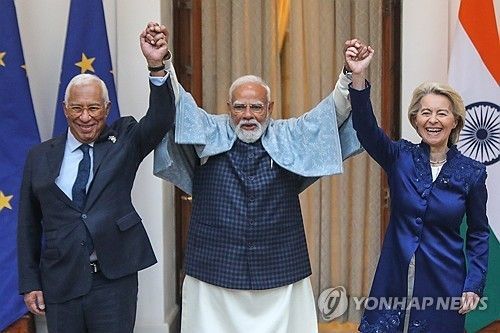 After the Free Trade Agreement (FTA) was signed, Indian Prime Minister Narendra Modi (center) joined hands with Charles Michel, President of the European Council (left), and Ursula von der Leyen, President of the European Commission. Photo by Yonhap News.
He stated, "Yesterday, a significant agreement was reached between the EU and India," emphasizing, "People around the world are calling this the 'mother of all agreements.'"
He added that the agreement accounts for 25 percent of global GDP and one-third of world trade, noting, "This will provide significant opportunities for India's 1.4 billion people and millions of Europeans."
President von der Leyen also wrote on social media, "India and Europe have made a clear choice-a choice for a strategic partnership, dialogue, and openness."
She further stressed, "We are showing that there is another path in a divided world," adding that exports from Europe to India are expected to double by 2032.
After the summit between Prime Minister Modi and President von der Leyen, the EU and India announced the details of the agreement.
According to Reuters, under this largest-ever agreement, India will lower or eliminate tariffs on 96.6 percent of major European products, resulting in an estimated 4 billion euros (about 6.8 trillion won) in tariff savings for European companies.
In particular, India will gradually reduce tariffs on EU-made automobiles from the current 110 percent to 10 percent over the next five years.
Negotiators expect that 250,000 European cars will be imported into India at preferential tariff rates.
Of these, tariffs on 160,000 internal combustion engine vehicles will be reduced to 10 percent within five years. However, for 90,000 electric vehicles, tariff reductions will only be applied starting in the tenth year, in order to protect India's nascent electric vehicle market.
India will also gradually lower tariffs on European wine from 150 percent to 20 percent, and will completely eliminate the current 50 percent tariff on processed foods, including pasta and chocolate.
The EU announced that European companies will gain preferential access to India's financial services and shipping markets. In return, the EU will reduce tariffs on 99.5 percent of Indian products over the next seven years, and will eliminate tariffs on leather goods, chemical products, plastics, rubber, textiles, clothing, jewelry, and more.
On the same day, the EU and India also signed a defense and security agreement to strengthen cooperation in areas such as maritime security, cyber security, and counter-terrorism.
© The Asia Business Daily(www.asiae.co.kr). All rights reserved.
![Clutching a Stolen Dior Bag, Saying "I Hate Being Poor but Real"... The Grotesque Con of a "Human Knockoff" [Slate]](https://cwcontent.asiae.co.kr/asiaresize/183/2026021902243444107_1771435474.jpg)
















