Strengthening Internal Unity Ahead of Next Month's Party Congress
Demonstrating Presence Amid Colby's Visit to South Korea
On January 27, North Korea launched multiple ballistic missiles into the East Sea. This marks North Korea's second ballistic missile launch of the year and the first in 23 days since the previous launch on January 4. The move is seen as both an effort to strengthen internal unity ahead of the anticipated 9th Workers' Party Congress next month and a show of force to assert its presence externally.
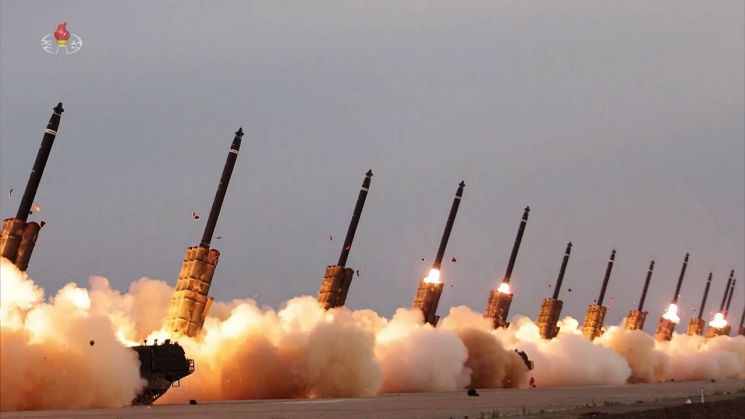 Demonstration firing scene of a 600mm super-large multiple rocket launcher with South Korea in striking range. Photo by Yonhap News
The Joint Chiefs of Staff stated, "At around 3:50 p.m., our military detected several unidentified ballistic missiles launched from the area north of Pyongyang toward the East Sea," adding, "The detected North Korean missiles flew approximately 350 kilometers, and the United States and South Korea are conducting a detailed analysis of their exact specifications." They further explained, "The intelligence authorities of South Korea and the United States tracked the launch activity," and reported that South Korea, the United States, and Japan closely shared information related to the North Korean missiles.
Intelligence authorities from South Korea and the United States are reportedly focusing their analysis on the possibility that North Korea launched the 600mm super-large multiple rocket launcher (KN-25), which was also fired on May 8 last year. The 600mm super-large multiple rocket launcher is a weapons system capable of striking major facilities in the South.
Previously, on December 28 last year, North Korean leader Kim Jong Un visited a production facility for the 600mm super-large multiple rocket launcher and stated, "This rocket launcher weapons system, which will become the main strike force of our military, will completely transform the composition of our artillery forces," adding, "It can also be used as a strategic offensive weapon." The term "strategic offensive weapon" is interpreted as indicating the capability to mount a nuclear warhead. North Korea has claimed that the tactical nuclear warhead "Hwasan-31" can be mounted on the 600mm rocket launcher.
The launch on this day coincided with the consecutive visits to South Korea and Japan by Elbridge Colby, U.S. Deputy Assistant Secretary of Defense for Policy. Colby, considered a key security advisor to former U.S. President Donald Trump, visited South Korea on January 25 and met with Foreign Minister Cho Hyun and Defense Minister Ahn Kyubaek, discussing key issues in the South Korea-U.S. alliance such as the introduction of nuclear-powered submarines, increases in defense spending, and the transfer of wartime operational control. He departed for Japan on the same day.
Regarding North Korea's ballistic missile launch, the Joint Chiefs of Staff emphasized, "Our military, under the robust South Korea-U.S. combined defense posture, is closely monitoring various North Korean activities and maintains the capability and readiness to respond overwhelmingly to any provocation."
The United States Forces Korea also issued a statement regarding the North Korean missile launch, saying, "We are aware of the missile launch and are consulting closely with our allies and partners." They added, "According to current assessments, this missile launch does not pose an immediate threat to U.S. citizens or territory," and reaffirmed, "The United States remains committed to the defense of the U.S. homeland and our allies in the region."
© The Asia Business Daily(www.asiae.co.kr). All rights reserved.

















