Choi Minhee Unveils Draft of Audiovisual Media Services Act
Netflix and YouTube Now Under Domestic Regulatory Framework
Numerous Challenges Remain, Including Inter-Ministerial Conflict
"Presidential Office Needs to Step In"
A comprehensive media law has emerged, enabling the regulation and management of online video services (OTT) and YouTube within Korea’s institutional framework. While the law focuses on addressing fairness issues between the traditional broadcasting market and new platforms, some critics argue that its effectiveness is limited because the level of regulation does not differ from existing laws.
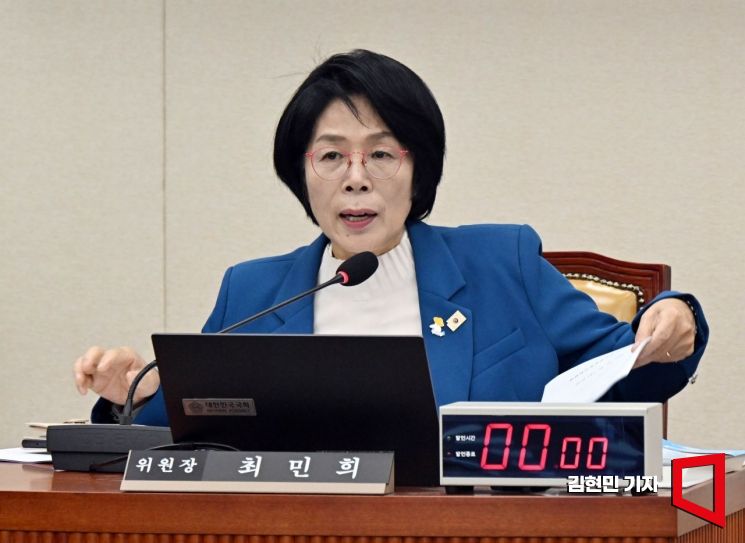 Choi Minhee, Chairperson of the National Assembly Science, Technology, Information and Broadcasting Committee, is presiding over the national audit on October 23, 2025, at the National Assembly Science, Technology, Information and Broadcasting Committee in Yeouido, Seoul, regarding the major shareholders of the Korean Broadcasting System (KBS), Educational Broadcasting System (EBS), and Munhwa Broadcasting Corporation (MBC), including the Korea Broadcasting Culture Promotion Foundation. Photo by Kim Hyunmin
Choi Minhee, Chairperson of the National Assembly’s Science, Technology, Information and Broadcasting Committee and a member of the Democratic Party, held a forum at the National Assembly Members’ Office Building on January 26 to discuss the direction of the “Audiovisual Media Services Act” (Audiovisual Act), unveiling a draft bill. This comes about seven months after Assemblywoman Choi launched the “Comprehensive Media Law Task Force” in June last year. The core of the bill is to bring together platforms such as OTT and YouTube, which have so far avoided regulation and oversight under the Broadcasting Act, into a unified management framework. The current Broadcasting Act system has seen little change since the enactment of the Integrated Broadcasting Act in 2000.
Specifically, the bill shifts the technology-centered concept of “broadcasting” to “audiovisual media” and divides the entire sector into “public” and “market” domains. The public domain includes public broadcasters, terrestrial channels, and news channels, while the market domain covers platforms and content services. Additionally, platforms are categorized based on whether they own transmission networks or facilities, and content is classified as real-time, non-real-time, or user-generated. Under this system, Netflix and YouTube would be classified as platforms without facilities, while creators above a certain scale would be classified as content providers, allowing for national-level management.
Debate Over the Comprehensive Media Law Amid Fairness Concerns... Rapid Growth of OTT and YouTube

Discussions around the comprehensive media law stem from the “fairness issue,” where the existing broadcasting system is subject to heavy regulation, while OTT and YouTube evade government oversight. For example, domestic terrestrial and cable broadcasters must comply with regulations such as limiting product placement (PPL) so that advertisements do not exceed one-quarter of the screen. They are also subject to sanctions from the Korea Communications Standards Commission for using profanity or offensive language. However, OTT and YouTube are not subject to the Broadcasting Act, allowing them to freely advertise and create content.
In reality, the fortunes of the broadcasting market, OTT, and YouTube have diverged. Terrestrial broadcasters’ revenue, which stood at 4.1601 trillion won in 2022, fell to 3.5337 trillion won in 2024. The impact is particularly severe in the broadcasting advertising sector. Terrestrial broadcasters’ advertising revenue, a major portion of their total revenue, dropped from 1.2104 trillion won in 2022 to 836.3 billion won in 2024. In contrast, OTT and YouTube have experienced rapid growth. According to data analysis platform Mobile Index, Netflix’s monthly active users (MAU) reached a record high of 15.59 million last month. YouTube’s MAU, as of November last year, stood at 48.48 million, demonstrating overwhelming market dominance.
"Regulatory Intensity Remains Unchanged"... OTT Industry Resistance Is a Major Hurdle
However, some point out that the Audiovisual Act alone will not be enough to curb the dominance of OTT platforms. Kwon Osang, head of the Digital Future Research Institute and a member of the task force, told The Asia Business Daily, “In reality, the regulatory intensity for OTT and YouTube is essentially the same as the current legal framework. Issues such as discrimination between broadcasting and OTT have not been resolved.” He added, “The significance lies in bringing OTT and YouTube into the institutional framework in the first place.” He also noted, “There are many stakeholders involved in the law. The goal should be to revitalize the entire media industry, not to artificially balance the market just because OTT is dominating the industry.”
Coordinating the “tug-of-war” between government ministries is another challenge. If the Broadcasting, Media, and Communications Commission takes the lead as the regulatory body for the comprehensive media law, conflicts with the Ministry of Science and ICT and the Ministry of Culture, Sports and Tourism, which also have overlapping jurisdictions, are expected. Chae Younggil, a professor at Hankuk University of Foreign Studies’ Department of Media and Communication, pointed out, “Without clear hierarchy and coordination leadership, it will be difficult to implement the comprehensive media law.” Kwon also said, “This issue should be resolved quickly by the Presidential Office, but inter-ministerial competition could have positive aspects. Hopefully, this will lead to better solutions.”
Overcoming resistance from the OTT industry is also a significant hurdle. Even if the comprehensive media law is enacted, it will be difficult in practice to regulate global OTT platforms such as Netflix, raising further fairness concerns within the industry. An industry official commented, “While we agree with the direction to clarify OTT’s legal status, expanding regulation without considering the unique characteristics of these services could shrink the industry. It is important to design a system that can achieve both user protection and industry growth.”
© The Asia Business Daily(www.asiae.co.kr). All rights reserved.



















