The National Pension Service has decided to increase its allocation to domestic equities this year from 14.4% to 14.9%. Considering the size of the fund and the allocation as of last year, this is estimated to create at least 7 trillion won in additional capacity for domestic investment.
The National Pension Fund Management Committee held its first meeting of 2026 at the Government Complex Seoul on the 26th and reviewed and approved the “National Pension Fund Portfolio Improvement Plan,” which includes these changes.
The committee decided to revise its target portfolio for this year, taking into account the increased burden of foreign currency procurement due to the fund’s expansion and the current foreign exchange market environment.
Raising Target for Domestic Equities, Lowering for Overseas Equities
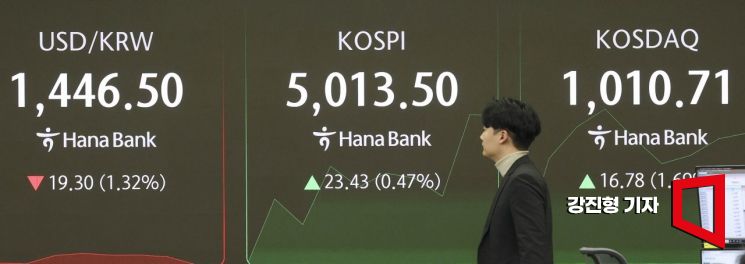 On the 26th, the KOSPI index opened at 4,997.54, up 7.47 points from the previous trading day, as dealers were working in the dealing room at the headquarters of Hana Bank in Jung-gu, Seoul.
Accordingly, the target allocation for domestic equities will be raised by 0.5 percentage points (P), from the originally planned 14.4% to 14.9%.
Given that the fund size reached 1,450 trillion won at the end of last year, this is estimated to provide at least 7.25 trillion won in additional investment capacity.
In addition, the target allocation for domestic bonds will also be increased from the previous plan of 23.7% to 24.9%.
Conversely, the target allocation for overseas equities will be adjusted downward from the original plan of 38.9% to 37.2%. As a result, dollar demand in the foreign exchange market is estimated to decrease by about 20 billion dollars (approximately 29 trillion won).
The committee explained, “We have decided to revise the target portfolio in the 2026 fund management plan, considering the increased burden of foreign currency procurement due to the fund’s expansion and the recent demand-driven foreign exchange market environment. This decision was made after comprehensively considering its impact on fund returns and the existing fund management direction.”
Temporary Suspension of ‘Rebalancing’ When Asset Class Targets Are Breached
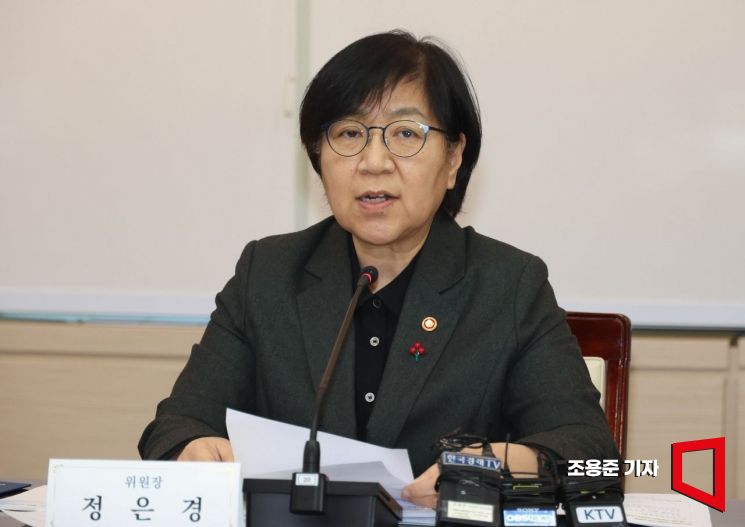 Jeung Eun-kyung, Minister of Health and Welfare, is attending and speaking at the 1st National Pension Fund Management Committee meeting of 2026 held on the 26th at the Government Complex Seoul in Jongno-gu, Seoul.
Additionally, the committee will temporarily suspend “rebalancing,” the process of restoring asset class allocations to their targets if they deviate from the set levels.
The National Pension Service invests the fund in a variety of assets, including domestic and overseas stocks and bonds, as well as real estate. Each asset class within the overall portfolio has a set allocation and target, and there are also established permissible deviation ranges to account for market fluctuations.
This decision was made out of concern that, given the recent high volatility in the market-such as the domestic equity allocation exceeding its target-continuous rebalancing could have an excessive impact on the market.
The committee stated, “Due to strong fund management performance in recent years, the fund has expanded rapidly, increasing the market impact of rebalancing. Additionally, with the domestic stock and foreign exchange markets experiencing significant short-term changes, it has become difficult to clearly assess market conditions and determine appropriate strategic asset allocation ranges.”
The committee will continue to periodically review the permissible deviation ranges and make adjustments as needed.
Minister of Health and Welfare Jeung Eun-kyung said, “The National Pension Service has achieved record-breaking results for three consecutive years since 2023, leading to a significant increase in the fund’s size and its influence on the market. Now is the time for a thorough review. While operating the National Pension Service to enhance fund returns in line with its purpose of securing retirement income for the public, we will also manage its impact on the market.”
Reviewing Foreign Currency Bond Issuance...“Close Consultation with Relevant Ministries and the National Assembly Depending on Legislative Developments”
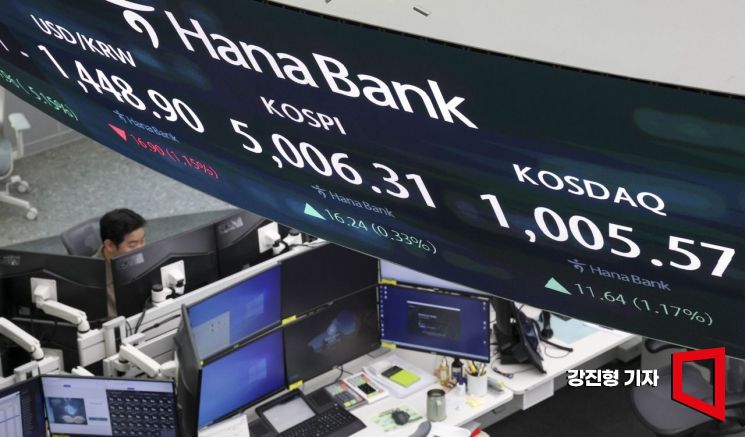 On the 26th, the KOSPI index opened at 4,997.54, up 7.47 points from the previous trading day, with dealers conducting their work in the dealing room at the Hana Bank headquarters in Jung-gu, Seoul.
The committee did not make a decision regarding foreign exchange hedging in response to volatility in the foreign exchange market. However, the National Pension Service has begun preparations for issuing foreign currency bonds. When the National Pension Service invests overseas, it must convert won into foreign currency in the domestic foreign exchange market, and the scale is so large that it exerts upward pressure on the won-dollar exchange rate. Issuing foreign currency bonds to raise investment funds could help offset this pressure.
Paek Jinju, Director of the National Pension Finance Division at the Ministry of Health and Welfare, said, “We are carefully reviewing the issuance of foreign currency bonds to stabilize the value of the won, but it is too early to say anything definitive.” She added, “We will proceed in close consultation with relevant ministries depending on legislative developments.” The Ministry of Health and Welfare has been reviewing the issuance of foreign currency bonds to stabilize the won since the end of last year.
At a National Assembly seminar held on the same day as the committee meeting, Ando Geol, a lawmaker from the Democratic Party, said, “Overseas investments by pension funds have created constant dollar demand in the domestic foreign exchange market, becoming the root cause of exchange rate instability.” He announced plans to soon sponsor an amendment to the National Pension Act that would allow the National Pension Service to issue foreign currency bonds overseas.
© The Asia Business Daily(www.asiae.co.kr). All rights reserved.
![Clutching a Stolen Dior Bag, Saying "I Hate Being Poor but Real"... The Grotesque Con of a "Human Knockoff" [Slate]](https://cwcontent.asiae.co.kr/asiaresize/183/2026021902243444107_1771435474.jpg)













