Trump Claims "Korean National Assembly Is Not Fulfilling the Agreement"
Raises Issue Over $350 Billion U.S. Investment Act Approval Process
Blue House: "No Prior Official Notification of Tariff Increase"
Policy Chief Kim Yongbeom Convenes Inter-M
U.S. President Donald Trump has announced plans to raise reciprocal tariffs on Korean products from 15% to 25%. He cited the Korean National Assembly’s failure to proceed with the necessary legal procedures following the Korea-U.S. trade agreement reached last October. The Blue House stated that there has been no official notification of a tariff increase, and held a countermeasure meeting chaired by Policy Chief Kim Yongbeom. Additionally, it decided to dispatch Minister of Trade, Industry and Energy Kim Jeonggwan, who is currently visiting Canada, urgently to Washington, D.C.
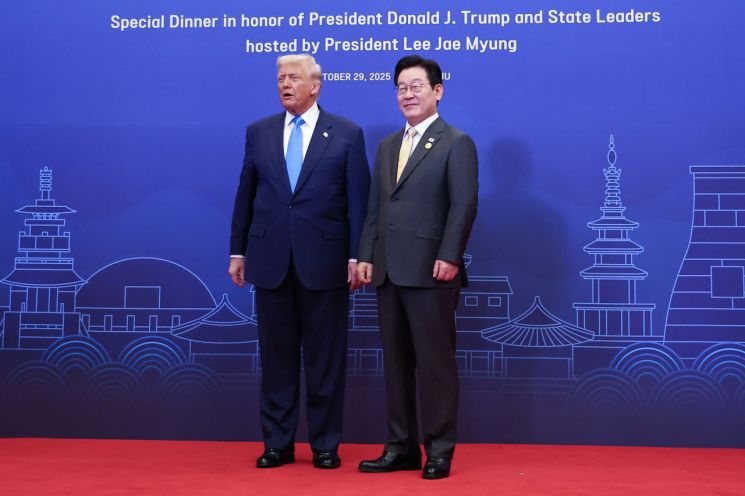 President Lee Jae-myung is welcoming U.S. President Donald Trump ahead of the special summit dinner hosted by the President at the Grand Ballroom of the Hilton Hotel in Gyeongju, Gyeongbuk, on the 29th. Photo by Yonhap News Agency
On the 27th, the Blue House announced through the spokesperson’s office, “President Trump posted on Truth Social that he would raise tariffs on automobiles and reciprocal tariffs from 15% to 25%, citing delays in the submission of the Korea-U.S. Strategic Investment Special Act to the National Assembly.” The Blue House added, “There has been no official notification or explanation of the details from the U.S. government yet.” This means President Trump has unilaterally announced his intention to raise reciprocal tariffs without any formal advance notice.
In response to President Trump’s unilateral claim, the Blue House convened a meeting with relevant ministries and decided to urgently send Minister Kim Jeonggwan to the United States. The spokesperson’s office explained, “A countermeasure meeting chaired by the Policy Chief and attended by relevant ministries will be held this morning,” and added, “Minister Kim, who is currently in Canada, will also visit the U.S. as soon as possible to discuss related matters with Secretary of Commerce Howard Lutnick.”
Previously, President Trump posted on Truth Social, “The Korean legislature is not honoring the agreement between Korea and the United States,” and declared, “Tariffs on automobiles, lumber, pharmaceuticals, and all other reciprocal tariffs will be raised from 15% to 25%.” Regarding the reason for the increase, President Trump claimed that he and President Lee Jaemyung reached an agreement on July 30 last year, finalized the details of a $350 billion Korea-U.S. investment fund on October 29 in Korea, but the Korean National Assembly has not completed the approval process.
The approval process in the Korean National Assembly mentioned by President Trump appears to refer to the “Special Act on Korea-U.S. Strategic Investment Management (Korea-U.S. Investment Special Act),” which must be passed by the legislature to fulfill investment commitments made to the United States. However, according to the memorandum of understanding (MOU) signed between Korea and the U.S., the retroactive application of tariff reductions is based on “the first day of the month in which the implementing legislation is submitted to the Korean National Assembly.” Therefore, there are criticisms that President Trump’s claim lacks sufficient grounds.
On October 29 last year, the two countries reached a final agreement on the details of the tariff negotiations during a summit held on the sidelines of the Asia-Pacific Economic Cooperation (APEC) summit in Gyeongju. On November 13, a joint fact sheet was released, detailing agreements in security and trade. The fact sheet stated that Korea would invest a total of $350 billion in the U.S., up to $20 billion per year, in exchange for lowering reciprocal tariffs from 25% to 15% and reducing tariffs on specific items such as automobiles. It also included provisions approving Korea’s uranium enrichment, spent nuclear fuel reprocessing, and the introduction of nuclear-powered submarines.
Furthermore, both countries agreed that the retroactive application of the tariff reduction would be based on the first day of the month in which the legislation to implement the “Memorandum of Understanding on Korea-U.S. Strategic Investment,” signed on November 14 last year, is submitted to the Korean National Assembly. Subsequently, the Democratic Party introduced the Korea-U.S. Investment Special Act in the National Assembly on November 26, and the U.S. published it in the Federal Register on December 4.
© The Asia Business Daily(www.asiae.co.kr). All rights reserved.

















