President Lee: "End of Capital Gains Tax Surcharge Suspension"
Multi-Homeowners Urge Early Tenant Move-Outs
Tenants Refuse to Move Despite Moving Expense Offers
Concerns Over Worsening Rental Shortage Amid Multi-Homeowner Sell-Offs
Some multi-homeowners in the Seoul area have started selling properties with remaining lease contracts in an effort to avoid the heavy capital gains tax. This move is seen as a response to a series of warnings issued by President Lee Jaemyung targeting multi-homeowners. However, despite offers to pay tenants not only moving expenses but also additional cash incentives, it remains difficult to put these homes on the market. This is because tenants, who are already struggling to find new jeonse (long-term lease) properties due to the land transaction permit system, are refusing landlords' requests. There is growing criticism that the shrinking jeonse market is becoming another obstacle to multi-homeowners listing their properties for sale.
Moving Expenses Offered in the Tens of Millions of Won... Landlords Urge Tenants to Relocate
According to local real estate agencies on January 27, there has been a slight increase in inquiries from multi-homeowners looking to sell this week. Some have reportedly offered moving expenses amounting to tens of millions of won in order to dispose of properties with existing jeonse tenants.
The head of a real estate agency near Gireum New Town said, "Some landlords are now handing tenants cash, combining real estate brokerage fees with moving expenses as a form of consolation payment," adding, "They need to sell their homes as soon as possible to avoid being hit with a tax bomb from the capital gains tax surcharge."
Landlords typically determine the moving expenses based on the remaining lease period. The longer the lease period remaining past May 9, when the capital gains tax surcharge is reinstated, the more money landlords have to pay tenants. The head of a real estate agency in Ahyeon-dong, Mapo-gu, said, "For properties with about six months left on the lease, sellers are offering tenants around 5 million won, including the brokerage fee, to vacate. If more than a year remains, landlords must pay whatever moving expenses the tenant demands, which can rise to between 10 million and 20 million won."

However, with a sharp decline in available jeonse properties, tenants are not eager to accept these offers. Due to the 10·15 policy implemented last year, all of Seoul has been designated as a land transaction permit zone, making it impossible to trade properties that are not for actual residence. The head of the aforementioned real estate agency said, "Even with extra moving expenses, it's hard to find a property comparable to the one they currently live in, so most tenants are refusing to move and are instead exercising their right to renew the lease," adding, "They believe it's better to stay in their current home than to take the moving money."
Multi-Homeowners Selling Instead of Leasing... Tenants Face Worsening Jeonse Shortage
Some experts have pointed out that policies encouraging multi-homeowners to sell due to the capital gains tax surcharge could, in the long run, increase the housing burden for tenants. Multi-homeowners have traditionally supplied inventory to the jeonse market, so if they choose to sell rather than lease, the supply of jeonse properties will inevitably decrease. This could worsen the housing difficulties for those who cannot afford to buy and must rely on jeonse rentals.
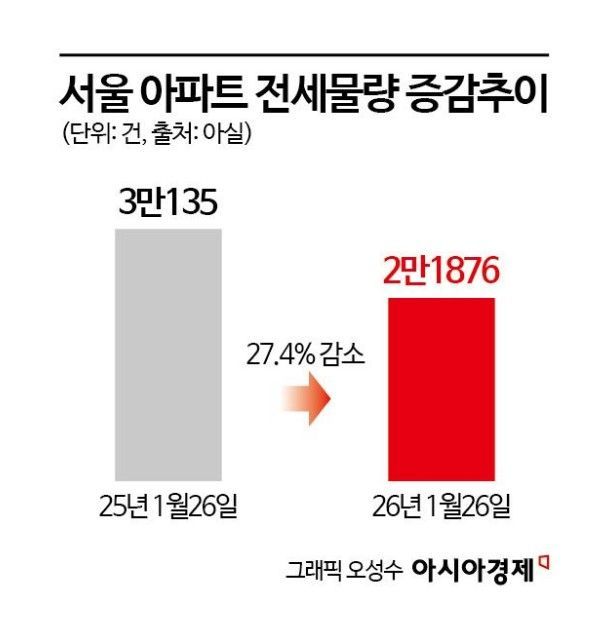
Since President Lee made it clear that there would be no further extension of the capital gains tax surcharge deferral for multi-homeowners, the number of jeonse listings for apartments in Seoul has been declining. According to data from real estate platform Asil, as of the previous day, there were 21,876 jeonse apartment listings in Seoul. This is a 27.4% decrease compared to 30,135 listings during the same period last year, and a 1.8% decrease from January 25, when President Lee mentioned the issue on social media. Jeonse listings are likely to continue declining. Two years ago, from January to April 2024, there were 5,188 cases in which tenants exercised their right to renew apartment leases in Seoul. Even if all of these units were to enter the jeonse market for new tenants, the supply would still be lower than in the past.
Lee Eunhyeong, a research fellow at the Korea Institute of Construction Policy, explained, "As mid- to large-sized jeonse units suitable for families are converted to sales, the jeonse shortage could worsen," adding, "Some landlords who have chosen to own multiple homes may also pass on the increased tax burden to tenants."
© The Asia Business Daily(www.asiae.co.kr). All rights reserved.



















