Minister Kim Sung-hwan Briefs on Direction of the 12th Basic Electricity Plan
"We Are Not Deliberately Closing Off the Possibility of Additional Nuclear Plants"
"Operating the Power Grid Solely on Solar Power Is Extremely Challenging"
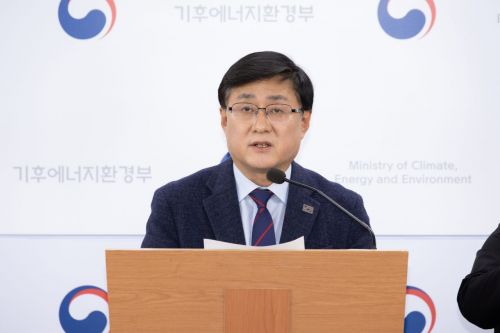 Kim Sung-hwan, Minister of the Ministry of Climate, Energy and Environment, is explaining the direction of the 12th Basic Plan for Electricity Supply and Demand at the Government Complex Sejong on January 26, 2026. Photo by Ministry of Climate, Energy and Environment
The government has decided to move forward as planned with the construction of two large nuclear power plants specified in the 11th Basic Plan for Electricity Supply and Demand (the Basic Electricity Plan), while also leaving open the possibility of additional nuclear power plant construction in the 12th Basic Electricity Plan. The government also appears to be pursuing a strategy to export renewable energy, nuclear power, and power grids as an integrated package.
On the morning of January 26, at a briefing on the direction of the 12th Basic Electricity Plan held at the Government Complex Sejong, Kim Sung-hwan, Minister of the Ministry of Climate, Energy and Environment, responded to a question about whether there is a possibility for additional nuclear power plants beyond the two large ones, provided there is public consensus, by saying, "We are not deliberately closing off that possibility." He added, "Whether it fits Korea's energy mix will be reviewed in the 12th Basic Electricity Plan."
On this day, the government announced that, based on two rounds of policy forums and public opinion surveys, it will proceed as planned with the construction of new nuclear power plants outlined in the 11th Basic Electricity Plan.
Minister Kim further stated that the possibility of additional nuclear power plants remains open in the 12th Basic Electricity Plan, which will be prepared this year.
According to the results of the public opinion survey, the energy sources that need to be expanded in the future were ranked in order as renewable energy and nuclear power. More than 80% of respondents said nuclear power is necessary, and over 60% agreed that the new nuclear power plant plans reflected in the 11th Basic Electricity Plan should be implemented.
The 11th Basic Electricity Plan, developed by the previous Ministry of Trade, Industry and Energy, originally called for the construction of three additional large nuclear power plants by 2038. However, during the government's report to the National Assembly, the plan was scaled back to two large nuclear power plants due to opposition from the Democratic Party, which was the opposition party at the time.
Minister Kim stated, "We plan to run various simulations to objectively and scientifically determine the most suitable mix of renewable energy and nuclear power, including gas power generation, for Korea's circumstances."
Minister Kim's remarks are considered to be significantly more forward-looking compared to previous positions. In the past, while serving as Mayor of Nowon District and as a member of the Democratic Party, he maintained a negative view on nuclear power. However, since taking office as Minister of Climate, Energy and Environment in October last year, his stance has gradually shifted toward emphasizing the importance of an energy mix of renewables and nuclear power for achieving Korea's carbon neutrality goals.
On this day, Minister Kim also said, "Unlike Europe or other continents, Korea is an energy island with a short east-west span, making it very difficult to operate the power system solely with solar power, which is our main source. In an environment where it is not easy to pass on all power generation costs to electricity rates as is done in Europe, and while reducing coal and gas, it is difficult to maintain the same policies as the Moon Jae-in administration and still operate the power system stably."
He cited the changing role of green hydrogen as one of the reasons for the policy shift under the Lee Jae-myung administration compared to the previous Moon Jae-in administration.
During the Moon Jae-in administration, in the wake of the Fukushima nuclear accident, concerns over nuclear power safety were heightened globally, leading to efforts to offset the intermittency of renewables with green hydrogen. However, as the price of green hydrogen has not decreased, many countries are now presenting nuclear power as an alternative instead of green hydrogen.
Regarding the role of liquefied natural gas (LNG) power generation, Minister Kim stated that it should be "converted to hydrogen and serve as an emergency power source." This implies that LNG power generation will be converted to hydrogen power, and some will serve as backup power to offset the intermittency of renewables. LNG power generation is considered effective in complementing the intermittency and variability of renewables due to its ability to adjust output instantaneously.
In the 12th Basic Electricity Plan, it is expected that energy storage systems (ESS) and pumped-storage hydroelectricity will be expanded to address the intermittency of renewables. Minister Kim explained, "Because Korea delivers energy sources during a very short daytime period, it is essential to absorb surplus electricity with ESS or pumped storage and then distribute it during early morning or evening hours." He added, "There may also be ways to absorb power from nuclear plants using ESS."
As for small modular reactors (SMRs), construction of one unit by 2035 will proceed as outlined in the 11th Basic Electricity Plan. However, the possibility of additional construction will depend on technological developments.
Minister Kim stated, "SMRs have various implications as a distributed power source, so we will proceed as planned," but also took a somewhat reserved stance, saying, "How successful they will be depends on the level of technology and issues to be addressed during implementation."
The Lee Jae-myung administration appears set to maintain its nuclear power export policy, with a focus on exporting packages that include renewables. Minister Kim assessed, "There are not many countries that possess both nuclear power design and manufacturing capabilities and are competitive, but Korea is one of the few countries with a competitive edge in nuclear power exports."
He added, "Given the explosive increase in electricity demand, it is true that there are countries requesting us to export packages that include renewables, nuclear power, and the grid." Minister Kim stated, "However, we will strive to enhance export competitiveness by considering appropriate profit margins and exporting renewables and the grid together."
He concluded, "Now, the status of hydrogen has changed, and nuclear power has its own position as a power source. Therefore, it is reasonable to pursue an appropriate energy mix and, if necessary, actively proceed with overseas exports."
© The Asia Business Daily(www.asiae.co.kr). All rights reserved.

![Clutching a Stolen Dior Bag, Saying "I Hate Being Poor but Real"... The Grotesque Con of a "Human Knockoff" [Slate]](https://cwcontent.asiae.co.kr/asiaresize/183/2026021902243444107_1771435474.jpg)















