Policy Debate on January 26: "Is the Current Drug Pricing System Reform Adequate?"
"Reform Focused on Lowering Generic Prices May Actually Increase Preference for Original Drugs"
The pharmaceutical industry has criticized the government's proposed drug pricing system reform, calling it a "structure that contradicts the logic of a market economy." Unlike the government's plan to secure health insurance finances by lowering the prices of generic drugs, industry insiders argue that the actual design of the system fails to consider the choice structure in medical settings, making it difficult to expect meaningful fiscal savings.
Industry representatives view the reform as a structure that lowers the prices of generic drugs while maintaining relatively high price levels and extended application periods for original drugs whose patents have expired. As a result, they argue, the price gap between original and generic drugs will persist in medical settings, preventing a shift in prescriptions toward generics. Consequently, the drug price reduction effect anticipated by the government is unlikely to be fully realized in practice.
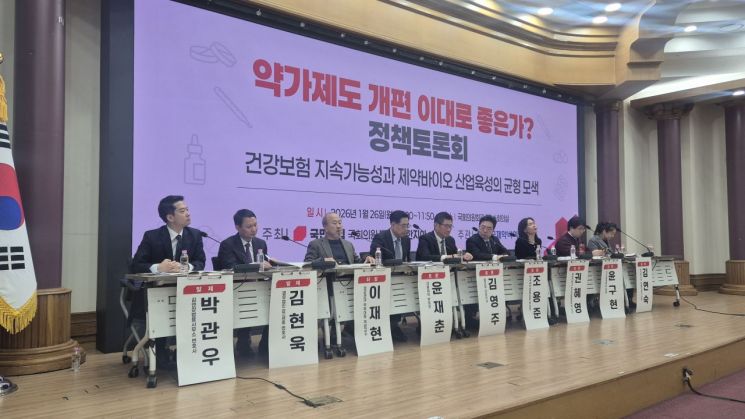 At the policy debate titled "Is the Current Drug Pricing System Reform Acceptable?" held on the 26th at the National Assembly Members' Office Building in Yeouido, Seoul, participants are speaking. Photo by Park Jungyeon
At the policy debate titled "Is the Current Drug Pricing System Reform Adequate?" held on January 26 at the National Assembly Members' Office Building in Yeouido, Seoul, Kim Youngjoo, CEO of Chong Kun Dang, commented on the reform plan focused on lowering the prices of generic drugs, saying, "As long as a price difference exists, the medical field will inevitably opt for the cheaper drug. The current reform plan is structured in a way that makes it difficult for the government's intended effects to materialize in the market."
The government is pushing for a reform of the drug pricing system starting in the second half of 2026, which would lower the price calculation standard for generic and patent-expired drugs from the current 53.55% of the original drug's price to the 40% range. The aim is to enhance the sustainability of health insurance finances through generic drug price reductions and to shift the industry structure toward new drug development.
Kim also pointed out another issue with the reform: the preferential treatment structure for original drugs whose patents have expired. He said, "In the past, the price levels for both original and generic drugs were gradually reduced to 53.5%, but under this reform, the original drug is set at 70%, and the additional period is extended to more than three years. This raises questions of fairness, considering that both compete in the same market."
He further emphasized, "If patent-expired original drugs account for about 60% of the market, this already means they represent a significant portion of health insurance expenditures. If the goal is to normalize finances, the focus should be on reviewing this structure rather than targeting generic drugs."
During the debate, concerns were also raised about the predictability of drug pricing policies. Yoon Jaechoon, Vice Chairman of Daewoong Pharmaceutical, said, "The pharmaceutical industry is inherently high-risk, and whether for new drugs or generics, investments must be made with a ten-year horizon. No industry can withstand sudden drug price cuts." He stressed, "Development must begin at least three years before patent expiration, but if drug prices are unpredictable, research and development itself becomes challenging."
Kim Yeonsook, Director at the Ministry of Health and Welfare, responded to the industry's concerns about fairness by stating, "The current reform does not newly create a price gap between original and generic drugs." She added, "Currently, the additional period is uniformly set at one year, and extending it to more than three years is a measure to promote innovation and ensure stable supply of essential medicines. Interpreting this as a policy solely for original drugs is a misunderstanding."
Director Kim further stated, "We agree on the need to promote generic drugs, but since price adjustments alone have limitations, we will work to ensure that the overall prescription structure and market mechanisms are also reviewed."
© The Asia Business Daily(www.asiae.co.kr). All rights reserved.

















