Trump Warns of Tariffs if Canada Signs Deal with China
Fierce Disputes Expected Ahead of USMCA Extension in July
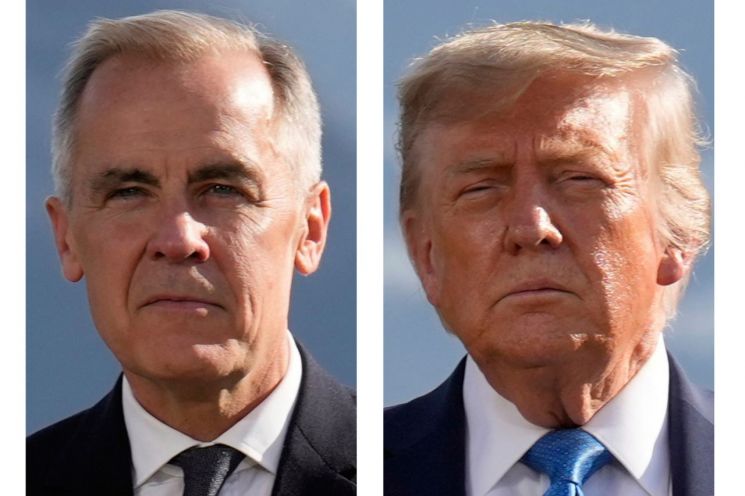 President Donald Trump of the United States (right) and Prime Minister Mark Carney of Canada (left). Photo by AP Yonhap News
President Donald Trump of the United States has once again hinted at the possibility of imposing tariffs on Canada. The Trump administration has strongly criticized the Canadian government, arguing that Chinese goods could circumvent U.S. sanctions in the future by passing through Canada. As a result, Canada’s plans to reduce its export dependence on the United States are expected to be significantly disrupted. Some observers claim that the Trump administration is deliberately pressuring Canada ahead of negotiations to extend the free trade agreement (FTA) between the two countries.
Prime Minister Carney: "No Intention to Sign FTA with China"... President Trump Launches Strong Criticism
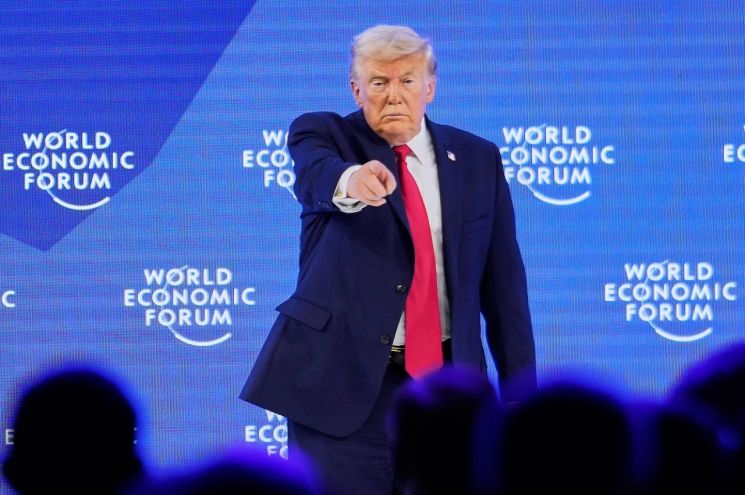
According to Canadian broadcaster CBC on the 25th (local time), Prime Minister Mark Carney stated at a press conference that day, "The measures we have taken with China are intended to address issues that have arisen in recent years," adding, "Under the United States-Mexico-Canada Agreement (USMCA), Canada cannot sign a free trade agreement with another country without prior notification to the United States or Mexico."
On January 16, Prime Minister Carney visited China for a summit meeting with President Xi Jinping, where they agreed to lower the punitive additional tariff on Chinese electric vehicles from 100% to 6.1%. In return, China agreed to reduce the combined tariff on Canadian canola seeds from approximately 84% to around 15%.
President Trump strongly objected to this tariff agreement between Canada and China. On his social networking platform Truth Social on the 25th, he sharply criticized, "Canada is systematically self-destructing," and warned, "Any trade deal with China will be disastrous for them." He further cautioned, "If Canada signs an agreement with China, all Canadian goods entering the United States will immediately be subject to a 100% tariff."
U.S. Treasury Secretary Scott Bessent also criticized the Canada-China tariff agreement in an interview with ABC News on the same day, stating, "The U.S. and Canadian markets are so highly integrated that products can cross the border as many as six times during manufacturing," and emphasized, "We cannot allow Canada to become a gateway for cheap Chinese products to flood into the United States."
Will the Maple-Yuan Deal Collapse?... Attention on U.S.-Canada-Mexico FTA Extension Negotiations
Due to President Trump's tariff pressure, Canada’s plans to reduce its export dependence on the United States are expected to face significant setbacks. Since taking office in March of last year, Prime Minister Carney has worked to ease trade disputes with China as a response to U.S. tariff pressure. Both inside and outside Canada, this initiative has been referred to as the "Maple-Yuan Deal."
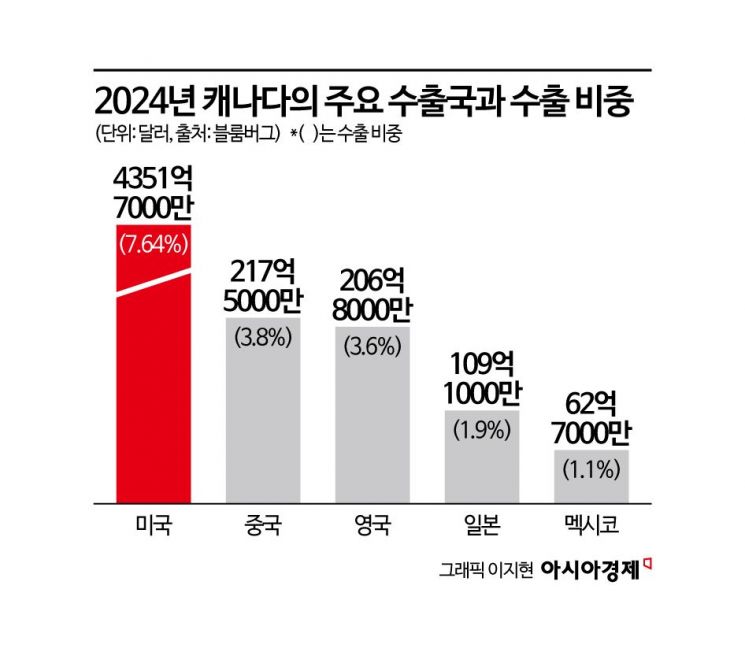
According to Bloomberg, as of 2024, Canada’s exports to the United States amounted to 435.17 billion dollars, accounting for 76.4% of its total exports. The share of its second-largest export destination, China, was only 3.8%, followed by the United Kingdom (3.6%), Japan (1.9%), and Mexico (1.1%). Prime Minister Carney also emphasized at a press conference following his meeting with President Xi on January 16, "In a somewhat divided and uncertain world, Canada must build a stronger, more independent, and resilient economy."
Some observers argue that the U.S. government is both seeking to keep Canada’s ties with China in check and to gain an advantageous position in the upcoming USMCA extension negotiations scheduled for July. Bloomberg reported, "The USMCA is approaching the sixth anniversary of its signing on July 1, with extension negotiations ahead," and added, "This signals that fierce disputes between the United States and Canada are expected in the upcoming talks."
© The Asia Business Daily(www.asiae.co.kr). All rights reserved.
![Clutching a Stolen Dior Bag, Saying "I Hate Being Poor but Real"... The Grotesque Con of a "Human Knockoff" [Slate]](https://cwcontent.asiae.co.kr/asiaresize/183/2026021902243444107_1771435474.jpg)


















