Higher Burnout and Lower Education Rates Than Other Youths
Estimated at 100,000... Experts Call for Elimination of Blind Spots
"Even though I worked all kinds of part-time jobs every day, such as serving at restaurants and working night shifts at convenience stores, my situation never improved."
Mr. Hong (21) became the head of his family at just eighteen to support his mother, who suffers from epilepsy and depression, as well as his three younger siblings. He dropped out of high school and took on various part-time jobs, but his monthly earnings amounted to only 1.5 million won. This was far from enough to cover living expenses and his mother's hospital bills. Because his mother, who has epilepsy, could collapse from unexpected seizures, he always had to stay by her side after work. Hong confessed, "When I first started supporting my family, I felt like I was falling behind every day because, unlike other high school students, I couldn't even prepare for college entrance."
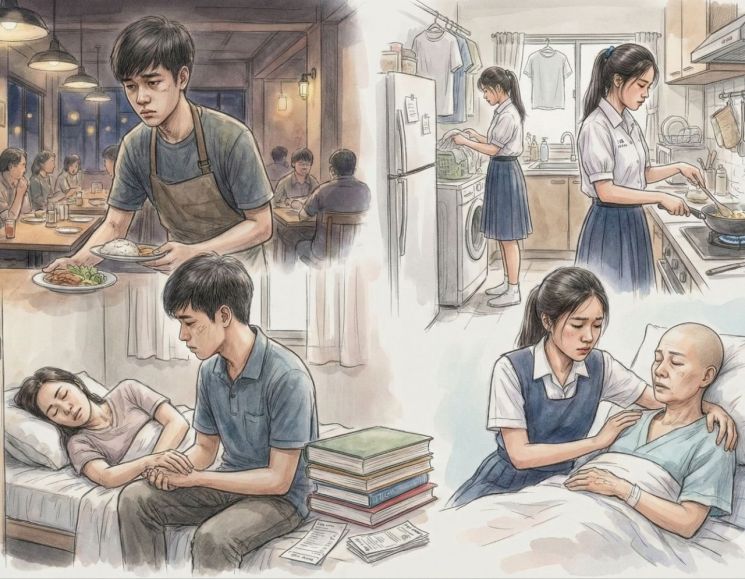
Miss Cho (19), who lives with her mother and younger sibling, became a caregiver when she was in the second year of middle school after her mother was diagnosed with cancer. All the household chores and nursing care, such as cleaning, laundry, and preparing meals, became the sole responsibility of this "young caregiver." After finishing school and returning home, it was common for her to finish her accumulated tasks well past 10 p.m. Cho shared, "Although I was doing it for my family, I often felt psychologically withdrawn and isolated whenever I couldn't join my friends when they invited me out."
Young people and adolescents who care for their families due to illness, disability, or mental health issues-known as "young family caregivers"-are experiencing psychological burnout. Since the exact number of these young people is unknown, there are calls for proactive government measures to identify and support those at risk.
According to a study released in May last year by the Korea Institute for Health and Social Affairs titled "A Study on the Status of Young Family Caregivers and Their Unmet Medical Needs," the burnout rate among young family caregivers was 46.3%. This is about 14 percentage points higher than the 32.4% rate among young people who do not provide family care. The burden of caregiving is even depriving them of opportunities to prepare for their futures. The proportion of young family caregivers whose highest educational attainment is high school graduation or less was 30.5%, more than twice that of non-family caregivers (13.8%).
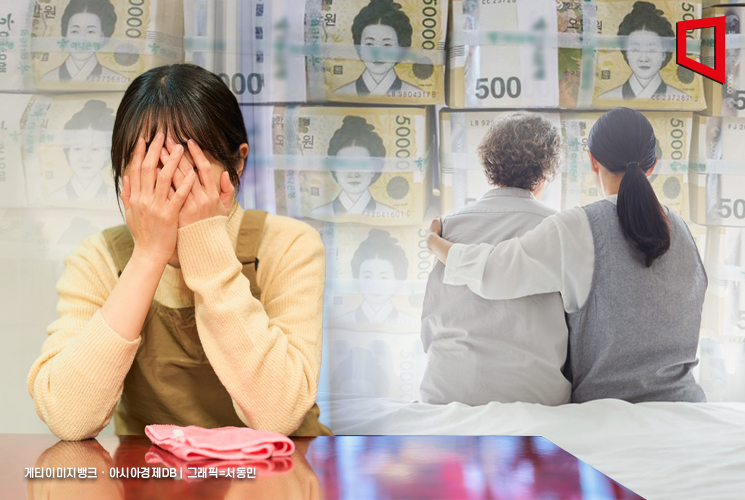
The most urgent issue is that the exact number of these young caregivers remains unknown. A 2022 survey by the Ministry of Health and Welfare estimated the number of young carers at around 100,000, but the actual figure is believed to be much higher. This is because the definition of young carers is inconsistent, and many are "hidden caregivers" who are socially isolated and thus not captured in statistics. An official from the Seoul Welfare Foundation commented, "From the perspective of local governments, it is difficult to identify these young people not only because their reported income is often too high for support, but also because the criteria for how much care they provide vary, making it hard to find them."
Ki-Hyun Cho, head of the care community "Ninbun," said, "Rather than relying on strict income or caregiving hour standards, we should eliminate blind spots through direct visits, as demonstrated by the proactive case in Seo-gu, Gwangju, where 6,000 people were surveyed to identify young family caregivers." He added, "It is necessary to relax the criteria for care services focused on severe illnesses and to provide practical support, such as assistance for self-help groups."
© The Asia Business Daily(www.asiae.co.kr). All rights reserved.


















