Rural Development Administration's Climate Change Research Building
Research on Extreme Rainfall Response and Crop Adaptation to Future Climate
"The Climate Change Research Building is a facility that utilizes artificial intelligence (AI) technology to predict weather and climate, and to recreate future climate scenarios for research on climate change in the agricultural sector. By precisely controlling weather conditions such as future temperature, humidity, and carbon dioxide concentration, we aim to predict the actual impact of climate change on agriculture and develop adaptation technologies," said Hong Seonggil, a researcher at the Rural Development Administration's Climate Change Research Building.
On the afternoon of the 22nd, we visited the Climate Change Research Building of the Rural Development Administration located in Jeonju. This facility was opened in November last year to proactively respond to climate change and develop sustainable agricultural technologies, and full-scale research is scheduled to begin this year. The research building covers a total area of 2,830 square meters and is equipped with an Eco Dome, Future Rainfall Building, artificial and natural light climate control rooms, and a weather and climate AI convergence lab.
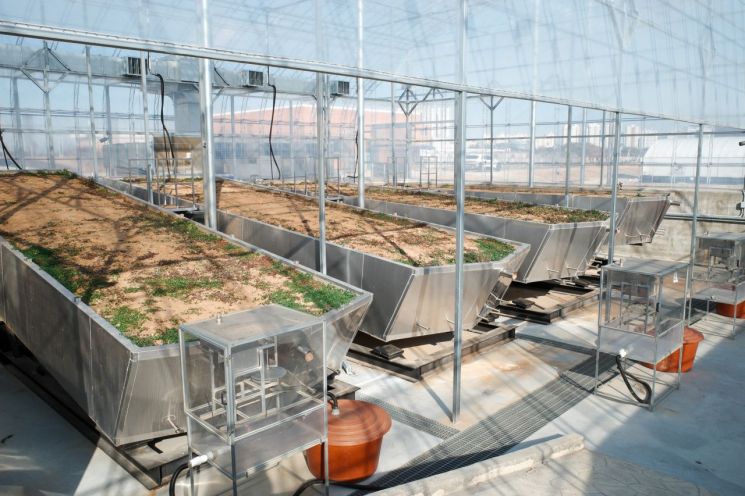 On the afternoon of the 22nd, the Future Rainfall Building of the Rural Development Administration Climate Change Research Center located in Jeonju. Using four chambers, soil slope and rainfall can be controlled. Photo by Joint Press Corps
Upon entering the Future Rainfall Building, which studies the effects of future extreme rainfall on soil erosion and nutrient runoff in farmland, four 'artificial rainfall chambers' measuring 2 meters wide and 10 meters long immediately caught the eye. These chambers can create slopes of 0 to 15 percent and are designed to analyze the degree of soil erosion under artificial rainfall of up to 50 millimeters per hour. The Rural Development Administration plans to upgrade the facility to allow for artificial rainfall of 150 to 200 millimeters per hour in the future.
Hong Seonggil, a researcher at the Rural Development Administration's Climate Change Research Building, explained, "We can analyze the vulnerability of farmland to climate impacts by examining soil runoff and the resulting nutrient losses according to rainfall, slope, and crop growth. By analyzing soil erosion after heavy rainfall, we can determine how much nutrient is lost and, based on this, develop technologies to supplement nutrients and reduce soil loss." The Rural Development Administration plans to plant soybeans and corn in the chambers in the first half of this year, and radishes in the second half, to analyze the degree of soil erosion under extreme rainfall and varying slopes.
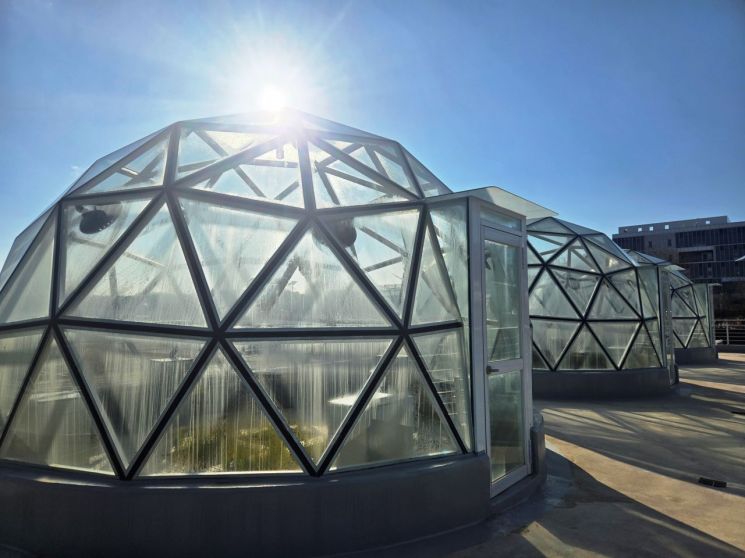 On the 22nd, the "Eco Dome" at the Climate Change Research Building of the Rural Development Administration was visited. Four domes simulate current and future extreme environments to observe changes in crop growth. Photo by Joint Press Corps
While the Future Rainfall Building is dedicated to research on responses to extreme rainfall, the Eco Dome and climate control rooms are designed for adaptation research in the agricultural sector under future climate conditions. Inside the Eco Dome, made of reinforced glass, there are facilities to control temperature and humidity, supplemental lighting devices to adjust light intensity, and cameras to observe crop growth. Each of the four domes can independently control current and future temperature, humidity, and carbon dioxide levels, enabling predictions of the actual impact of climate change on agriculture and the development of adaptation technologies. Researcher Hong stated, "Through the Eco Dome, we will predict the impact on the soil-water-atmosphere ecosystem by building future climate environment control facilities and develop adaptation technologies. In the climate control rooms, we will precisely control temperature and carbon dioxide, which affect crop growth, and propose carbon reduction measures for the agricultural sector."
The Rural Development Administration is also promoting the 'Agricultural Science and Technology AI Convergence Strategy' to transform agriculture from a traditional experience-based industry into an intelligent, data- and AI-driven industry. The goal is to dramatically increase productivity through AI by 2030, raising farm income by 20 percent and reducing agricultural work risks by 20 percent. To achieve this, the agency will provide 'AI Isaki,' a customized solution tailored to the needs of farmers and stakeholders, and will enhance the AI-based pest and disease diagnosis solution using smartphones to enable rapid diagnosis of 82 crops and 744 types of pests and diseases by 2029, as well as predict pest migration routes to support timely pest control. In addition, the agency plans to strengthen safety disaster prediction and response systems using AI, integrate and analyze agricultural safety data to classify risk groups, and develop and distribute smart convenience and safety technologies such as wearable power-assist suits.
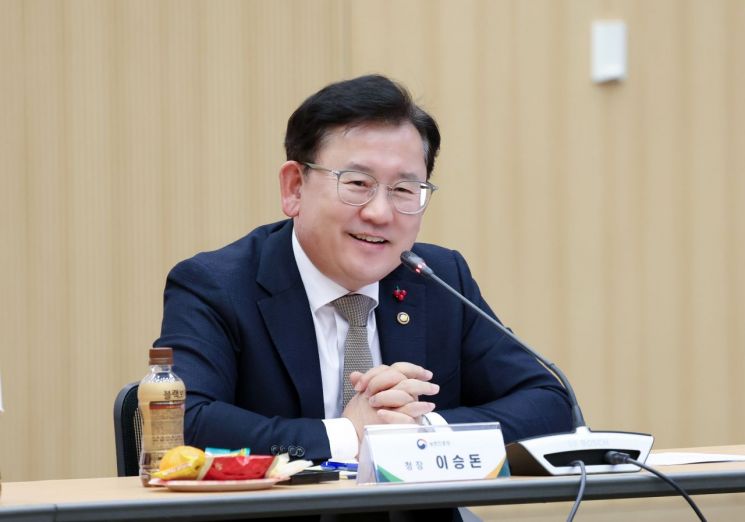 On the 22nd, Seungdon Lee, Administrator of the Rural Development Administration, is answering reporters' questions. Photo by Joint Press Corps
Seungdon Lee, Administrator of the Rural Development Administration, said, "At the Climate Change Research Building, we can create extreme conditions to measure crop growth, soil erosion, and abnormal weather. Based on this, we aim to prepare crop cultivation manuals and preemptive response systems for extreme environments. Furthermore, the development of agricultural science and technology using AI is not only for productivity, but also to make rural communities happier. Therefore, we will actively promote AI innovation, mechanization of field farming, pest and disease response, agricultural safety, and innovation in rural management."
© The Asia Business Daily(www.asiae.co.kr). All rights reserved.
![Clutching a Stolen Dior Bag, Saying "I Hate Being Poor but Real"... The Grotesque Con of a "Human Knockoff" [Slate]](https://cwcontent.asiae.co.kr/asiaresize/183/2026021902243444107_1771435474.jpg)













