Hanwha Proposes Comprehensive Industrial Cooperation
Across Shipbuilding, Steel, and Space Ahead of Submarine Bid
KPMG: "Employment Effect of 15,000 Jobs Annually"
As Hanwha prepares to bid for the 'Canadian Patrol Submarine Project (CPSP),' the company is pursuing industrial cooperation initiatives in Canada across various sectors, including shipbuilding, steel, artificial intelligence (AI), and space. Global management consulting firm KPMG has projected that Hanwha's collaboration will generate cumulative employment of over 200,000 job-years between 2026 and 2040.
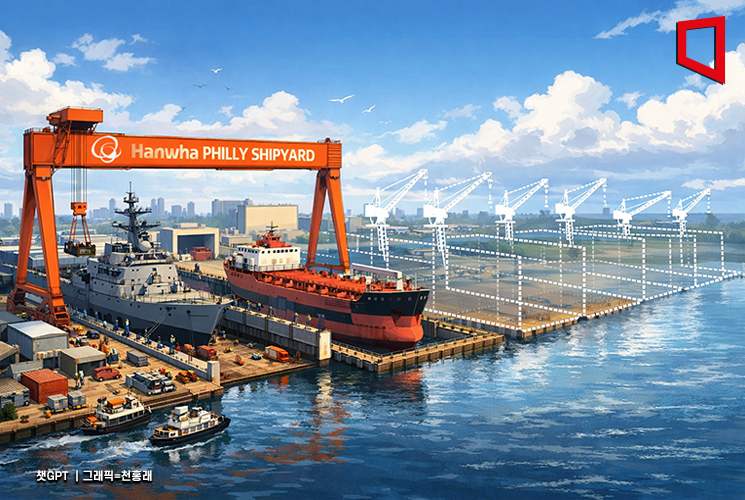
On January 22 (local time), Canadian media outlets, citing KPMG's analysis, reported that "Hanwha's proposed industrial cooperation is expected to create employment equivalent to more than 200,000 job-years by 2040." KPMG analyzed that Hanwha's proposals would drive investments and job creation across Canada's key industries-such as shipbuilding, steel, AI, and satellite communications-as well as throughout the country, including Ontario, Quebec, British Columbia, Nova Scotia, and Alberta.
The employment effect presented this time is an interim evaluation result based on the analysis period from 2026 to 2040. Considering that the submarine project is a long-term initiative extending over several decades-including maintenance, servicing, and performance upgrades throughout the lifecycle even after construction-the employment effect is likely to be sustained or even expanded beyond 2040. Furthermore, if concrete investment plans for renewable energy businesses such as wind power are added, the employment impact is expected to grow even further. In addition, if industrial cooperation proposals from other domestic companies in sectors like automotive and aerospace are implemented, local job creation could be further expanded.
KPMG explained that the employment generated from Hanwha's proposed industrial cooperation is primarily centered on long-term operational functions such as manufacturing, maintenance and repair, system integration, and lifecycle services. As a result, it is expected that this will strengthen supply chain continuity and the skilled workforce base through a stable employment structure, rather than being subject to short-term economic fluctuations.
Recently, Hanwha has accelerated its investments in Canada as part of efforts to support its bid for the submarine project. Q Energy, Hanwha Group's European energy subsidiary, announced its participation in an offshore wind power project promoted by the province of Nova Scotia in eastern Canada. In addition, Hanwha Ocean signed a memorandum of understanding (MOU) with Fermeuse Energy to jointly pursue a liquefied natural gas (LNG) project in Newfoundland and Labrador.
Meanwhile, in the evaluation criteria for the Canadian submarine project, economic benefits such as Industrial and Technological Benefits (ITB), job creation, and integration into the Canadian defense supply chain account for 15% of the bid score. It is crucial for Hanwha to demonstrate a comparative advantage over Germany, its competitor for the Canadian submarine project, through differentiated proposals.
Choi Yongseon, Senior Expert at Yulchon LLC (former Director of Defense Industry at the National Security Office), emphasized, "It is necessary to present a structure that aligns with the Canadian government's 'Buy Canadian' policy and its industrial, economic, and resource security priorities through a government-to-government (G2G) cooperation model that links critical minerals and advanced manufacturing capabilities."
© The Asia Business Daily(www.asiae.co.kr). All rights reserved.
![User Who Sold Erroneously Deposited Bitcoins to Repay Debt and Fund Entertainment... What Did the Supreme Court Decide in 2021? [Legal Issue Check]](https://cwcontent.asiae.co.kr/asiaresize/183/2026020910431234020_1770601391.png)















