"Obsessed with Results, Caused Harm to Colleagues"
"Fiscal Productivity and Sustainability Are Crucial"
Lee Hyehoon, nominee for Minister of Planning and Budget, apologized for her past words and actions and outlined her philosophy for achieving growth and welfare through fiscal policy at the National Assembly’s Finance and Economy Planning Committee confirmation hearing on January 23, 2026.
In her opening statement at the hearing, Lee said, “Since being nominated as Minister, there have been numerous criticisms of my shortcomings,” and bowed her head, adding, “I sincerely apologize to everyone who was hurt by my immature words and actions.”
She continued, “I failed to recognize the harm I caused my colleagues by becoming too focused on outcomes and proving myself only through results, neglecting the importance of our shared efforts. I once again apologize for having stood in a position where I made a wrong judgment that is difficult to defend against accusations of supporting insurrection. I will offer no excuses.”
Lee acknowledged, “I admit that my failure to immediately admit my mistakes, and the year I spent in silence, as well as this belated apology, are themselves further mistakes. If I am given even a single opportunity to contribute to the success of a government founded on the sovereignty of the people, with the experience and expertise in fiscal policy I have built up over my lifetime, I will regard it as a mandate from the people to atone for my faults through the weight of public service, and I will dedicate myself fully.”
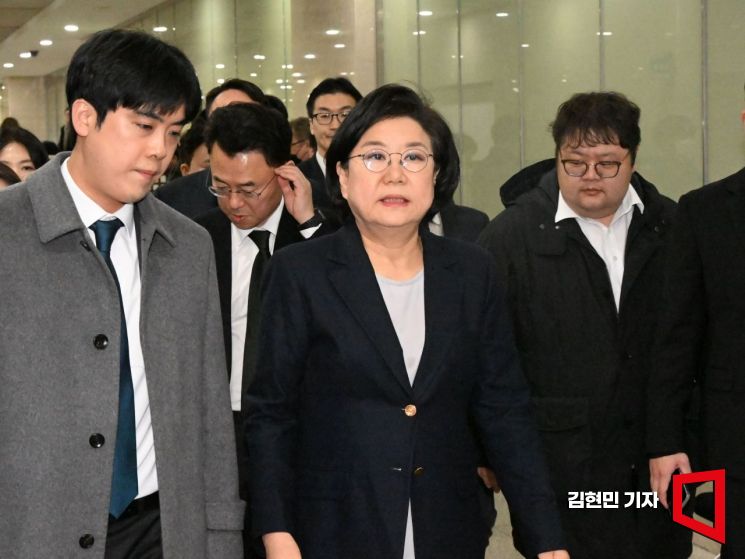 Lee Hyehun, the nominee for Minister of Planning and Budget, is moving while receiving questions from reporters at the National Assembly in Yeouido, Seoul on the 19th. The plenary meeting of the Finance and Economy Planning Committee held that day was adjourned after a dispute between the ruling and opposition parties over whether to hold a hearing for Minister Lee. January 19, 2026 Photo by Kim Hyunmin
Regarding her acceptance of the ministerial post, she said, “The need for integration and cooperation has always been raised, but there have been no tangible results. Now, as the ruling party holds a large majority and has no need to consolidate its power, the move toward integration is seen as a genuine step toward institutionalizing cooperation.” She added, “I have taken this position with the resolve to open a new path for Korea, even if it means facing criticism, as the country has been unable to move forward due to partisan politics.”
Addressing controversy over her changing political stance, Lee explained, “Even when I was part of the conservative bloc, I consistently advocated for economic democratization. I was attacked for sponsoring bills such as the Minimum Wage Act, the Interest Rate Limitation Act, and the Wheelchair Ban Act, but I have always chosen pragmatism for the sake of the national interest and the people.”
On fiscal management, Lee stated, “After four consecutive quarters of growth in the 0% range, the economy is now at a crossroads for recovery. To boost the potential growth rate and ease polarization, an active fiscal role is needed. Attention to the productivity and sustainability of public finances is more important than ever.” She added, “I have consistently advocated for eliminating duplication and preventing waste to improve spending efficiency. I will pursue ‘smart fiscal management’ that maximizes budget efficiency through data-driven and performance-based fiscal operations.”
She also highlighted five major crises-high exchange rates, high perceived inflation, demographic crisis, climate crisis, rapid transformation in AI industrial technology, polarization, and regional extinction-stressing, “The reason for establishing the Ministry of Planning and Budget is to transform the budget into a means for realizing the national vision.” To this end, Lee presented four key tasks: ▲ establishing a mid- to long-term national development strategy ▲ achieving growth and welfare simultaneously ▲ building a virtuous cycle to ensure fiscal sustainability ▲ realizing open fiscal management with enhanced public participation and transparency.
Lee concluded, “I will undergo rigorous scrutiny from the public’s perspective. While I will humbly accept criticism, if I am given this final opportunity to serve the country, I will turn that criticism into tangible results that the people can experience.”
© The Asia Business Daily(www.asiae.co.kr). All rights reserved.

















