Seoul Metropolitan Council-Commissioned Study Finds
"Restructuring Around User Experience Needed
Beyond Simply Expanding Facilities Like Elevators"
It has been suggested that accessibility to public transportation in Seoul for people with visual and hearing impairments is low and needs improvement. The recommendation is to restructure existing approaches-such as expanding the installation of elevators and low-floor buses-by focusing on user experience.
According to a research report commissioned by the Seoul Metropolitan Council titled "Measures to Improve Public Transportation Use for People with Disabilities in Seoul," the current state of mobility rights for people with disabilities in the city is analyzed as "mobility is possible, but independent and safe movement remains in a poor state."
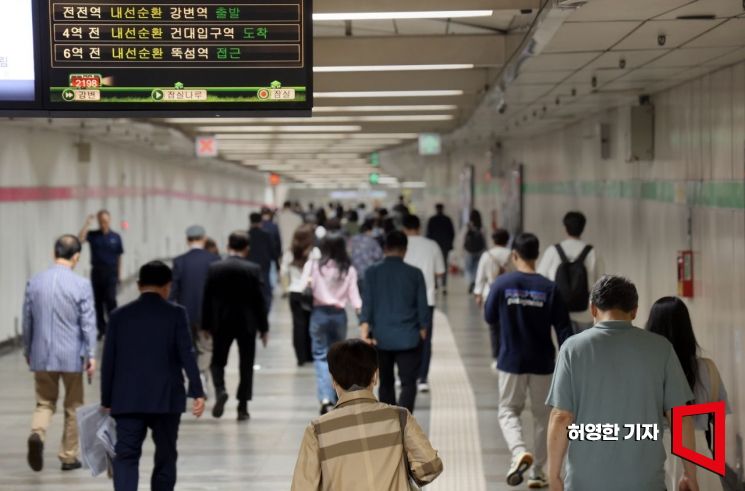 Passengers are passing through the transfer passage to Line 8 at Jamsil Station of Seoul Subway. 2024.05.23 Photo by Heo Younghan
Based on data provided by the Seoul Transport Operation & Information Service (TOPIS), a survey of public transportation patterns among people with disabilities in Seoul revealed that, as of 2024, 91.9% of people with disabilities travel alone without assistance from others. The research team explained, "This figure only indicates the possibility of traveling alone; it does not mean that issues such as safety and information awareness during the journey have been resolved." They added, "In fact, the risks and anxiety factors associated with traveling alone need to be considered even more seriously."
Regarding facility accessibility by mode of transportation, although the installation rate of elevators at Seoul subway stations has increased, the connection between routes within stations is often not seamless, and there is a lack of guidance signage. As a result, people with visual and hearing impairments do not feel that accessibility is adequate. One visually impaired person said, "It is difficult to find the location of elevators within stations or bus terminals, and guidance signs and maps are mainly provided in visual formats, so there is a lack of audio or tactile guidance." For people with hearing impairments, information about train delays or emergency situations on platforms is not provided visually, leading to confusion and increased exposure to danger.
The report emphasized, "The mobility rights of people with disabilities can no longer be addressed solely by expanding facilities," and stressed the need to reorganize the transportation system based on individuals' mobility experiences. While existing policies have focused on increasing facility installation rates and expanding transportation options-a supply-centered approach-future policies should be restructured based on the actual travel routes of people with disabilities and the differences in information needs according to disability type.
Specifically, to enhance public transportation accessibility for people with visual and hearing impairments, the report proposed the following: establishing artificial intelligence (AI)-based personalized transportation information services; creating a decision-making system based on mobility data for people with disabilities; and regularizing accessibility satisfaction evaluations.
© The Asia Business Daily(www.asiae.co.kr). All rights reserved.
![Clutching a Stolen Dior Bag, Saying "I Hate Being Poor but Real"... The Grotesque Con of a "Human Knockoff" [Slate]](https://cwcontent.asiae.co.kr/asiaresize/183/2026021902243444107_1771435474.jpg)
















