Trump Establishes Framework for Future Agreement with NATO and on Greenland
Greenland Tariffs Withdrawn, Military Options Ruled Out
Q3 GDP and November Consumption Data Remain Strong; Labor Market Stays Resilient
JP Morgan Rises Slightly De
All three major U.S. stock indexes rose on January 22 (local time). This upward trend followed the previous day's easing of geopolitical tensions, which resulted from the U.S. withdrawing tariffs on Greenland-bound European goods and ruling out military options for the annexation of Greenland. Additionally, the release of solid economic indicators on this day further supported investor sentiment.
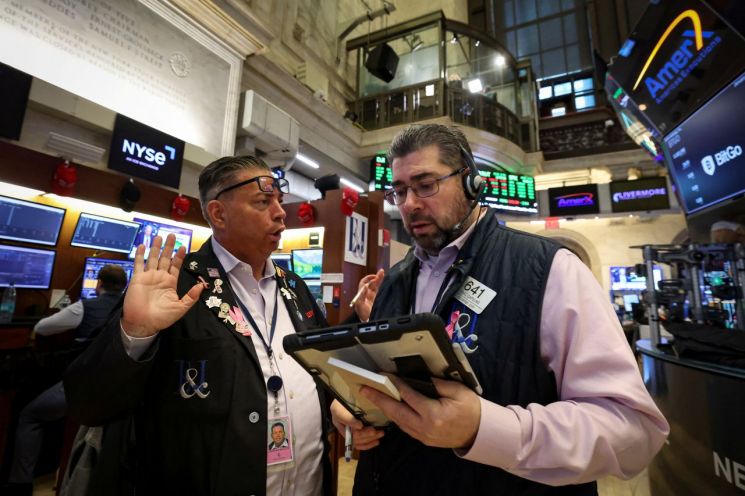 A trader is working on the floor of the New York Stock Exchange (NYSE) in the United States. Photo by Reuters Yonhap News Agency
As of 2:20 p.m. on the New York Stock Exchange, the blue-chip Dow Jones Industrial Average was up 456.03 points (0.92%) at 49,533.26 compared to the previous trading day. The large-cap S&P 500 Index rose 54.27 points (0.79%) to 6,929.89, while the tech-heavy Nasdaq Index jumped 260.432 points (1.12%) to 23,485.256.
By sector, major technology stocks were all strong. Nvidia was up 0.68%. Microsoft and Meta, Facebook's parent company, rose 1.74% and 5.57%, respectively. JP Morgan was also up 0.84%, despite news that President Donald Trump had filed a lawsuit against the company and its Chairman and CEO Jamie Dimon. The Trump administration stated that the lawsuit was filed because JP Morgan had closed his account for political reasons.
The previous day, stocks surged as President Trump established a framework for an agreement regarding NATO and the Greenland issue. He withdrew the plan to impose tariffs on eight European countries, including Denmark, starting February 1, and ruled out the use of force regarding Greenland. As a result, the so-called "Sell America" trend, which involved simultaneous selling of U.S. stocks, bonds, and the dollar, also appeared to subside.
However, some risks remain. Danish Prime Minister Mette Frederiksen stated, "We can negotiate everything-security, investment, and the economy-politically, but our sovereignty is non-negotiable," drawing a red line on territorial sovereignty.
Positive economic indicators are also supporting investor sentiment. On this day, the U.S. Bureau of Economic Analysis (BEA) under the Department of Commerce announced that the U.S. real gross domestic product (GDP) for the third quarter grew at an annualized rate of 4.4% compared to the previous quarter, according to preliminary figures. This is 0.1 percentage point higher than the earlier advance estimate of 4.3%, with strong exports and a decrease in corporate inventories contributing to the growth rate.
In addition, real personal consumption, adjusted for inflation, increased by 0.3% from the previous month, widening from the 0.1% increase in October. Despite concerns over a slowing labor market and high inflation, consumption has remained relatively robust, supporting the U.S. economy. In November of last year, the Personal Consumption Expenditures (PCE) price index rose 2.8% year-on-year, up 0.1 percentage point from October's 2.7%, in line with market expectations. The number of new jobless claims for the week of January 11-17 was 200,000, falling short of market expectations.
Thus, even amid concerns that the labor market may be slowing, there are continued signs that growth driven by consumption is being maintained. As a result, there is growing expectation that the Federal Reserve will keep its benchmark interest rate unchanged at next week's meeting.
Lale Akoner, economist at eToro, said, "U.S. consumers continue to support the economy," adding, "Resilient consumption reduces the risk of a short-term recession and supports corporate sales, especially in consumer goods-related sectors." She went on to say, "However, steady demand means that interest rates are likely to remain high for an extended period."
U.S. Treasury yields were steady. The yield on the 10-year Treasury, the global bond benchmark, was unchanged from the previous session at 4.25%, while the yield on the two-year Treasury, which is sensitive to monetary policy, rose 1 basis point (1bp = 0.01 percentage point) to 3.61%.
© The Asia Business Daily(www.asiae.co.kr). All rights reserved.

















