'World Leprosy Day' on January 25...
Average Age of Hansen's Disease Survivors in Korea is 80.9 Years
Fewer Than 10 New Cases Annually, Indicating Stable Management
In order to detect and treat foreign Hansen's disease (leprosy) patients residing in Korea at an early stage, the health authorities will increase the number of free screenings. For elderly Hansen's disease survivors who have been cured but still require rehabilitation and care, support for improving living conditions and living expenses will continue.
The Korea Disease Control and Prevention Agency (KDCA) announced on January 23 that, in commemoration of 'World Leprosy Day' on January 25, it is sharing the current status of leprosy cases both domestically and internationally, and presenting prevention policies and patient management achievements to maintain the level of leprosy elimination.
Leprosy is an infectious disease caused by Mycobacterium leprae. In the past, it was considered incurable, but now, just a single dose of rifampicin eliminates 99.9% of its infectivity, making it a disease with no risk of transmission. Complete recovery is possible with multidrug therapy including dapsone, rifampicin, and clofazimine.
The World Health Organization (WHO) has designated the last Sunday of January each year as World Leprosy Day to eliminate social stigma and discrimination against leprosy, and to raise awareness of the importance of prevention and cure. This year's World Leprosy Day slogan is, "Leprosy is curable, but the real challenge is stigma."
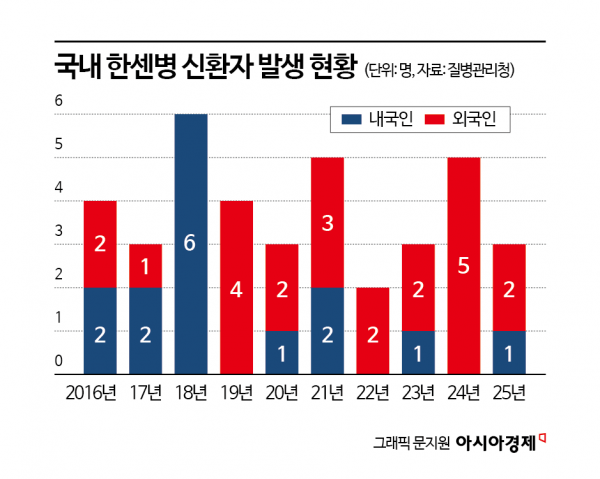
According to the KDCA, last year there were only three new leprosy patients in Korea: one Korean national and two foreign nationals. This is a decrease from the five new cases in 2024, and the number of patients has remained below 10 per year over the past decade, indicating stable management.
However, globally, there were 172,717 new cases as of 2024, with 72% concentrated in Southeast Asia, including India and Indonesia. The one new Korean patient last year was also confirmed to be a long-term resident of the South Pacific region, indicating that cases continue to be brought in from overseas.
To address this, the KDCA will expand the number of free leprosy screenings for foreigners from 15 to 17 sessions per year and will enhance accessibility by implementing "weekend mobile screenings." The agency will also strengthen leprosy screening programs for foreigners. In addition, a cooperative network among medical institutions, such as dermatology and infectious disease departments, will be established to strengthen medical staff's diagnostic and treatment capabilities.
Support will also be provided for elderly Hansen's disease survivors who have been cured but still have disabilities. Currently, the average age of Hansen's disease survivors in Korea is 80.9 years, and many live in outdated environments. The government provides support including: ▲ assistance for rehabilitation surgery and production of assistive devices ▲ operation of protective facilities for patients without family or support ▲ meal and heating cost support for residents of temporary senior housing in settlement villages ▲ and living expense support for low-income, home-based Hansen's disease survivors.
Im Seungkwan, Commissioner of the KDCA, stated, "Leprosy management in Korea remains at an advanced level, but the disease has not yet been eradicated," and urged, "As cases continue to be brought in from overseas, I ask medical professionals to pay close attention and actively conduct screenings to ensure early detection and treatment of leprosy."
© The Asia Business Daily(www.asiae.co.kr). All rights reserved.
![Clutching a Stolen Dior Bag, Saying "I Hate Being Poor but Real"... The Grotesque Con of a "Human Knockoff" [Slate]](https://cwcontent.asiae.co.kr/asiaresize/183/2026021902243444107_1771435474.jpg)
















